Managing the Perfectionist Nurse
2026-05-28 01:00:15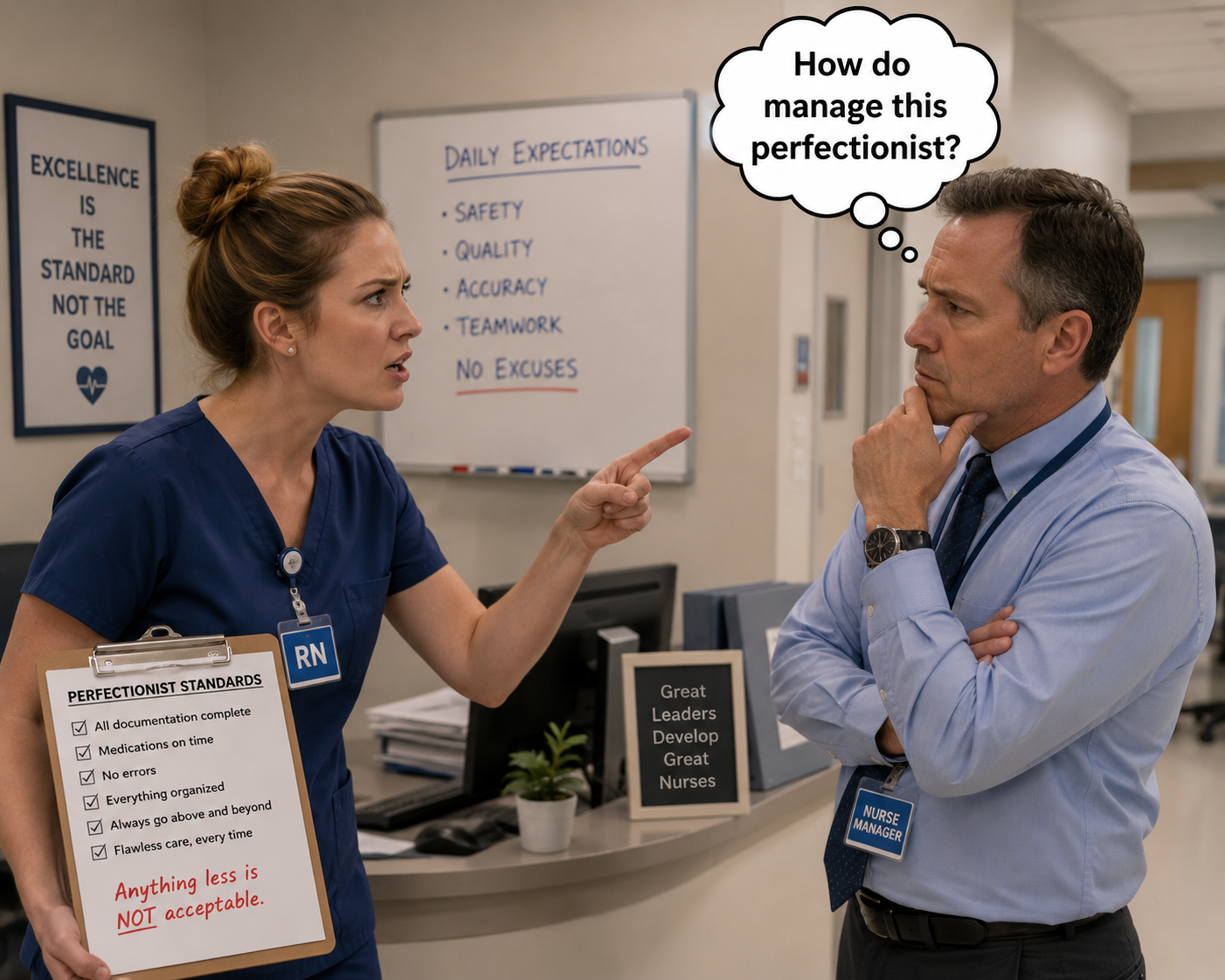
Managing perfectionist nurses is a big challenge for nurse managers. On one hand, you love their attention to detail and clinical accuracy. On the other hand, perfectionism in nursing is a fast track to severe burnout, delayed charting, anxiety, and sometimes friction with you, their leader, when you try to give them performance feedback. Consider the story a manager recently told during a session:
It is hard to get into nursing school today. So many new graduates proudly tell me that they have a 4.0 GPA and strive for perfection in all they do. Social media actually encourages this way of thinking. Yet I know that healthcare is messy, and I have seen nurses like this quit too soon because they lack a growth mindset. I encourage my staff to be excellent but remind them that they are also human. Perfectionism is fragile and fear-based – they are always worried about making a mistake. When you try to give a perfectionist nurse feedback, often they don’t take it well. They believe they are either excelling or failing – there seems to be no gray zone with these staff.
This leader makes a great point. After all, what could be wrong with a nurse who double-checks every medication, cross-references every lab value, and keeps a meticulously organized patient room? But look closer. The perfectionist nurse is often the one still finishing their charting two hours after their shift ended. They are the one agonizing over a minor, non-clinical critique from a patient, or burning out at twice the rate of their peers because they cannot let anything go. In a high-stakes healthcare environment, perfectionism isn’t a superpower—it’s a vulnerability. As leaders, our job isn’t to dim their high standards, but to help them channel those standards into sustainable excellence rather than exhausting perfection.
Here is how you can help your perfectionist nurses thrive without burning out.
- Distinguish for them the difference between a mindset of excellence and a mindset of perfectionism.
-
Perfectionism is driven by fear: “If I make a single mistake, I am a failure.” It focuses on avoiding blame and maintaining a flawless facade.
-
Excellence is driven by growth: “How can I provide the highest quality care while working within reality?” Excellence allows for human error, prioritizes learning, and recognizes that time is a finite resource.
When coaching a perfectionist, praise their commitment to excellence while gently challenging perfectionist behaviors. For example, if they are spending excessive time making a patient’s room perfectly symmetrical, acknowledge the care they put into the environment, but redirect them to the bigger picture of energy management.
2. Define what good enough looks like in charting and documentation.
Over-documentation is a classic hallmark of the perfectionist nurse. They write novels in the narrative notes out of fear that they will leave out a detail that could later be questioned. This leads to massive time-management struggles and late shifts.
When coaching a perfectionist, talk about “focused efficiency.” Sit down with them and review a few charts. Point out where standard flowsheets already capture the data and where narrative notes can be streamlined. Give them permission to be concise. Remind them that a clear, concise chart is often safer and more useful to the next nurse than a wall of text.
3. Normalize good mistakes, near misses, and psychological safety.
Perfectionists are terrified of failure, which can lead them to hide small mistakes or become incredibly defensive when corrected. To break this cycle, leaders must cultivate a culture of psychological safety.
When coaching a perfectionist about errors that occur—as they inevitably do—frame them as system lessons rather than personal failures. Share your own early career missteps. When a perfectionist nurse sees that a mistake doesn’t result in exile or shame, their anxiety drops, and their cognitive bandwidth increases.
4. Channel their critiques of others into coaching.
A perfectionist nurse who is hyper-critical of others can quickly create a toxic environment, especially for newer nurses or those still building confidence. They don’t mean to bully; in their minds, they are just “holding people to the standard.” But to the rest of the staff, it feels like nothing they do is ever good enough. When a nurse demands perfection from themselves, they naturally expect it from everyone else. This can manifest as eye-rolling at the nurses’ station, correcting peers in front of patients, or giving hyper-critical handoffs that leave the incoming shift feeling defeated.
When coaching a perfectionist who is overly critical of others, acknowledge their high standards, but redefine what “psychological safety” on the floor looks like. Tell them: “Your clinical eye is incredibly sharp. But a great nurse doesn’t just catch errors; they build up the team’s capability to prevent them.” Shift them from the role of enforcer to educator.
We don’t want our nurses to care less; we want them to care sustainably. When we coach our perfectionist nurses to trade the heavy armor of perfection for the flexible mindset of excellence, we aren’t just saving their charts—we might just be saving their careers.
To effectively lead through these challenges and others, nurse leaders need new tools and strategies. Let me help you as I have helped hundreds of organizations over the past five years. Please contact me at roseosherman@outlook.com to book a workshop or keynote for your team. Not seeing what you want on this list? Feel free to reach out, and I am happy to design a custom program to meet your needs.
Brand New For 2026 and Already Receiving Rave Reviews – Staying Power Building a Culture of Retention in the New World of Work Brand New for 2026 and Already Popular – The Inverted Pyramid: Leading Teams of Novice Nurses The Inverted Pyramid WS Information Sheet Our Most Popular Right Now –The New World of Work Workshop A Leader Favorite – Building Bridges Not Walls: Leading Multigenerational Work Teams – Click Here for More Information Building Bridges Not Walls A Must-Read Book in 2026 – Click Here to Buy
Inverted Pyramid Workshop - Open to All Leaders - June 17 2026
2026-05-22 01:00:38Just a few slots left.
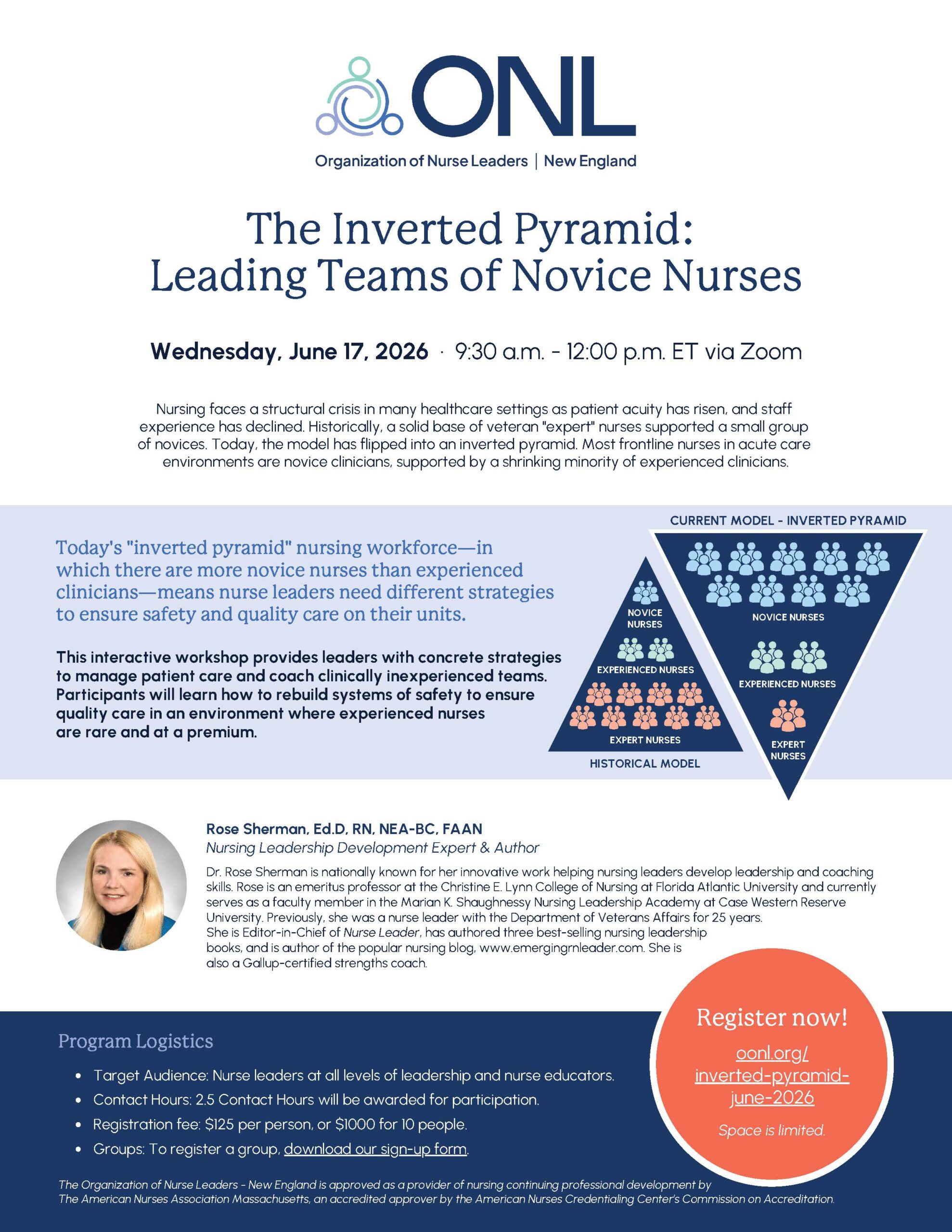
I am pleased to partner with the New England ONL on the workshop that’s generating a lot of discussion, as leaders now see that the nursing workforce has undergone a structural change in acute care. The traditional staffing pyramid — anchored by a deep layer of expert clinicians — has inverted. Today’s acute care units often rely on novice-dense teams supported by a limited experienced core. The leadership approaches that worked in the past assumed informal mentorship, accessible intuition, and layered experiential judgment. Those assumptions no longer consistently hold. The Inverted Pyramid™ framework helps leaders respond strategically to this shift in the workforce. Participants will learn how to reduce cognitive load, engineer safety supports, protect experienced staff from burnout, and rebuild sustainable pathways for clinical growth. This program moves the conversation from “How do we fix novice nurses?” to “How do we redesign systems to match today’s workforce reality? Register your team today using this LINK
Losing Ground: Why the Sudden Drop in Male Nurses Matters
2026-05-21 01:00:02By Rose O. Sherman, EdD, RN, NEA-BC, FAAN
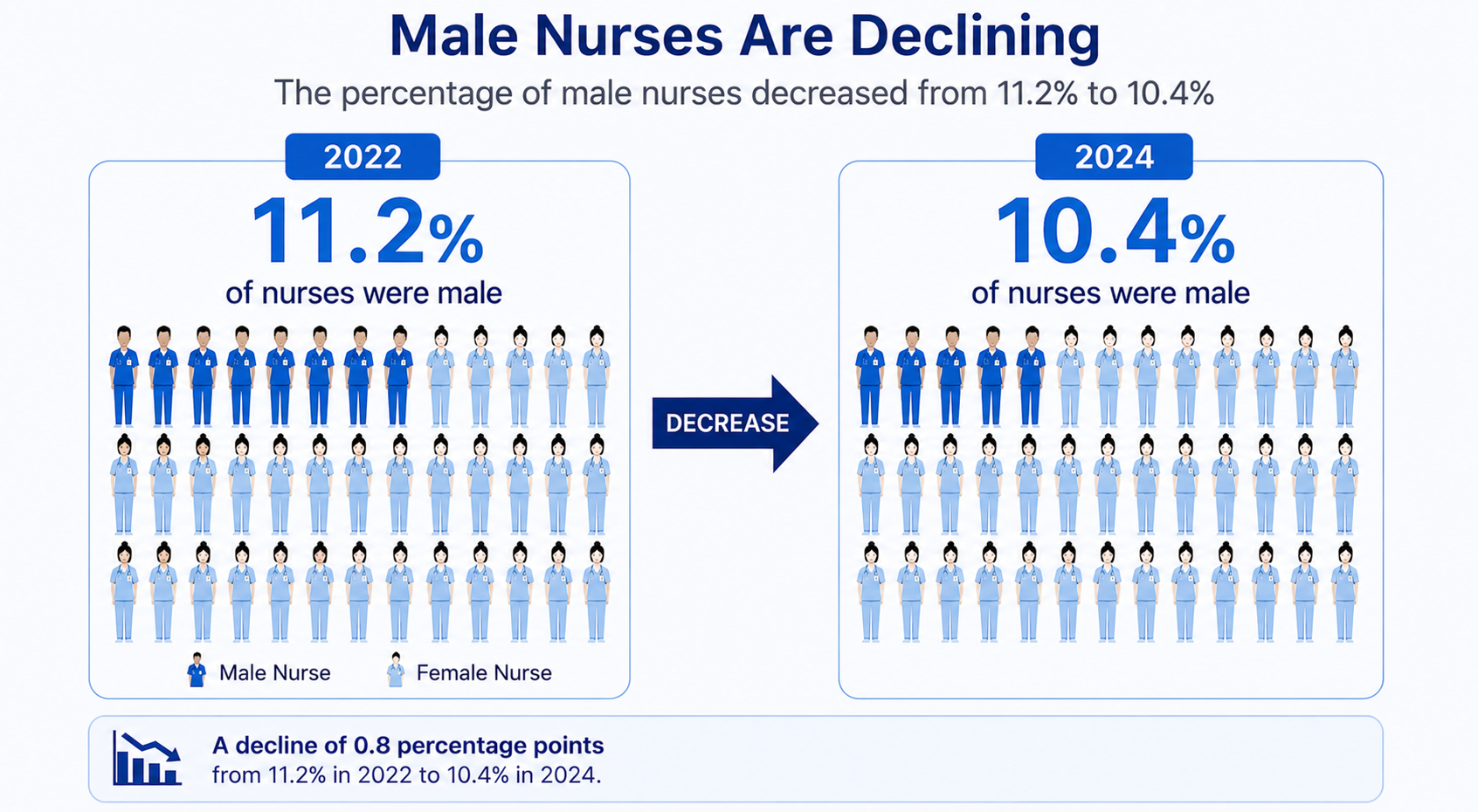
Becker’s Hospital Review recently reported on a stunning reversal. After almost a decade of improvement, the number of men in nursing is now declining. Men represented 10.4% of registered nurses in 2024, down from 11.2% in 2022, according to data from the National Council of State Boards of Nursing’s 2024 National Nursing Workforce Survey. RegisteredNurse.jobs, a nursing job platform that reportedly lists about 70,000 active nursing openings nationwide, told Becker’s that fewer than 5% of RN candidate profiles created on the platform to date are men.
For nearly a decade, the narrative was clear: more men were entering nursing. It was a win for diversity and workforce volume. While the drop seems small on paper, it represents the first major decline after years of steady growth (up from 8% in 2015). The reasons why need to be studied. A relevant context is the timing of the data collection (March to December 2024). The years leading up to 2022 saw severe pandemic-era disruptions, an explosion of high-paying travel nursing contracts, and acute staffing crises. As the market stabilized through 2024, many nurses shifted roles or left bedside care entirely. Because male nurses have historically been more highly represented in acute, high-stress specialties such as emergency medicine, critical care, and travel nursing, they may have been disproportionately involved in this post-pandemic career migration. Their loss in these areas could not come at a worse time, as turnover is now up in acute care areas for 2026.
Data from the American Association of Colleges of Nursing (AACN) shows that male enrollment in undergraduate nursing programs is currently hovering around 11.9%. While this is a slight, fractional tick down from its peak, the broader story in academia isn’t that men are suddenly fleeing nursing schools. Right now, men make up roughly 11.9% of nursing students, but only 10.4% of the active RN workforce. This gap suggests the problem might not be a lack of interest among men entering the profession, but rather a retention issue after they graduate. Whether due to culture shock during clinicals, a lack of male mentorship, or rapid burnout in their first 24 months at the bedside, we are losing men somewhere between the classroom and the long-term career. While undergraduate male enrollment is stagnant, men are disproportionately pursuing advanced degrees once they do stay in the field. Men slightly outpace women in earning Master of Science in Nursing (MSN) and doctoral degrees.
The Questions We Need to Be Asking Male Nurses
- The data shows a sudden drop in male RNs over the last two years. In your immediate circle, are you seeing male colleagues leave the bedside, and if so, where are they heading?
- Male nurses have historically been highly represented in high-stress specialties such as the ER, ICU, and flight nursing. Do you think the workload, burnout, and turnover in these areas is contributing to the decline in the number of male nurses?
- The average nurse salary crossed $101,000, and sign-on bonuses are still everywhere—yet recruitment of men has stalled. What do you think is a bigger barrier for men entering or staying in the field right now: the lingering cultural stereotypes, or the actual daily working conditions?
- If you were talking to a young Gen Z guy who is considering nursing but hesitant because of the gender imbalance, what would you tell him about the reality of the job today?
Ultimately, the numbers tell us that the traditional nursing pipeline is leaking. Men are entering the classroom, albeit in small numbers, but a combination of factors, including some we may not yet fully understand, means they are not staying in the profession. True diversity isn’t just about who we welcome through the front doors of our hospitals and nursing schools—it’s about creating an environment sustainable enough to keep them there. We are losing ground with male nurses and need to better understand why.
© emergingrnleader.com 2026
To effectively lead through these challenges and others, nurse leaders need new tools and strategies. Let me help you as I have helped hundreds of organizations over the past five years. Please contact me at roseosherman@outlook.com to book a workshop or keynote for your team. Not seeing what you want on this list? Feel free to reach out, and I am happy to design a custom program to meet your needs.
Brand New For 2026 and Already Receiving Rave Reviews – Staying Power Building a Culture of Retention in the New World of Work
Brand New for 2026 and Already Popular – The Inverted Pyramid: Leading Teams of Novice Nurses The Inverted Pyramid WS Information Sheet
Our Most Popular Right Now –The New World of Work Workshop
A Leader Favorite – Building Bridges Not Walls: Leading Multigenerational Work Teams – Click Here for More Information Building Bridges Not Walls
A Must-Read Book in 2026 – Click Here to Buy
Checklists as a Launchpad for Critical Thinking
2026-05-18 01:00:52By Rose O. Sherman, EdD, RN, NEA-BC, FAAN
Last week, during a session, a nurse leader posed a very interesting question. Her unit, like many in acute care today, is staffed by a novice-dense team of nurses. Her question was about the tradeoffs between providing extensive checklists and promoting critical thinking. She pointed out that in a novice-dense environment, reliance on checklists is a survival mechanism. New nurses are overwhelmed by cognitive overload.
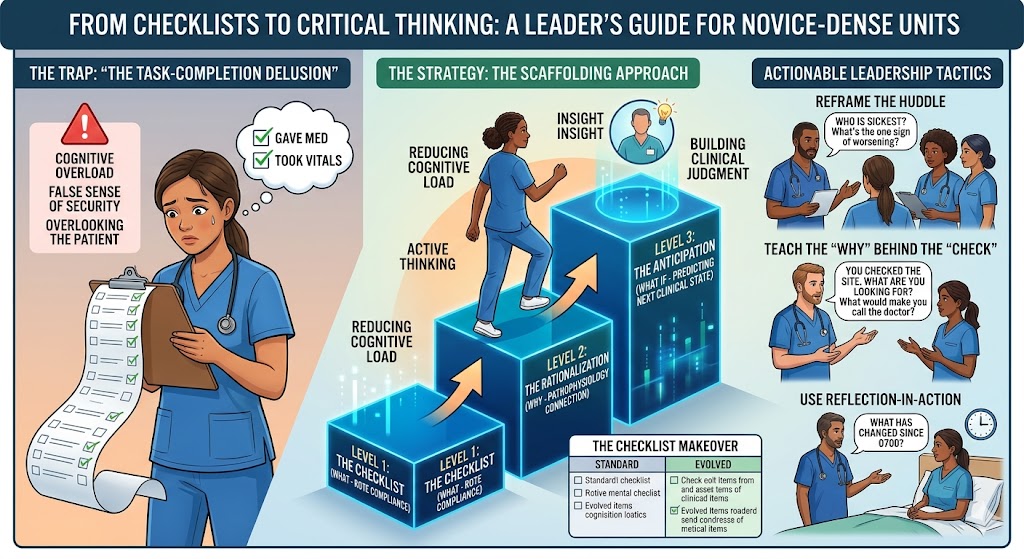
While there is a definite need to provide novice nurses with checklists to avoid omitting critical tasks, we need to avoid framing this as a binary “Checklists vs. Critical Thinking” war. Checklists are helpful to reduce cognitive load; critical thinking is what you do with the brainpower you just saved. Checklists prevent omissions; critical thinking prevents progressive deterioration in condition. A checklist tells a novice nurse what to do and when. Critical thinking tells them why they are doing it and what to look for next. As nurse leaders, we shouldn’t try to replace checklists; we must use them as a scaffolding to build clinical judgment.
The Trap: Checklists create a false sense of security (the “task-completion delusion”). A nurse can check off that they gave a beta-blocker on time, but fails to notice the patient’s trending bradycardia.
The Goal: Shift from “task completion” to “situational awareness.”
To avoid the trap and switch to the goal, leaders and educators can use cognitive scaffolding to help nurses transition from rote compliance to active thinking.
Levels of Cognitive Scaffolding
-
Level 1: The Checklist (What): Essential for psychological safety and basic compliance.
-
Level 2: The Rationalization (Why): Connecting the checklist item to the pathophysiology.
-
Level 3: The Anticipation (What if): Predicting the next clinical state and maintaining situational awareness to prevent its occurrence.
The Following are Some Suggestions on How to Do This in Everyday Practice:
-
Reframe the Huddle: Instead of just reviewing tasks, ask “Who is your sickest patient, and what is the one sign that will tell you they are getting worse?”
-
Teach the “Why” Behind the “Check”: Encourage preceptors to ask, “You just checked off that you assessed the surgical site. What exactly were you looking for, and what would make you call the doctor?”
-
Use Reflection-in-Action: When a leader rounds, don’t just look at the chart. Ask the novice nurse: “What has changed about this patient since 0700?” This forces them to look up from the computer and evaluate the human in the bed.
One additional strategy is to reframe the way we construct checklists to promote more critical thinking. I have outlined some examples below:
If your current checklist is to do Vital Signs q 4 Hours, consider revising to Check vitals q 4 hours and assess whether the numbers are higher or lower than 4 hours ago. If high – Why?
If your current checklist is to Document I+O q 2 Hours, consider revising it to Document I+O q 2 hours and assess whether fluid balance is positive or negative, and assess the impact on the lungs.
Checklists are not the enemy of critical thinking—they are the floor, not the ceiling. A leader’s job in a novice-dense unit is to build the staircase from the floor up.
To effectively lead through these challenges and others, nurse leaders need new tools and strategies. Let me help you as I have helped hundreds of organizations over the past five years. Please contact me at roseosherman@outlook.com to book a workshop or keynote for your team. Not seeing what you want on this list? Feel free to reach out, and I am happy to design a custom program to meet your needs.
Brand New For 2026 and Already Receiving Rave Reviews – Staying Power Building a Culture of Retention in the New World of Work
Brand New for 2026 and Already Popular – The Inverted Pyramid: Leading Teams of Novice Nurses The Inverted Pyramid WS Information Sheet
Our Most Popular Right Now –The New World of Work Workshop
A Leader Favorite – Building Bridges Not Walls: Leading Multigenerational Work Teams – Click Here for More Information Building Bridges Not Walls
A Must-Read Book in 2026 – Click Here to Buy
Why Nurse Recognition is More Complicated Today
2026-05-11 01:00:04By Rose O. Sherman, EdD, RN, NEA-BC, FAAN
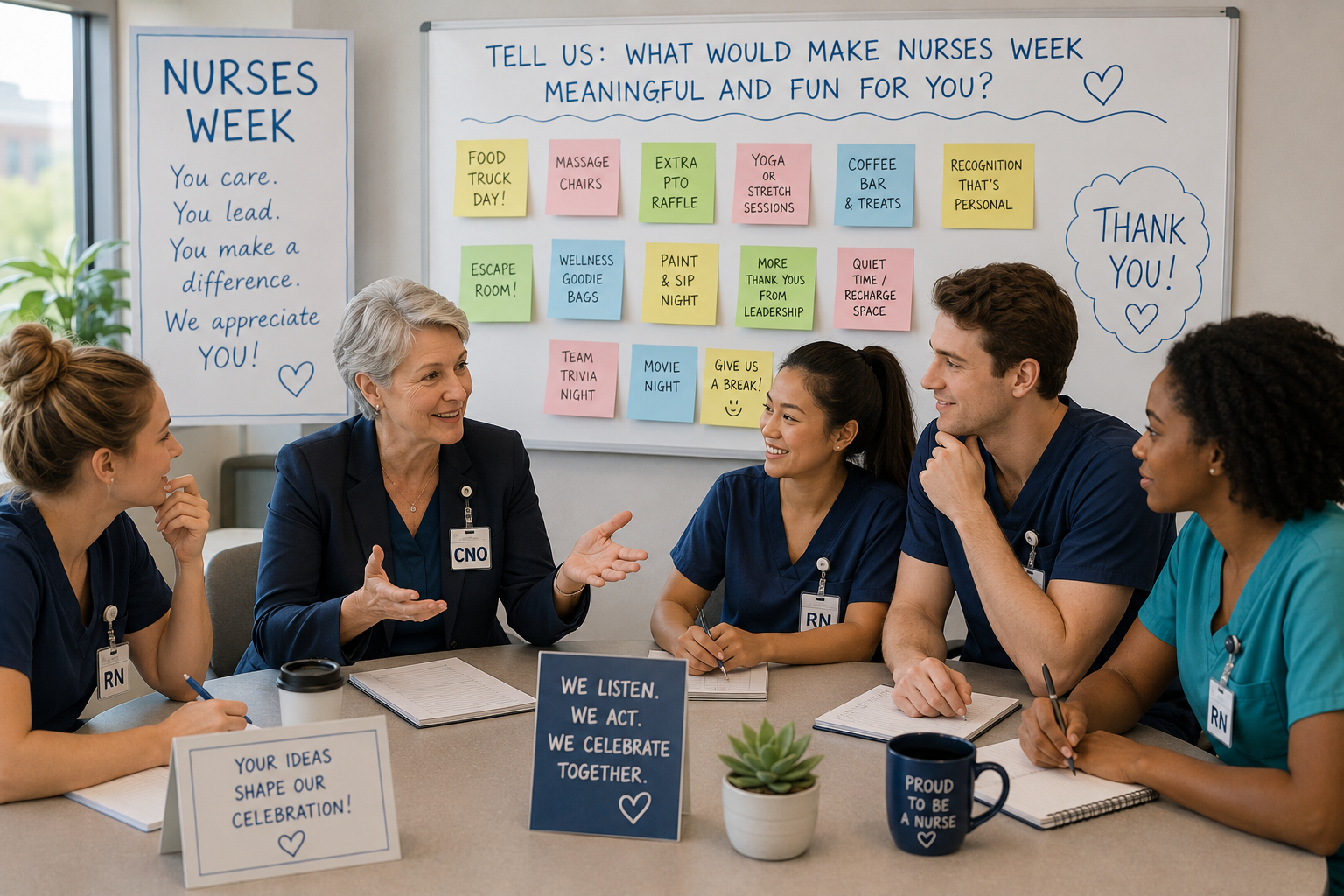
As I have spoken with nurse leaders at events during Nurses’ Week, I realize how much more complicated it is to plan meaningful recognition programs today. While leaders strongly desire to reward and recognize staff, they are sometimes very disappointed by nurses’ low participation in these events and, in some cases, their criticism of efforts on TikTok, Instagram, and other social media forums. Part of the challenge is that we have a very diverse nursing workforce. In acute care environments, units are now increasingly dominated by younger nurses with different ideas about recognition.
Developing a recognition strategy that resonates across different career stages is essential, especially during a high-visibility event like Nurses Week. Since generational values influence how individuals perceive “meaningful” rewards, a nuanced approach is more effective than a one-size-fits-all celebration. While traditional “swag” or a shared meal still has a place, research increasingly shows that modern nursing teams—particularly those with a heavy concentration of newer clinicians—crave recognition that validates their specific contributions and professional growth.
Seasoned Baby Boomer nurses value peer respect and legacy recognition. For them, a formal note of thanks from a senior executive or an opportunity to be recognized as a mentor carries significant weight. Public acknowledgment of their clinical expertise is often highly valued. Millennial nurses are focused on professional development and work-life integration. Meaningful recognition for this group might look like a “professional development grant” to attend a conference or a schedule-related reward that grants them time back with their families. Gen Z Nurses value immediate feedback and personalized impact. They appreciate “in-the-moment” recognition and social validation. They often respond well to specific, private praise from their direct supervisor or recognition from their peers.
One CNO told me that she had met with her Generation Z advisory group (what a fantastic idea this is) to get their feedback before events were planned, and here is what they told her:
- They wanted to see more peer recognition programs for nurses. They told her that, given the short lengths of stay and the lack of assignment continuity on most units, patients and families are not always the best judges of great nurses. Too many very good nurses never even get nominated, yet every day they precept others and are quietly reliable.
- They did not want hospital swag as gifts.
- They don’t want to sit in an auditorium and listen to an inspirational speaker talk about how great nursing is. No speeches and no PowerPoint.
- They don’t want to hear about Florence Nightingale.
- They would love a fun event with games, meaningful prizes, opportunities to take funny pictures with their friends, and food trucks – not pizza or hospital catering.
- They pointed out that many of the nursing staff have talents – why not a talent show to showcase nurse artists, photographers, actors, musicians, and poets?
- They don’t want us to forget about the night shift.
The most meaningful Nurses Week strategies are less about gifts and more about helping nurses feel seen, supported, respected, and professionally valued. In addition to the strategies suggested above, I recommend that leaders use this time to highlight actions they have taken to address staff needs. Create a “You Spoke – We Acted” campaign and use posters, screensavers, or short videos to illustrate actions taken:
- “You asked for quieter report rooms → completed.”
- “You wanted better night-shift food access → implemented.”
- “You requested more lift equipment → approved.”
Today’s nurses want to be acknowledged for the work they do. Don’t minimize their challenges. Messaging like “We recognize that many of you are caring for increasingly complex patients while also supporting newer teammates and adapting to constant change. Your work matters deeply” resonates better than ” We are fortunate to be able to do the work we do every day – it is our passion.”
As you wrap up Nurses Week this year, consider what resonated with your staff and what did not. Don’t be on autopilot with Nurse Week planning, and don’t delegate to the same group to organize each year. Our nursing workforce has changed, and so have the ways that they want to be recognized.
To effectively lead through these challenges and others, nurse leaders need new tools and strategies. Let me help you as I have helped hundreds of organizations over the past five years. Please contact me at roseosherman@outlook.com to book a workshop or keynote for your team. Not seeing what you want on this list? Feel free to reach out, and I am happy to design a custom program to meet your needs.
Brand New For 2026 and Already Receiving Rave Reviews – Staying Power Building a Culture of Retention in the New World of Work
Brand New for 2026 and Already Popular – The Inverted Pyramid: Leading Teams of Novice Nurses The Inverted Pyramid WS Information Sheet
Our Most Popular Right Now –The New World of Work Workshop
A Leader Favorite – Building Bridges Not Walls: Leading Multigenerational Work Teams – Click Here for More Information Building Bridges Not Walls
A Must-Read Book in 2026 – Click Here to Buy
[news count=”4″ pagination=”2″ terms=”24,22″][/news]


 LinkedIn
 Instagram