By Rose O. Sherman, EdD, RN, NEA-BC, FAAN
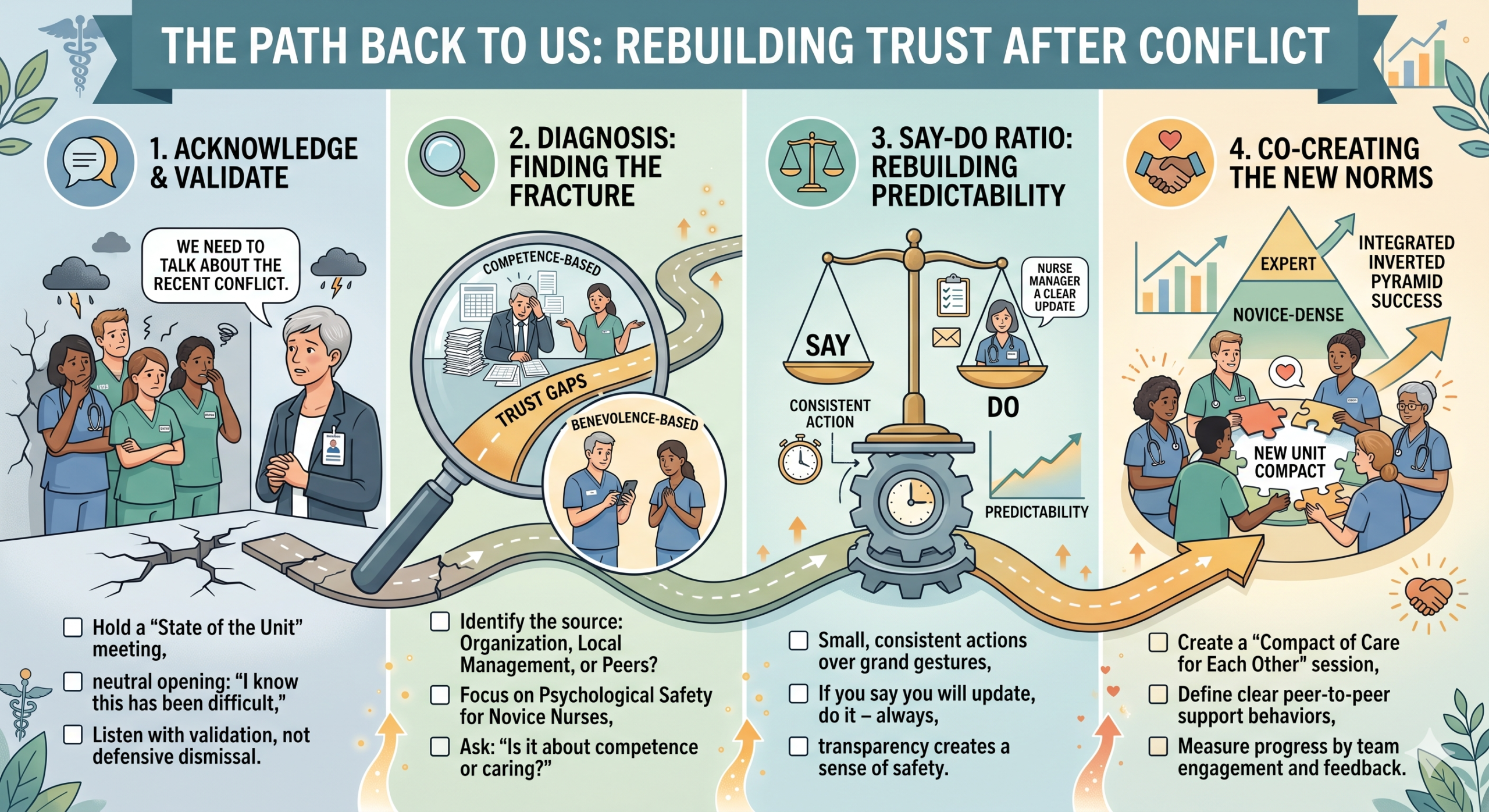
I was recently reminded of how difficult it can be to rebuild broken trust in talking with leaders whose health system experienced a nursing strike. Trust acts as the essential “glue” holding a unit together. When conflict occurs—whether due to a strike, staffing shortages, a difficult clinical event, a CNO fired without apparent cause, or a breakdown in communication—that glue dissolves, leaving a workforce and their leaders feeling vulnerable and unsupported.
Trust is easy to lose and arduous to regain. For a nurse manager, a “trust fracture” on the unit doesn’t just impact morale; it directly affects patient safety and staff retention. When nurses don’t trust their leaders and leaders don’t trust staff—or each other—they stop sharing critical information and start looking for the exit.
1. Validate what happened
The biggest mistake a leader can make after a conflict is to either not acknowledge what happened or “move on” too quickly. To the staff, silence feels like a dismissal of their concerns
-
Action: Hold a “State of the Unit” meeting. Use a neutral opening: “I recognize that the last few weeks have been incredibly difficult, and I know that trust has been shaken. I am here to listen to how that has affected you.”
-
The Goal: Validation is not necessarily agreement; it is the recognition that their feelings of frustration or betrayal are real.
2. Diagnose the fracture points.
Conflict usually leaves a trail. Is the lack of trust directed at the organization, the local management, or peers?
-
Action: Identify whether the trust gap is Competence-based (staff doesn’t think leadership is capable), Psychological-safety (the staff doesn’t feel safe about their own future in the organization), or Benevolence-based (staff doesn’t think leadership cares).
- The Goal: Design interventions to bridge fracture points.
3. Demonstrate predictability and consistency.
Trust is rebuilt through a series of small, consistent actions rather than one grand gesture. This is what I call the “Say-Do” ratio.
-
Action: If you say you will provide an update on staffing by Thursday, do it—even if there is no new information—and let staff know you are still working on this.
-
The Goal: Predictability from leadership creates a sense of safety in an otherwise chaotic environment.
4. Create new norms of behavior and team values.
You cannot “mandate” trust back into existence; you have to invite the staff to build the new foundation.
-
Action: Facilitate a session to create a “Compact of Care for Each Other.” Ask the team: “What is one thing we can all agree to do to support each other during this time?” What values matter most to us as a team?”
-
The Goal: This moves the unit from a “Me vs. Them” mindset back to “Us.”
Key Leadership Behaviors to Rebuild Trust
-
Be Visible: High-stress periods require “intentional presence.” Be on the unit during the busiest times, not just for the “huddle.”
-
Own the Narrative: If a mistake was made at the leadership level, own it. Vulnerability is a high-trust behavior.
-
Protect the Newcomers: Ensure that your new staff isn’t being caught in the crossfire of veteran staff frustrations.
-
Measure Progress: Trust doesn’t return overnight. Look for small wins: Are people asking more questions? Is the “grapevine” chatter slowing down?
The path back to “Us” is not a straight line. It is a slow, intentional process of proving—shift by shift—that the unit is a safe place to practice and a supportive place to grow. As a leader, you are the architect of that safety.
To effectively lead through these challenges and others, nurse leaders need new tools and strategies. Let me help you as I have helped hundreds of organizations over the past five years. Please contact me at roseosherman@outlook.com to book a workshop or keynote for your team. Not seeing what you want on this list? Feel free to reach out, and I am happy to design a custom program to meet your needs.
Brand New For 2026 and Already Receiving Rave Reviews – Staying Power Building a Culture of Retention in the New World of Work
Brand New for 2026 and Already Popular – The Inverted Pyramid: Leading Teams of Novice Nurses The Inverted Pyramid WS Information Sheet
Our Most Popular Right Now –The New World of Work Workshop
A Leader Favorite – Building Bridges Not Walls: Leading Multigenerational Work Teams – Click Here for More Information Building Bridges Not Walls
A Must-Read Book in 2026 – Click Here to Buy



 LinkedIn
 Instagram