By Rose O. Sherman, EdD, RN, NEA-BC, FAAN
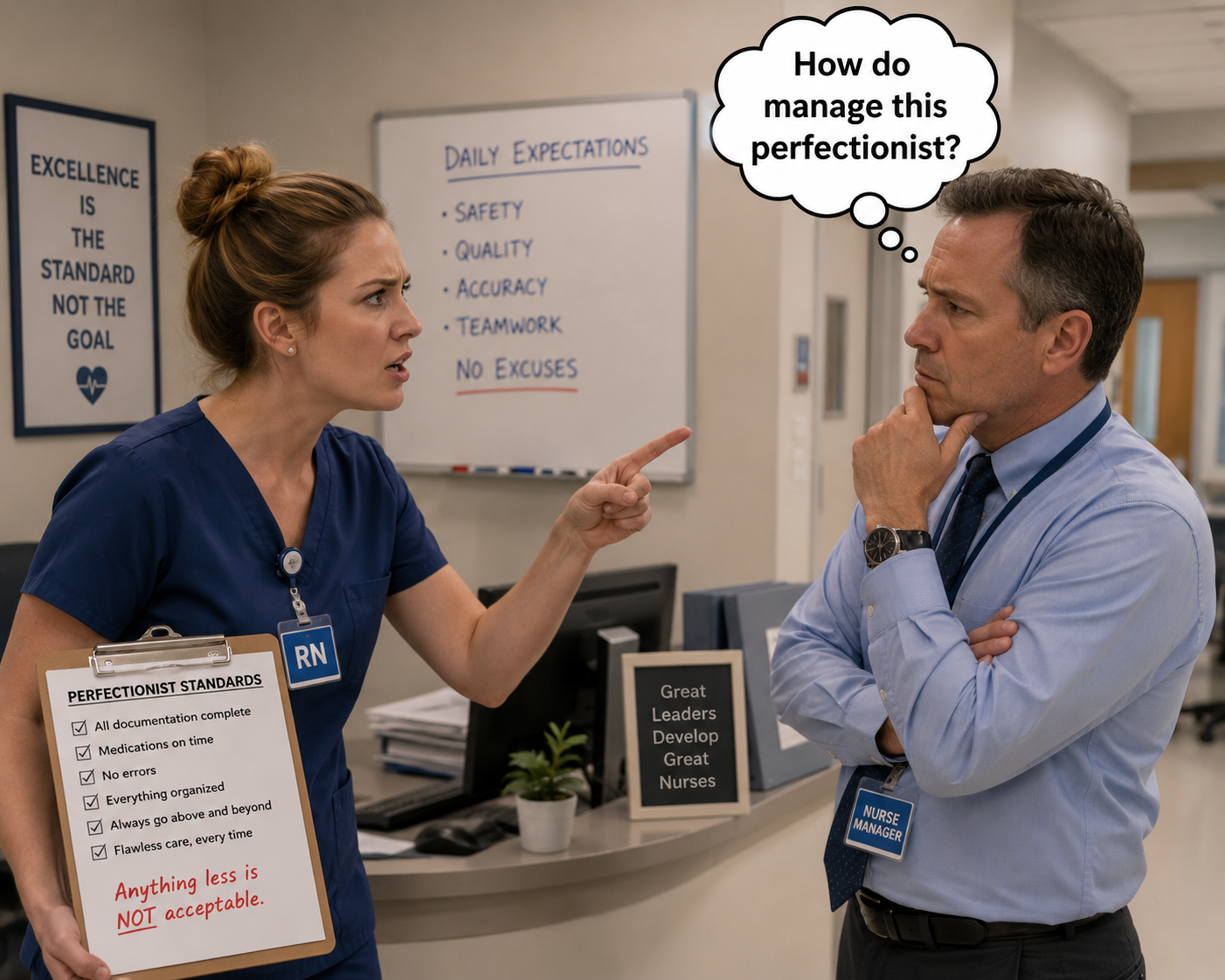
Managing perfectionist nurses is a big challenge for nurse managers. On one hand, you love their attention to detail and clinical accuracy. On the other hand, perfectionism in nursing is a fast track to severe burnout, delayed charting, anxiety, and sometimes friction with you, their leader, when you try to give them performance feedback. Consider the story a manager recently told during a session:
It is hard to get into nursing school today. So many new graduates proudly tell me that they have a 4.0 GPA and strive for perfection in all they do. Social media actually encourages this way of thinking. Yet I know that healthcare is messy, and I have seen nurses like this quit too soon because they lack a growth mindset. I encourage my staff to be excellent but remind them that they are also human. Perfectionism is fragile and fear-based – they are always worried about making a mistake. When you try to give a perfectionist nurse feedback, often they don’t take it well. They believe they are either excelling or failing – there seems to be no gray zone with these staff.
This leader makes a great point. After all, what could be wrong with a nurse who double-checks every medication, cross-references every lab value, and keeps a meticulously organized patient room? But look closer. The perfectionist nurse is often the one still finishing their charting two hours after their shift ended. They are the one agonizing over a minor, non-clinical critique from a patient, or burning out at twice the rate of their peers because they cannot let anything go. In a high-stakes healthcare environment, perfectionism isn’t a superpower—it’s a vulnerability. As leaders, our job isn’t to dim their high standards, but to help them channel those standards into sustainable excellence rather than exhausting perfection.
Here is how you can help your perfectionist nurses thrive without burning out.
- Distinguish for them the difference between a mindset of excellence and a mindset of perfectionism.
-
Perfectionism is driven by fear: “If I make a single mistake, I am a failure.” It focuses on avoiding blame and maintaining a flawless facade.
-
Excellence is driven by growth: “How can I provide the highest quality care while working within reality?” Excellence allows for human error, prioritizes learning, and recognizes that time is a finite resource.
When coaching a perfectionist, praise their commitment to excellence while gently challenging perfectionist behaviors. For example, if they are spending excessive time making a patient’s room perfectly symmetrical, acknowledge the care they put into the environment, but redirect them to the bigger picture of energy management.
2. Define what good enough looks like in charting and documentation.
Over-documentation is a classic hallmark of the perfectionist nurse. They write novels in the narrative notes out of fear that they will leave out a detail that could later be questioned. This leads to massive time-management struggles and late shifts.
When coaching a perfectionist, talk about “focused efficiency.” Sit down with them and review a few charts. Point out where standard flowsheets already capture the data and where narrative notes can be streamlined. Give them permission to be concise. Remind them that a clear, concise chart is often safer and more useful to the next nurse than a wall of text.
3. Normalize good mistakes, near misses, and psychological safety.
Perfectionists are terrified of failure, which can lead them to hide small mistakes or become incredibly defensive when corrected. To break this cycle, leaders must cultivate a culture of psychological safety.
When coaching a perfectionist about errors that occur—as they inevitably do—frame them as system lessons rather than personal failures. Share your own early career missteps. When a perfectionist nurse sees that a mistake doesn’t result in exile or shame, their anxiety drops, and their cognitive bandwidth increases.
4. Channel their critiques of others into coaching.
A perfectionist nurse who is hyper-critical of others can quickly create a toxic environment, especially for newer nurses or those still building confidence. They don’t mean to bully; in their minds, they are just “holding people to the standard.” But to the rest of the staff, it feels like nothing they do is ever good enough. When a nurse demands perfection from themselves, they naturally expect it from everyone else. This can manifest as eye-rolling at the nurses’ station, correcting peers in front of patients, or giving hyper-critical handoffs that leave the incoming shift feeling defeated.
When coaching a perfectionist who is overly critical of others, acknowledge their high standards, but redefine what “psychological safety” on the floor looks like. Tell them: “Your clinical eye is incredibly sharp. But a great nurse doesn’t just catch errors; they build up the team’s capability to prevent them.” Shift them from the role of enforcer to educator.
We don’t want our nurses to care less; we want them to care sustainably. When we coach our perfectionist nurses to trade the heavy armor of perfection for the flexible mindset of excellence, we aren’t just saving their charts—we might just be saving their careers.
© emergingrnleader.com 2026
To effectively lead through these challenges and others, nurse leaders need new tools and strategies. Let me help you as I have helped hundreds of organizations over the past five years. Please contact me at roseosherman@outlook.com to book a workshop or keynote for your team. Not seeing what you want on this list? Feel free to reach out, and I am happy to design a custom program to meet your needs.
Brand New For 2026 and Already Receiving Rave Reviews – Staying Power Building a Culture of Retention in the New World of Work
Brand New for 2026 and Already Popular – The Inverted Pyramid: Leading Teams of Novice Nurses The Inverted Pyramid WS Information Sheet
Our Most Popular Right Now –The New World of Work Workshop
A Leader Favorite – Building Bridges Not Walls: Leading Multigenerational Work Teams – Click Here for More Information Building Bridges Not Walls
A Must-Read Book in 2026 – Click Here to Buy



 LinkedIn
 Instagram