By Rose O. Sherman, EdD, RN, NEA-BC, FAAN
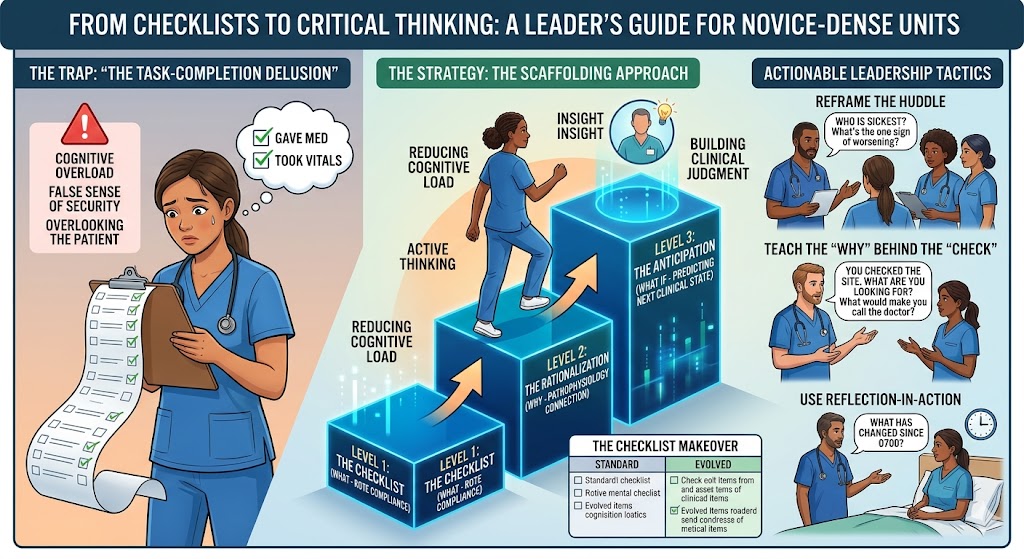
Last week, during a session, a nurse leader posed a very interesting question. Her unit, like many in acute care today, is staffed by a novice-dense team of nurses. Her question was about the tradeoffs between providing extensive checklists and promoting critical thinking. She pointed out that in a novice-dense environment, reliance on checklists is a survival mechanism. New nurses are overwhelmed by cognitive overload.
While there is a definite need to provide novice nurses with checklists to avoid omitting critical tasks, we need to avoid framing this as a binary “Checklists vs. Critical Thinking” war. Checklists are helpful to reduce cognitive load; critical thinking is what you do with the brainpower you just saved. Checklists prevent omissions; critical thinking prevents progressive deterioration in condition. A checklist tells a novice nurse what to do and when. Critical thinking tells them why they are doing it and what to look for next. As nurse leaders, we shouldn’t try to replace checklists; we must use them as a scaffolding to build clinical judgment.
The Trap: Checklists create a false sense of security (the “task-completion delusion”). A nurse can check off that they gave a beta-blocker on time, but fails to notice the patient’s trending bradycardia.
The Goal: Shift from “task completion” to “situational awareness.”
To avoid the trap and switch to the goal, leaders and educators can use cognitive scaffolding to help nurses transition from rote compliance to active thinking.
Levels of Cognitive Scaffolding
-
Level 1: The Checklist (What): Essential for psychological safety and basic compliance.
-
Level 2: The Rationalization (Why): Connecting the checklist item to the pathophysiology.
-
Level 3: The Anticipation (What if): Predicting the next clinical state and maintaining situational awareness to prevent its occurrence.
The Following are Some Suggestions on How to Do This in Everyday Practice:
-
Reframe the Huddle: Instead of just reviewing tasks, ask “Who is your sickest patient, and what is the one sign that will tell you they are getting worse?”
-
Teach the “Why” Behind the “Check”: Encourage preceptors to ask, “You just checked off that you assessed the surgical site. What exactly were you looking for, and what would make you call the doctor?”
-
Use Reflection-in-Action: When a leader rounds, don’t just look at the chart. Ask the novice nurse: “What has changed about this patient since 0700?” This forces them to look up from the computer and evaluate the human in the bed.
One additional strategy is to reframe the way we construct checklists to promote more critical thinking. I have outlined some examples below:
If your current checklist is to do Vital Signs q 4 Hours, consider revising to Check vitals q 4 hours and assess whether the numbers are higher or lower than 4 hours ago. If high – Why?
If your current checklist is to Document I+O q 2 Hours, consider revising it to Document I+O q 2 hours and assess whether fluid balance is positive or negative, and assess the impact on the lungs.
Checklists are not the enemy of critical thinking—they are the floor, not the ceiling. A leader’s job in a novice-dense unit is to build the staircase from the floor up.
To effectively lead through these challenges and others, nurse leaders need new tools and strategies. Let me help you as I have helped hundreds of organizations over the past five years. Please contact me at roseosherman@outlook.com to book a workshop or keynote for your team. Not seeing what you want on this list? Feel free to reach out, and I am happy to design a custom program to meet your needs.
Brand New For 2026 and Already Receiving Rave Reviews – Staying Power Building a Culture of Retention in the New World of Work
Brand New for 2026 and Already Popular – The Inverted Pyramid: Leading Teams of Novice Nurses The Inverted Pyramid WS Information Sheet
Our Most Popular Right Now –The New World of Work Workshop
A Leader Favorite – Building Bridges Not Walls: Leading Multigenerational Work Teams – Click Here for More Information Building Bridges Not Walls
A Must-Read Book in 2026 – Click Here to Buy



 LinkedIn
 Instagram