By Rose O. Sherman, EdD, RN, NEA-BC, FAAN
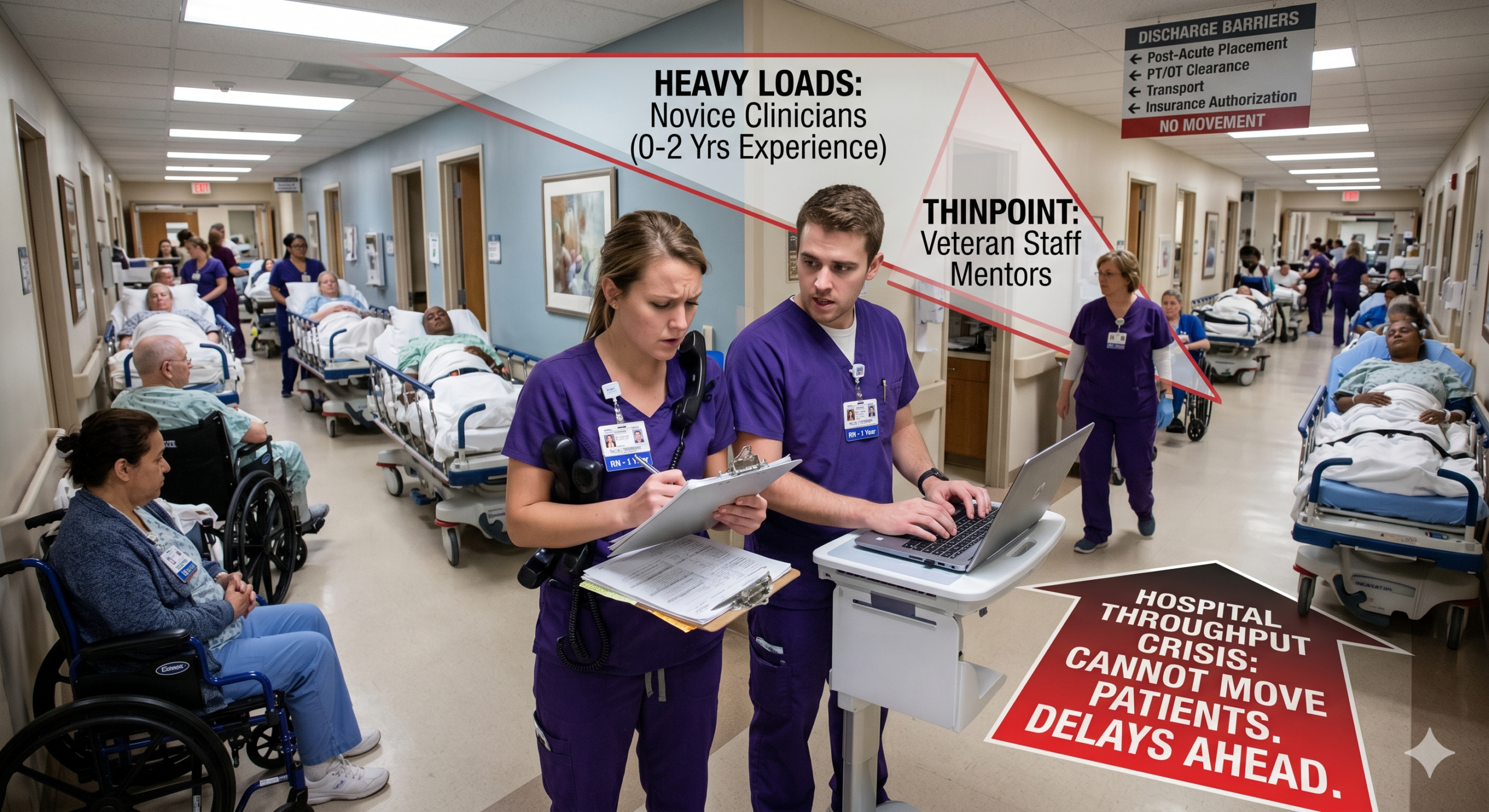
If you ask any Chief Nursing Officer what is driving their stubbornly high Length of Stay (LOS), you will likely get a familiar list of macro-bottlenecks: delayed physician orders, transportation challenges, physical therapy clearances, or a shortage of post-acute nursing beds. But there may be another explanation that is happening quietly, shift by shift, right at the bedside. Over the past few years, the structural makeup of the acute care workforce has undergone a seismic, unprecedented shift. Historically, clinical units were shaped like a traditional pyramid: a broad, sturdy foundation of veteran clinicians supporting a small, manageable top layer of incoming new graduates. Now, on many units, the pyramid of nursing experience has been inverted with large numbers of novice nurses and fewer experienced staff.
The challenge is that novice clinicians practice reactively (doing tasks as they are ordered). Veteran clinicians practice predictively—they see an order for oxygen today and immediately start planning for the home-health oxygen setup required for discharge on Thursday. Without a robust safety net of veteran peers, hospitals are experiencing a systemic drain on clinical intuition—the very operational lubricant required to anticipate complications, coordinate care, and efficiently progress a patient toward discharge.
This issue was recently raised during an Inverted Pyramid Workshop attended by an experienced case manager. She made the following observation:
I attended this workshop today to better understand the factors that could impact our length of stay, which we are working hard to reduce. This has become a much greater challenge, and over the last year, I have become convinced that our nursing workforce plays a role in what we are seeing. They not only lack clinical experience but also life experience. When I round, I find that discharge-planning risks that would be obvious to experienced clinicians are not apparent to our novice nurses. Simple things like getting the patient out of bed and walking, so critical to one’s ability to function at home, are being missed. When I ask about it, I am told, “I just don’t have time.”
Interestingly, this same point about the relationship between nursing experience and LOS was made in a landmark study published in the American Economic Journal in 2014. The researchers found that a one-year increase in the average unit tenure of registered nurses is associated with an approximately 1.3% decrease in patient length of stay, suggesting a direct link between RN experience on units and patient length of stay. Their work suggests that when turnover occurs, and a unit becomes “novice-heavy,” the team’s intelligence in discharge planning disappears, causing the residual length of stay to rise.
So, What Strategies Can Be Implemented?
-
Virtual Nursing & Mentorship: Using remote monitoring, veteran nurses can handle discharge paperwork and mentor novices in real-time around discharge planning interventions. Many health systems are now incorporating LOS as a metric to justify implementing virtual nursing.
- Provide More Support on Inverted Pyramid Units: Novice dense units need different role support than other units to compensate for inexperience. Some health systems place CNLs or Clinical Nurse Leaders on these units to support both the manager and the staff. In their MSN programs, CNLs receive more in-depth knowledge and skills in assessing patient discharge planning needs.
-
Nurse Leader and Case Manager Rounding: When leading an Inverted Pyramid, nurse leaders need to round differently. I discussed the concept of cognitive rounding in a blog several months The Power of Cognitive Rounding. When units are novice-dense, both nurse managers and case managers need to ask the novice coaching questions to assess their focus (or lack thereof) on discharge planning. Five coaching questions to increase skills in discharge planning include:
If the physician walked in right now and said, ‘Let’s discharge them today,’ what would make you say, ‘Whoa, wait, they aren’t ready yet’?”
When you look at this patient’s support system and home environment, what do you think will trip up their discharge on Thursday?
What is the longest ‘lead-time’ item (referral, durable medical equipment, etc.) this patient needs, and have we begun planning for it yet?
Based on that lab value we just discussed, how does that change our target discharge timeline?
What are the milestones this patient needs to achieve to be safely discharged home?
If nurse leaders want to fix their throughput crisis, they must stop looking exclusively at external bottlenecks and start addressing the internal experience gap as an additional variable.
Reference
Bartel, A. P., Beaulieu, N. D., Phibbs, C. S., & Stone, P. W. (2014). Human capital and productivity in a team environment: Evidence from the healthcare sector. American Economic Journal: Applied Economics, 6(2), 231–259.
© emergingrnleader.com 2026
To effectively lead through these challenges and others, nurse leaders need new tools and strategies. Let me help you as I have helped hundreds of organizations over the past five years. Please contact me at roseosherman@outlook.com to book a workshop or keynote for your team. Not seeing what you want on this list? Feel free to reach out, and I am happy to design a custom program to meet your needs.
Brand New For 2026 and Already Receiving Rave Reviews – Staying Power Building a Culture of Retention in the New World of Work
Brand New for 2026 and Already Popular – The Inverted Pyramid: Leading Teams of Novice Nurses The Inverted Pyramid WS Information Sheet
Our Most Popular Right Now –The New World of Work Workshop
A Leader Favorite – Building Bridges Not Walls: Leading Multigenerational Work Teams – Click Here for More Information Building Bridges Not Walls
A Must-Read Book in 2026 – Click Here to Buy



 LinkedIn
 Instagram