By Rose O. Sherman, EdD, RN, NEA-BC, FAAN
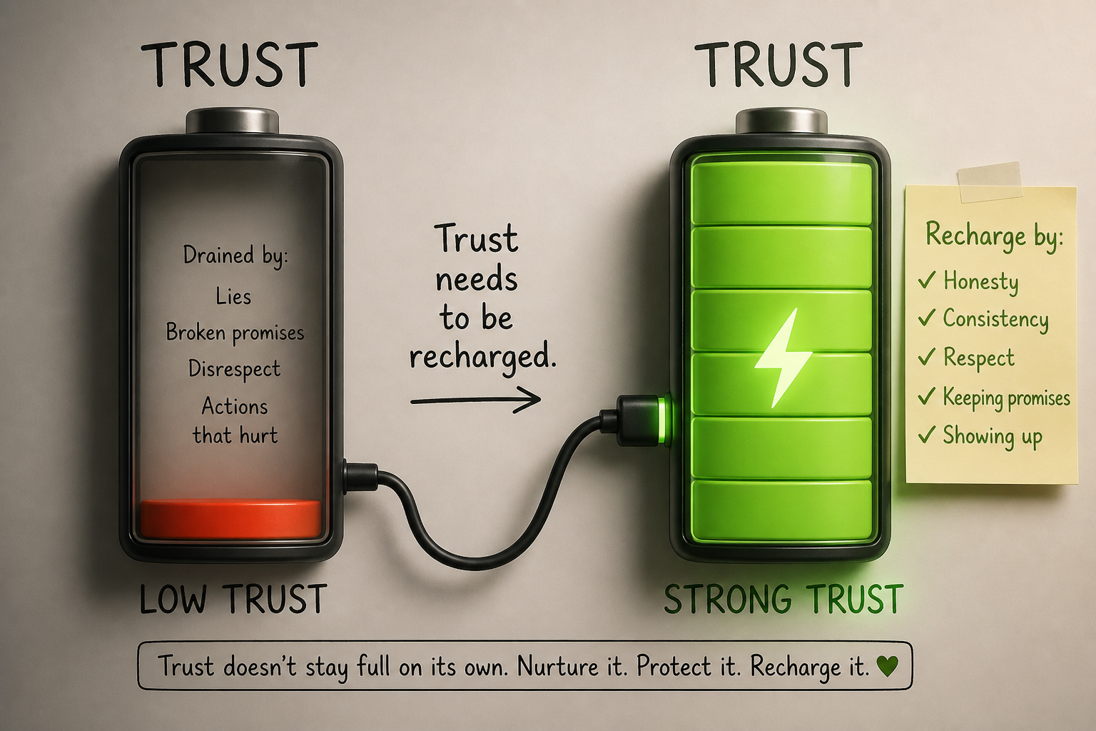
One question that nurse leaders often ask today is how to expedite the process of building trust with their team. As nurse leaders, we understand that trust is built over time—and it is. But I’ve come to believe that trust is also much more dynamic than that. It behaves like a battery. Every interaction you have with a team member either adds a little charge or drains it. There are very few neutral conversations.
The challenge is that leaders often underestimate how quickly the battery can lose power. A rushed interaction, a missed commitment, or an employee who feels unheard can slowly drain trust over weeks or months. As I tell leaders, your staff watches your actions much more than just the words that you say.
Then one difficult conversation, an unpopular staffing decision, or an organizational change arrives, and suddenly the battery is empty. There are times when a nurse’s reaction seems disproportionate to the situation. In reality, they aren’t responding to one conversation. They’re responding to the cumulative charge—or lack of it—that has been building over time.
In my experience, trust is built in much smaller moments. It happens when you stop at the nurses’ station and ask, “How’s your day going?“—and genuinely listen to the answer. It happens when you remember my birthday or follow through on the reference you promised to write for me for my graduate program. It happens when you admit in a staff meeting that you don’t have all the answers. It happens when you thank someone for speaking up and voicing an unpopular viewpoint, rather than becoming defensive. It happens when you are fully present, even if only for a few minutes.
These moments may seem insignificant, but they steadily recharge the battery. The good news is that charging trust doesn’t require perfection. The bad news is that trust can be drained in surprisingly ordinary ways.
Common trust drains include:
- Not following through on commitments.
- Cancelling one-on-one meetings repeatedly.
- Being distracted during conversations.
- Delivering feedback only when something goes wrong.
- Failing to explain the “why” behind difficult decisions.
- Becoming defensive when employees raise concerns.
- Saying, “I’ll get back to you,” and never doing it.
None of these behaviors may seem dramatic. Yet repeated over time, they communicate a message employees hear loud and clear: “I’m not that important.”
Fortunately, lost trust can also be replenished through consistent leadership behaviors such as:
- Keeping your commitments.
- Listening without interrupting even when you don’t agree.
- Following up when you say you will – even if the answer is that I can’t do that.
- Explaining decisions with honesty and transparency – if you can’t discuss something, say that.
- Recognizing effort—not just outcomes.
- Admitting your own mistakes.
- Showing empathy without trying to immediately solve every problem.
- Advocating for your staff whenever you can.
Employees don’t expect perfection. They expect consistency.
The Battery Gets Tested During Difficult Times
The real value of a fully charged trust battery becomes apparent during challenging moments.
Every nurse leader eventually has to say:
- “I can’t approve that vacation request.”
- “I need you to float today.”
- “We have to adjust the schedule.”
- “I need to give you some difficult feedback.”
When trust is low, employees often hear choose to hear messages as evidence that leadership doesn’t care. When trust is high, the exact same message is more likely to be interpreted as, “I don’t like this decision, but I know my manager is being honest with me.” Trust doesn’t eliminate disappointment. It changes how disappointment is received.
You won’t get every interaction right. None of us do. But leadership isn’t about perfection. It’s about recognizing that every conversation is an opportunity to invest in the relationship. Trust isn’t built in a single heroic moment. It’s built one interaction at a time. And just like a battery, it requires continual recharging. The most effective nurse leaders understand this. They know that every conversation matters because every conversation either charges trust—or drains it. When you interact with your staff – establish a goal to have a conversation that will leave nurses with a trust battery that is more charged – not depleted.
© emergingrnleader.com 2026
To effectively lead through these challenges and others, nurse leaders need new tools and strategies. Let me help you as I have helped hundreds of organizations over the past five years. Please contact me at roseosherman@outlook.com to book a workshop or keynote for your team. Not seeing what you want on this list? Feel free to reach out, and I am happy to design a custom program to meet your needs.
Brand New For 2026 and Already Receiving Rave Reviews – Staying Power Building a Culture of Retention in the New World of Work
Brand New for 2026 and Already Popular – The Inverted Pyramid: Leading Teams of Novice Nurses The Inverted Pyramid WS Information Sheet
Our Most Popular Right Now –The New World of Work Workshop
A Leader Favorite – Building Bridges Not Walls: Leading Multigenerational Work Teams – Click Here for More Information Building Bridges Not Walls
A Must-Read Book in 2026 – Click Here to Buy



 LinkedIn
 Instagram