By Rose O. Sherman, EdD, RN, NEA-BC, FAAN
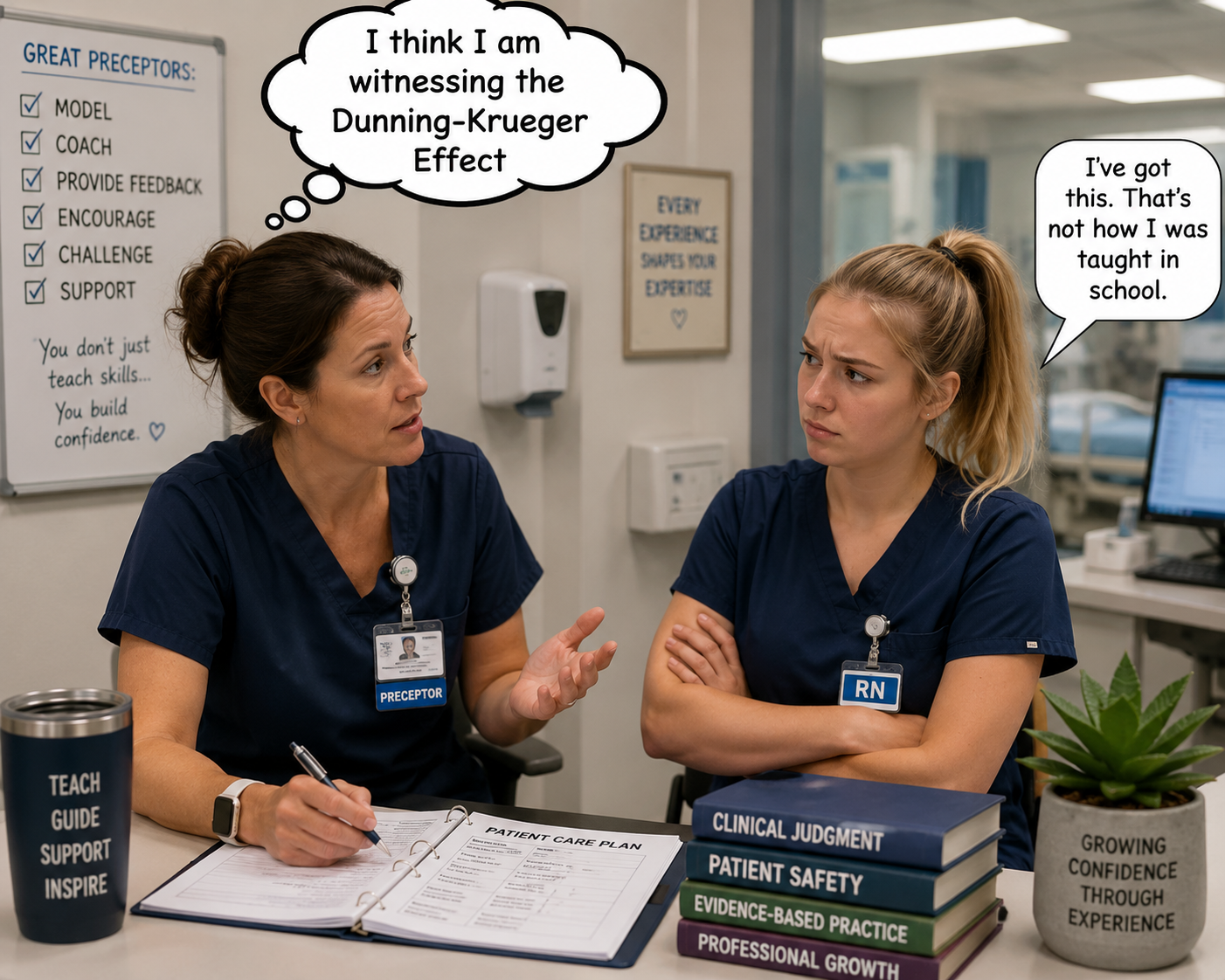
A nurse leader recently asked me how to manage overconfidence with her novice team. She told me that many of her newest nurses had challenges taking feedback. She further explained: “Ironically, some of my new graduates think they are very high performers when they are not. I think they are comparing themselves to other nurses with a similar level of experience on the unit. They don’t seem to know or sometimes care what they don’t know, and this is frustrating our preceptors. How do I manage this on a very novice-dense unit?”
The Dunning-Kruger Effect Defined
The Dunning-Kruger Effect is a cognitive bias in which people who are new to or unskilled at something drastically overestimate their abilities, while true experts often underestimate theirs. Simply put: The less you know about a subject, the less qualified you are to judge how little you know. The challenge for the nurse leader who asked the question is that she now has a unit dominated by novices. If not managed, this cognitive bias among nursing staff could become a major patient safety risk.
The Dunning-Krueger Effect is not new in nursing, but historically, it was not a major issue because we had many experienced nurses in acute care who could rein in overconfident new graduates by pointing out what they had overlooked. On many units today, that built-in safety net no longer exists, and much of this coaching falls to nurse leaders and preceptors.
Coaching Overconfident Staff
Coaching an overconfident new graduate requires leadership finesse. If you push too hard, you risk crushing their spirit and triggering defensive behavior. Other the other hand, if you are too hands-off, patient safety is compromised. The first important concept as you think about coaching nurses who seem overconfident as an outcome of the Dunning-Krueger Effect is to understand that you are not witnessing arrogance. What you are seeing is a biological cognitive limit. Because they lack clinical pattern recognition, they literally cannot see what they don’t know. These nurses are at risk of missing subtle patient decompensations because they assume everything is under control. They don’t call for help because they don’t realize help is needed.
Some Good Leader Interventions to Counter the Dunning-Krueger Effect
- Don’t ask an overconfident novice – “Do you have any questions?” (to which a confident novice will always say no).
- Shift toward active cognitive rounding. Ask the nurse to articulate their clinical reasoning by using active, inquiry-based dialogue. Instead of saying “Let me know if you need help with this admission.” Instead say, “This patient has a complex history. Tell me the three worst-case scenarios you’re monitoring for during this shift, and what your first action will be if they happen.”
- Create objective, non-negotiable clinical triggers that mandate a second set of eyes, bypassing a novice’s subjective confidence. Overconfident individuals often perceive subjective feedback as a personal critique or “micromanagement.” To bypass their defensive ego, anchor your coaching in objective data, policies, and evidence-based checklists. Example – “Our policy requires a dual-sign-off for high-alert meds. It doesn’t matter how comfortable you feel with it; it’s a safety guardrail for all of us.”
- Coach preceptors to look for the “overconfident new grad” Teach preceptors about the Dunning-Krueger Effect so they can gently but firmly guide the nurse to reality before a clinical error occurs. When an experienced preceptor performs a task, 80% of their critical thinking happens invisibly in their head. The overconfident new grad only sees the physical action and thinks, “Oh, that looks easy.” Coach preceptors to narrate their own internal monologues to expose the hidden layers of clinical practice. Example “I am giving this medication, but notice how I’m checking the patient’s trending potassium levels first, even though the morning lab was normal? I’m doing that because their urine output dropped last hour. See how those two things connect?” By making the invisible visible, you demonstrate to the new nurse just how much nuance they are currently overlooking.
- Praise the Ask. New graduates often view asking for help as a confession of weakness or failure. They overcompensate by acting like they have everything under control. Leaders must actively flip this script. It is important as a leader to normalize the Dunning-Krueger Effect and work with new graduates to avoid this cognitive bias (as you would any other cognitive bias). When a new graduate actually does ask a question or requests a second pair of eyes, reward that behavior immediately and publicly. Say – “I love that you called the charge nurse to double-check that rhythm. Recognizing when a situation requires a team approach is exactly what highly competent, safe nurses do. Great catch.”
The Inverse Pyramid of Experience is the reality of the modern healthcare workforce. But an inexperienced staff only becomes a dangerous staff when leadership fails to manage the gaps in confidence and competence.
© emergingrnleader.com 2026
To effectively lead through these challenges and others, nurse leaders need new tools and strategies. Let me help you as I have helped hundreds of organizations over the past five years. Please contact me at roseosherman@outlook.com to book a workshop or keynote for your team. Not seeing what you want on this list? Feel free to reach out, and I am happy to design a custom program to meet your needs.
Brand New For 2026 and Already Receiving Rave Reviews – Staying Power Building a Culture of Retention in the New World of Work
Brand New for 2026 and Already Popular – The Inverted Pyramid: Leading Teams of Novice Nurses The Inverted Pyramid WS Information Sheet
Our Most Popular Right Now –The New World of Work Workshop
A Leader Favorite – Building Bridges Not Walls: Leading Multigenerational Work Teams – Click Here for More Information Building Bridges Not Walls
A Must-Read Book in 2026 – Click Here to Buy



 LinkedIn
 Instagram