By Rose O. Sherman, EdD, RN, NEA-BC, FAAN
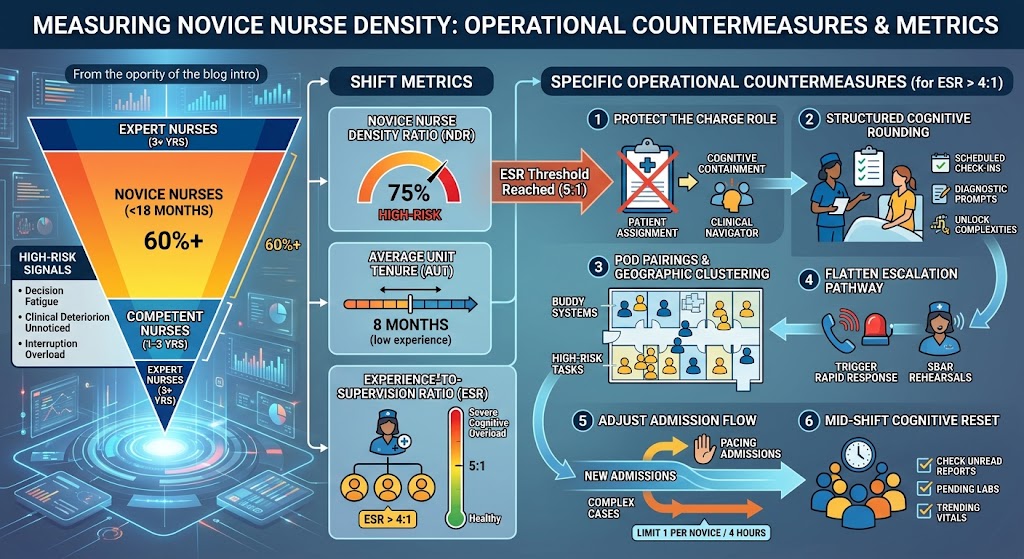
The work I am doing right now on the Inverted Pyramid of Nursing Experience ™ is resonating with not only nurse leaders but also preceptors and charge nurses. Consider the story a charge nurse shared during one of our recent workshops:
I think what you are talking about here helps to explain why I feel my work as a charge nurse is so hard. Last night was a good example. There were 12 nurses scheduled in our ICU. On paper, we looked fully staffed and compliant with budgeted ratios. But as I began reviewing the assignments, reality told an entirely different story. Eight of the twelve nurses had been off orientation for less than six months. Two had barely marked their one-year anniversary. Along with one travel nurse, I represented the unit’s entire seasoned clinical staff. The nurses tried to manage complex post-op recoveries, delicate titration protocols, and erratic telemetry alarms. Every few minutes, one would come to me and ask: “Can you double-check this heparin calculation?” “Does this rhythm strip look like new-onset atrial fibrillation to you?” “I’ve paged the resident twice and haven’t heard back—what do I do next?” By the end of the shift, I was emotionally and physically exhausted. With the constant interruptions and coaching now expected in my role, it is a far different picture than it was even five years ago.
This discussion naturally evolved into what a healthy skill mix balance should look like versus what we have today. While there is no firm research on the right mix, competency experts often recommend that novices should comprise no more than 15-20% of unit staffing (or shift staffing). Ideally, you want 50 – 70% of your nurses to be competent/proficient and 15-20% to be clinical experts.
Changes with the Inverted Pyramid
This traditional distribution provided a natural buffer where institutional wisdom, situational awareness, and pattern recognition were passed down effortlessly during routine shift work. Today, many acute care units cannot recruit enough experienced staff. They face an inverted pyramid of nursing experience where the following staffing is not unusual:
-
60% to 75% novice staff with under eighteen months of acute care tenure.
-
15% to 25% competent mid-tier nurses who are frequently drafted into charge or preceptor roles prematurely.
-
Less than 10% seasoned expert clinicians, creating an unsustainable cognitive load on a dwindling few.
The challenge is that nurse leaders cannot instantly recruit tenured staff who simply do not exist in the labor pool. Acknowledging high novice nurse density isn’t an admission of poor management; it is a metric of structural reality. When novice density is high, staffing cannot be calculated purely by warm bodies to patient beds. It requires experience-based staffing models, intentional cognitive rounding, dedicated relief charge roles, and visual tools that measure unit tenure as rigorously as patient acuity.
Why Traditional Staffing Models are Not Working
Traditional staffing systems measure nurse-to-patient ratios, but they fail to capture the collective clinical judgment on the floor. So many CNOs now tell me their staffing on paper has never looked better, but care quality has declined, and nurses are exhausted. This is not surprising when the structural makeup of the nursing workforce, especially in acute care, has fundamentally changed with no indication that it will look different in the near future
To make experience visible on an assignment sheet, leaders can track two operational formulas:
1. Novice Nurse Density Ratio (NDR)
This metric provides a high-level percentage of staff who are still developing baseline clinical pattern recognition and require active cognitive supervision. To track the NDR, leaders can use the following formula:
NDR = The Numerator is the Number of Nurses with Less than 18 Months of Experience x 100
The Denominator is the Total Number of Direct Care Nurses on a Shift or on the Unit
-
Safe/Stable Zone: Under 25%
-
Caution Zone: 26% to 49%
-
High-Risk Threshold: 50% or greater
2. Cumulative Shift Experience/Average Unit Tenure (AUT)
Headcount alone obscures the depth of wisdom on a unit. Calculating total months or years of acute care experience highlights how vulnerable a shift is when seasoned staff rotates off.
AUT = The Numerator is the Total Months of Acute Care Experience for Each Nurse on the Shift x 100
The Denominator is the Total Number of Direct Care Nurses on a Shift or on the Unit
Application: A night shift with six nurses averaging 8 months of tenure will experience radically different cognitive strain, rapid response calls, and escalation bottlenecks than a day shift with six nurses averaging 48 months of tenure, even if patient census and acuity scores are identical. These calculations take less than two minutes during pre-shift huddle planning, transforming an abstract feeling of shift chaos into objective data that nurse leaders can escalate, staff against, and manage proactively. Some proactive actions might include the following:
- Assigning a charge or resource nurse without a patient care assignment. The charge role shifts from logistical coordinator to bedside consultant and rapid second look.
- Avoid floating a nurse from the unit to meet the staffing needs on another unit.
- Justifying the assignment of unit-based or hospital educators on the night shift.
- Implementation of a mandatory mid-shift huddle to reassess care needs and support the novices.
- Justifying the implementation of virtual nursing on a unit 24/7.
- Assigning novice staff to patients in adjacent rooms near the charge nurse or seasoned staff.
- Diverting multi-system high acuity admissions to bypass high-novice pods or be routed to units with lower novice density.
As I talk with nurse leaders across the country, I am becoming more convinced that the novice nurse density now seen on so many acute care units is contributing to the exhaustion and burnout nurses feel. Our current staffing models were built in a different era with a very different nursing workforce. Nurse experience matters in one’s ability to manage workload – it always has – and always will.
Downloadable Copy – Novice Density Risk Assessment
© emergingrnleader.com 2026
To effectively lead through these challenges and others, nurse leaders need new tools and strategies. Let me help you as I have helped hundreds of organizations over the past five years. Please contact me at roseosherman@outlook.com to book a workshop or keynote for your team. Not seeing what you want on this list? Feel free to reach out, and I am happy to design a custom program to meet your needs.
Brand New For 2026 and Already Receiving Rave Reviews – Staying Power: Building a Culture of Retention in the New World of Work
Brand New for 2026 and Already Popular – The Inverted Pyramid: Leading Teams of Novice Nurses The Inverted Pyramid WS Information Sheet
Our Most Popular Right Now –The New World of Work Workshop
A Leader Favorite – Building Bridges Not Walls: Leading Multigenerational Work Teams – Click Here for More Information Building Bridges Not Walls
A Must-Read Book in 2026 – Click Here to Buy



 LinkedIn
 Instagram