By Rose O. Sherman, EdD, RN, NEA-BC, FAAN
As I lead workshops on the Inverted Pyramid of Nursing Experience™, the content seems to be deeply resonating with a growing number of nurse leaders who now see this phenomenon on their units. One leader recently explained, “You are providing a framework for what I am seeing on my unit, but even more important – you are explaining why I am feeling overwhelmed and exhausted so much of the time. I thought I was just getting old and maybe nursing leadership is just too much for me now, but I now see from what you are saying – how much my role has changed as the number of inexperienced nurses on my unit continues to grow.”
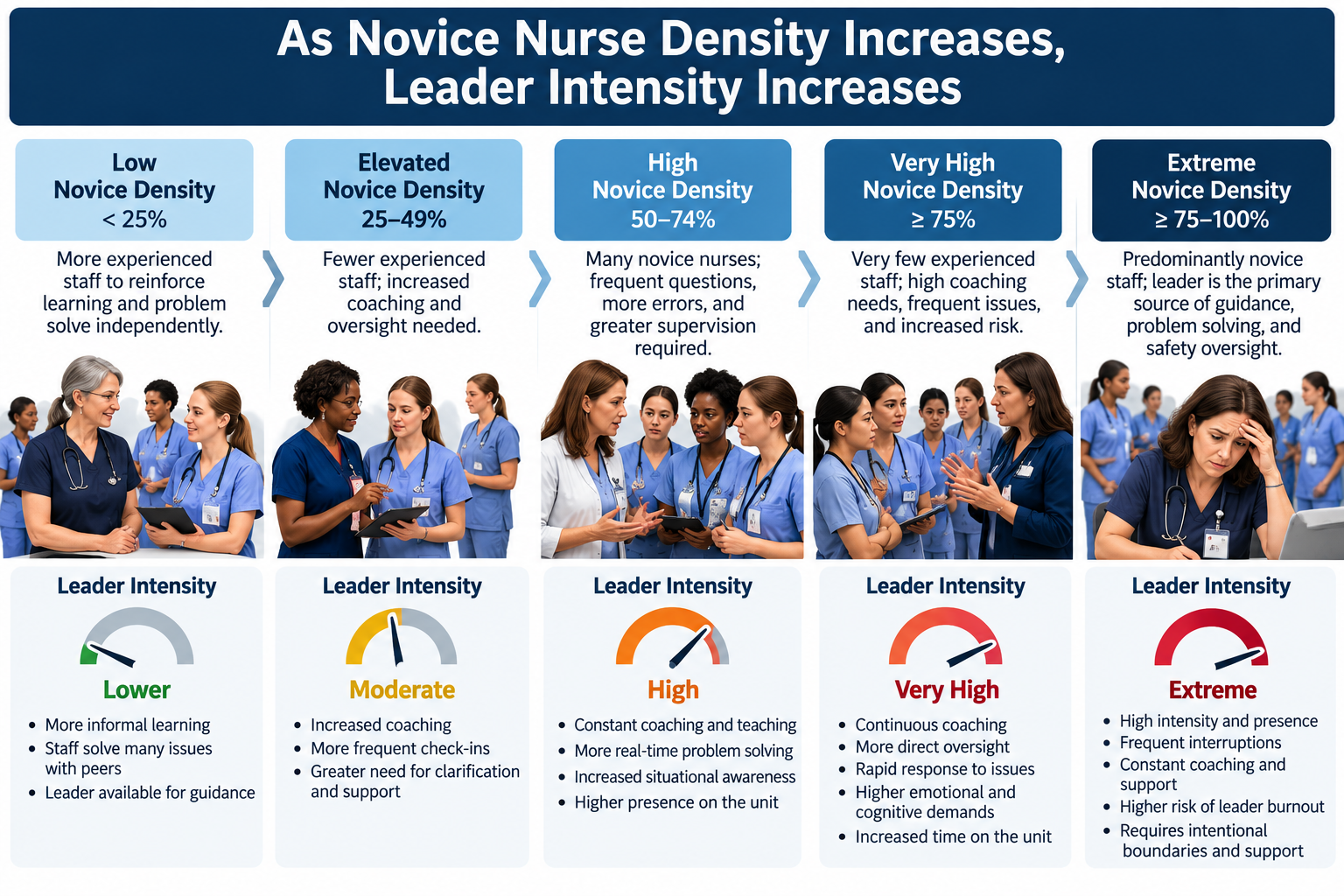
When a team shifts from a majority of experienced staff to a growing percentage of early-career staff, the supervisory burden multiplies. This dynamic is called Leadership Intensity, or the compounding strain that drains unit leadership when novice density reaches critical mass. The escalation curve can look like the following on a unit:
-
Low Density (< 25%): Teams maintain a healthy ratio of experienced mentors. Peer-to-peer problem-solving flourishes, and informal learning handles day-to-day uncertainties without pulling leaders away from strategic work.
-
Elevated Density (25–49%): The loss of senior peers creates small support gaps. Leaders step in for targeted check-ins, structured coaching, and frequent workflow clarifications.
-
High Density (50–74%): As novices outnumber veteran peers, questions compound and routine error rates tick upward. Managers shift from macro oversight to continuous, real-time troubleshooting and persistent situational awareness.
-
Very High to Extreme Density (75–100%): Informal peer coaching collapses. The unit leader becomes a key backstop for safety oversight, technical problem-solving, and guidance.
Many units today are in the high-, very high-, to extreme-density range. This dramatically shifts nursing leadership workloads, even when all other aspects of the span of accountability stay the same.
The Hidden Costs of Increasing Leadership Intensity
When organizations ignore novice density, the real costs manifest across three primary operational layers:
-
Cognitive Fragmentation & Interruption Fatigue: At extreme density, managers navigate relentless context switching. Urgent tactical firefighting crowds out strategic planning, talent development, and process improvements.
-
Leader Burnout & Attrition: Extreme intensity demands sustained vigilance and deep emotional resilience. When frontline leaders are consumed by safety backstopping, their risk of rapid burnout escalates sharply.
-
Depleted System Resilience: Without an intermediate layer of seasoned talent, institutional memory vanishes, leaving the team vulnerable to sudden surges or unexpected crises.
Rebalancing the Equation
Units with high novice density need more structural support than simply adjusting span of accountability. To decide what structural support is needed and for what units, organizations should do the following:
-
Track Experience Ratios, Not Just Headcounts: Measure unit-level novice density and average acute care clinical experience alongside standard vacancy metrics.
-
Build Mid-Tier Buffers: Staff novice-dense units with assistant managers, resource nurses, charge nurses without assignments, and unit-based educators so frontline nurse managers do not absorb 100% of novice coaching needs.
-
Protect Leader Capacity: Advocate for strict leader boundaries, hard stops to leader days, and support groups to help nurse leaders deal with the leadership intensity on their units.
A fully staffed shift means very little if the collective experience on the floor cannot sustain itself. When we treat headcounts as interchangeable numbers, we pass the hidden tax of a novice-dense workforce directly to our frontline leaders—until their capacity, resilience, and willingness to absorb the pressure finally run out.
True workforce stability isn’t just about filling vacancies; it requires protecting the balance of skill and intentionally safeguarding the bandwidth of those we ask to lead. If we want safe environments, high-performing teams, and sustainable leadership, we must stop asking managers to be the shock absorbers for an unbalanced system and start designing staffing models that account for the true cost of having an inexperienced staff.
© emergingrnleader.com 2026
To effectively lead through these challenges and others, nurse leaders need new tools and strategies. Let me help you as I have helped hundreds of organizations over the past five years. Please contact me at roseosherman@outlook.com to book a workshop or keynote for your team. Not seeing what you want on this list? Feel free to reach out, and I am happy to design a custom program to meet your needs.
Brand New For 2026 and Already Receiving Rave Reviews – Staying Power: Building a Culture of Retention in the New World of Work
Brand New for 2026 and Already Popular – The Inverted Pyramid: Leading Teams of Novice Nurses The Inverted Pyramid WS Information Sheet
Our Most Popular Right Now –The New World of Work Workshop
A Leader Favorite – Building Bridges Not Walls: Leading Multigenerational Work Teams – Click Here for More Information Building Bridges Not Walls
A Must-Read Book in 2026 – Click Here to Buy



 LinkedIn
 Instagram