By Rose O. Sherman, EdD, RN, NEA-BC, FAAN
The landscape of our workforce has shifted dramatically, yet many of our professional governance structures remain frozen in a 1990s time capsule. When I talk to nurse leaders across the country, a common frustration emerges: “We have the councils, but we can’t get anyone to show up—especially our younger nurses.” Press Ganey data in the Press Gainey nurse-experience-2025 support these observations. Yet the follow-up question from leaders is inevitably, “How can we re-engage our nurses?” rather than “What are we getting wrong in our Professional Governance efforts?”
If we want to re-engage our teams, we need to stop doing relaunches (Professional Governance 2.0 or 3.0) and be honest about what we are getting wrong. Professional governance was never meant to be a series of tedious monthly meetings where we review the previous month’s minutes. It was meant to be about agency—the power of the nurse at the bedside to influence their practice and environment. But many younger staff have told me that they don’t see that happening. One young Generation Z nurse leader recently observed during a leadership session – I am tired of hearing that we are disengaged from older leaders – we are engaged, but in different things than you are.
What We are Getting Wrong
-
Formal Council Meetings – We’ve equated governance with formal council structures using diagrams of decision flow that are often quite elaborate. For a Gen Z nurse who lives in a world of synchronous digital collaboration, sitting in a windowless conference room for two hours to discuss a policy change that won’t be implemented for six months feels like a poor use of their time. Coming in on one’s day off, even if paid for it, is seen as an infringement on one’s well-being and personal time.
-
Lack of “WIIFM” (What’s In It For Me?): Younger nurses are mission-driven but also pragmatically focused on their own career and professional development. If the governance work doesn’t clearly link to gaining new skills, resume building, or immediate bedside improvements, they will opt out.
-
Multiple Layers of Approval for Each Decision: We say that clinical staff should be empowered to improve their environments, but often the “decisions” made in councils are still filtered through so many layers of administrative “red tape” (some even going for systems-level approval) that staff feel their voices are performative rather than impactful.
Meeting Younger Nurses Where They Are
To bridge the gap, we need to move toward more Micro-Governance and agile decision-making. Some suggestions on how to do this include:
-
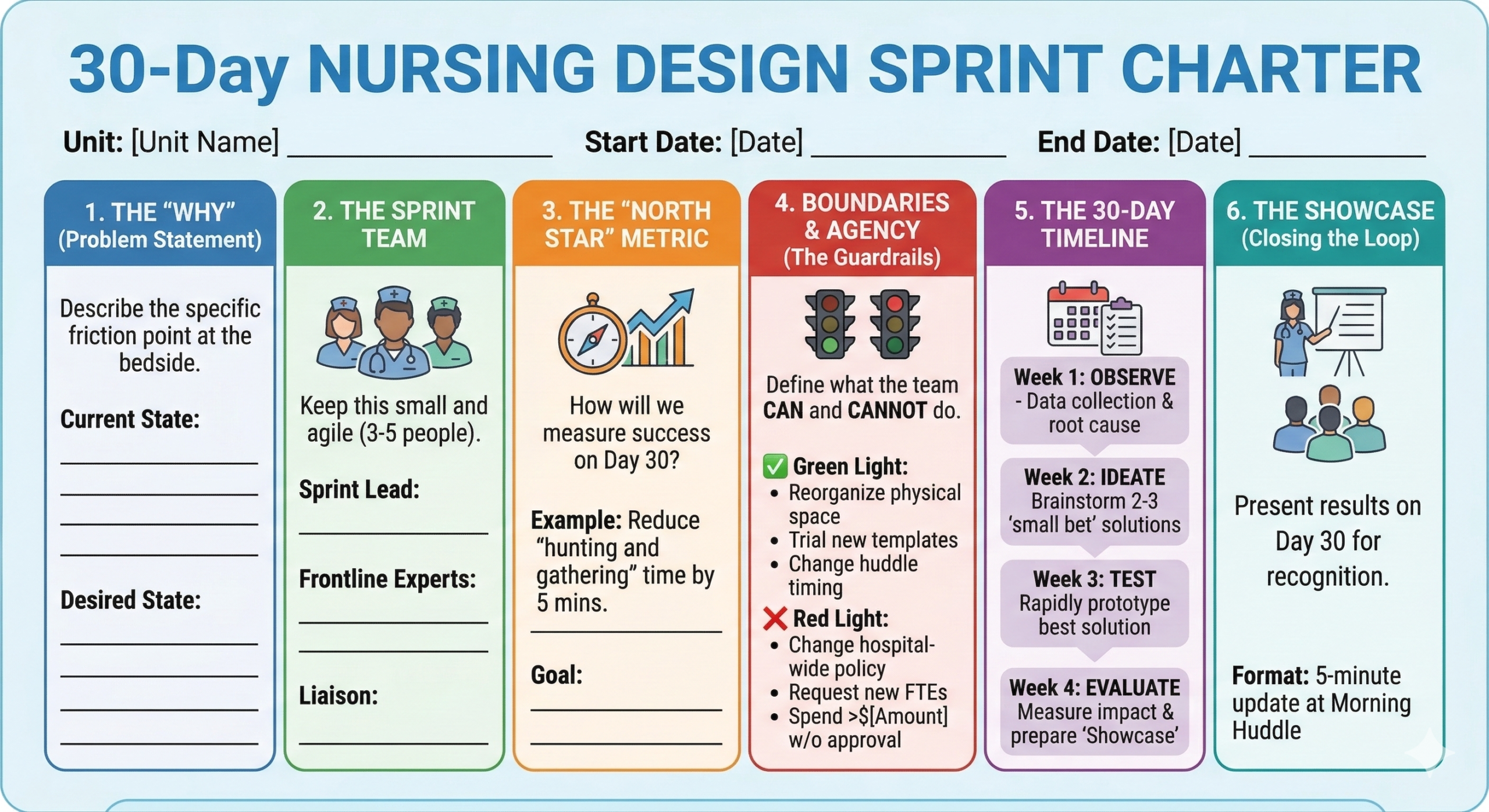
Move to Project-Based Work: Instead of a standing “Practice Council,” try “Design Sprints.” Give a group of young nurses a specific problem (e.g., “How do we fix the supply room workflow?”) and a 30-day window to solve it. Use micro-project charters to guide small teams of nurses in solving problems. Click Here for Sample 30 Day Design Sprint Charter
-
Leverage Technology: Why must everyone be physically present? Use asynchronous platforms (like Slack, Teams, Zoom, or even short video updates) to allow nurses to contribute on their own time and participate only in the parts of the meeting that interest them.
-
Focus on Competency: Frame governance as a leadership laboratory. When a nurse leads a task force, they aren’t just “doing a committee”; they are building project management, communication, public speaking, and negotiation skills that are essential for their career progression. Link whatever you ask a young nurse to do to their career goals. Ask every nurse what their superpower is and try to find ways to help them use it in governance activities.
-
Radical Transparency: Close the feedback loop quickly. If a suggestion is made, the “why” behind the acceptance or rejection must be communicated within days, not months.
Professional governance isn’t dead, but the old way of doing it is on life support. Our younger nurses want to engage—they just want to do it in a way that feels relevant to the modern world of work. It is vital that we shift the conversation from “serving on a council” to “solving a problem.” When recruiting Gen Z nurses for these more agile, project-based roles, the goal is to highlight their unique strengths—like their digital fluency and desire for immediate impact.
© emergingrnleader.com 2026
To effectively lead through these challenges and others, nurse leaders need new tools and strategies. Let me help you as I have helped hundreds of organizations over the past five years. Book a workshop or keynote for your team by contacting me at roseosherman@outlook.com
Brand New For 2026 and Already Receiving Rave Reviews – Staying Power Building a Culture of Retention in the New World of Work
Brand New for 2026 and Already Popular – The Inverted Pyramid: Leading Teams of Novice Nurses The Inverted Pyramid WS Information Sheet
Our Most Popular Right Now –The New World of Work Workshop
A Leader Favorite – Building Bridges Not Walls: Leading Multigenerational Work Teams – Click Here for More Information Building Bridges Not Walls
A Must-Read Book in 2026 – Click Here to Buy



 LinkedIn
 Instagram