By Rose O. Sherman, EdD, RN, NEA-BC, FAAN
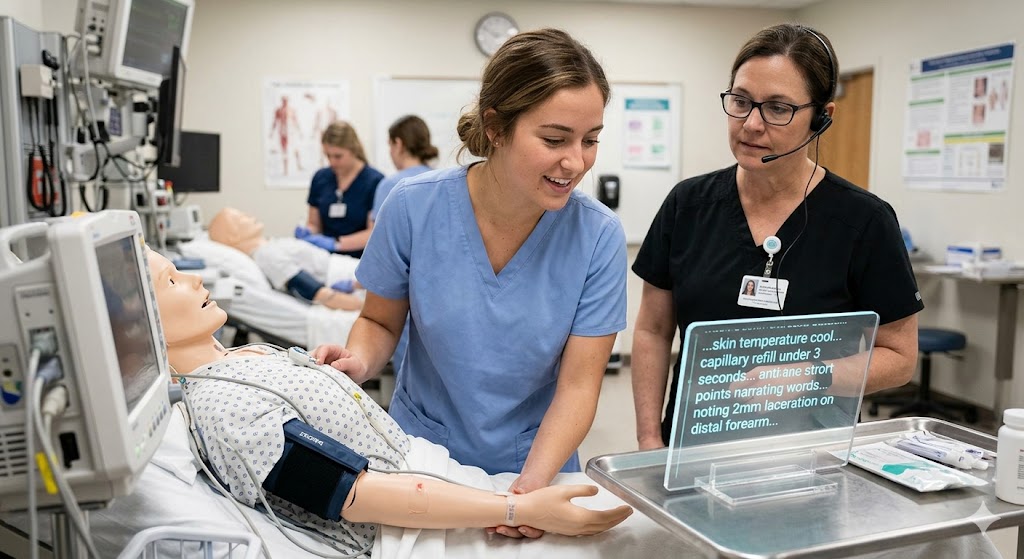
If you walk down a hospital unit today, you’ll likely see nurses staring into screens, clicking through exhaustive, fragmented electronic health record (EHR) flowsheets. But the healthcare landscape is shifting rapidly, and soon nurse charting will look very different from what it does today.
Ambient nursing AI is arriving—background technology that listens to natural nurse-patient bedside conversations and automatically drafts documentation, updates flowsheets, and flags care cues. Nurses then edit the notes in the record.
While this technology is expected to significantly reduce the time a nurse spends charting, it introduces a massive paradigm shift for our frontline staff: if the AI documents based on what we say out loud, nurses must learn to narrate clinical care in real time. For two decades, modern nursing education and hospital orientation have trained nurses to be exceptionally good at clicking checkboxes. We have incentivized “click-thinking.” The shift from click thinking to nursing out loud will be significant for nursing, especially for our new generation of nurses, who have become dependent on technology for communication.
The good news is that this shift will have positive outcomes beyond saving time with documentation. By teaching nurses how to articulate their clinical reasoning and actively weave a patient’s story aloud, we aren’t just practicing excellent patient-centered care—we are helping our nurses develop stronger critical thinking skills. But the shift will not be easy and will require a new set of nursing competencies.
Ambient AI Changes the Rules of Care Documentation
-
The Microphone is the New Keyboard: The AI cannot document what it doesn’t hear. If a nurse performs a brilliant, highly nuanced visual assessment of a patient’s surgical wound but does it in total silence, the ambient tool registers zero data.
-
The Loss of Intention: A drop-down menu doesn’t care why you selected a specific intervention. An AI, however, builds a much better, safer clinical picture when it captures the clinical rationale spoken aloud during care.
Strategies to Teach Narrative Nursing for an Ambient Future
Health systems who are piloting ambient document have learned (sometimes the hard way) that teaching narrative nursing is step 1 before the technology is implemented. They have realized that they must focus on transforming silent clinical tasks into interactive, verbalized stories.
- Teaching Clinical Narration
Educate nurses to treat every bedside assessment as a shared radio broadcast or podcast. Instead of checking a pulse or examining an incision silently, the nurse discusses their findings to the patient in real time. This educates the patient, lowers their anxiety, and feeds the ambient mic exactly what it needs.
The Silent Paradigm: A nurse checks a localized site, logs “Edema +1, erythema resolving” on a workstation on wheels, and leaves.
The Narrative Paradigm: “Mr. Davis, I’m looking at your lower right leg here. The swelling has gone down significantly since yesterday—barely a dimple when I press now—and that redness is fading back to your normal skin tone. The antibiotics are doing exactly what they’re supposed to do.”
2. You Can Start with Simulation
During high-fidelity simulation or roleplay exercises, introduce a strict rule: Students and orientees must vocalize their internal monologue. If they are calculating a drip rate adjustment or prioritizing a symptom check, they must say it out loud. This helps educators correct flawed clinical reasoning instantly.
3. Teach the Art of Story Telling
To teach narrative nursing you need to push back against standardized, checklist-style handoffs. Ask your learners to summarize their patient’s shift using a structured three-part story arc:
-
The Baseline Structure: Who the person is beyond their diagnosis.
-
The Disruption: The clinical event or complication that altered their trajectory.
-
The Navigation: How the nursing team’s specific interventions are steering them toward recovery.
4. Highlight how this will improve both nursing care and the patient experience.
Don’t be surprised if you get initially get quite a bit of pushback from nurses on the changes Ambient Listening will require of them. For many of the same reasons that some nurse resist bedside shift report (lack of confidence, increased accountability in one’s actions, lack of time), they will resist a shift to narrative nursing. It requires a communication skill set that many of our nurses don’t currently have. But the positives of implementation are likely to outweigh the negatives.
| For the Patient | For the Ambient AI |
| Feels deeply seen, heard, and actively included in their own care decisions. | Captures rich, context-aware audio data to precisely map to flowsheets. |
| Demystifies medical jargon through ongoing, transparent bedside explanations. | Minimizes data gaps, reducing the time the nurse spends editing notes later. |
| Builds foundational trust, significantly lowering anxiety and distress. | Creates a seamless digital handoff text block for successive shifts. |
We shouldn’t wait for ambient AI units to be installed in our facilities before we change how we teach documentation. Nurse leaders need to begin to talk with both staff and their academic partners now. By prioritizing narrative nursing today, we are preserving the deeply human, holistic heart of our profession while seamlessly preparing our clinicians to excel in the automated tomorrow.
© emergingrnleader.com 2026
To effectively lead through these challenges and others, nurse leaders need new tools and strategies. Let me help you as I have helped hundreds of organizations over the past five years. Please contact me at roseosherman@outlook.com to book a workshop or keynote for your team. Not seeing what you want on this list? Feel free to reach out, and I am happy to design a custom program to meet your needs.
Brand New For 2026 and Already Receiving Rave Reviews – Staying Power Building a Culture of Retention in the New World of Work
Brand New for 2026 and Already Popular – The Inverted Pyramid: Leading Teams of Novice Nurses The Inverted Pyramid WS Information Sheet
Our Most Popular Right Now –The New World of Work Workshop
A Leader Favorite – Building Bridges Not Walls: Leading Multigenerational Work Teams – Click Here for More Information Building Bridges Not Walls
A Must-Read Book in 2026 – Click Here to Buy



 LinkedIn
 Instagram