By Rose O. Sherman, EdD, RN, NEA-BC, FAAN
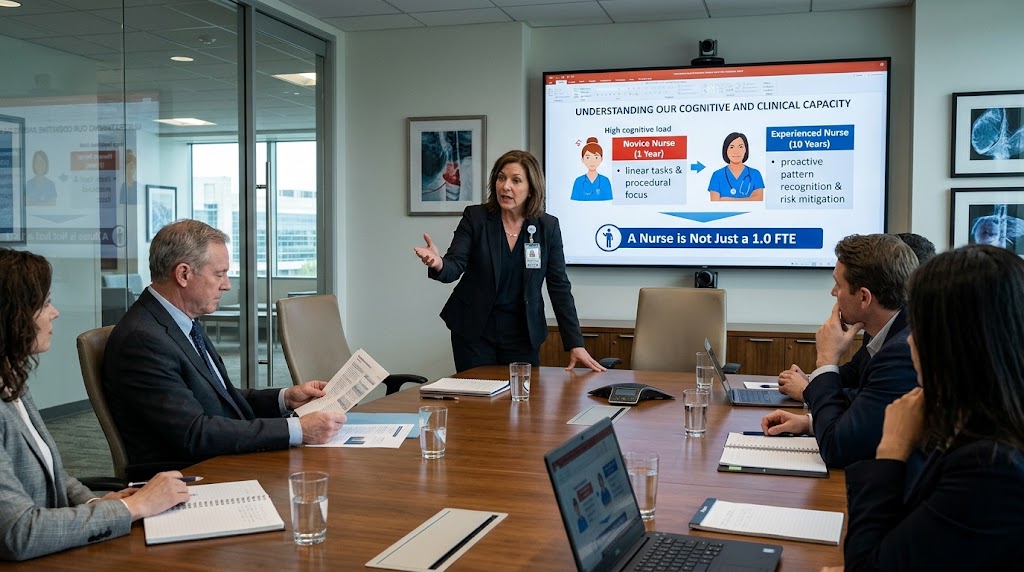
As more nurse leaders struggle with novice density (and its accompanying challenges) on their units, they increasingly face criticism from C-suite colleagues. Consider the story a CNO recently shared with me:
I just met with our CFO this week. He reviewed the productivity dashboard for 4-East, one of our medical-surgical units. He noted the unit was staffed at 98% of its budgeted FTE. On the positive side, staffing was stabilizing, and agency spend on this unit was down 40%. But his balanced scorecard showed a spike in overtime toward the end of shifts, a 0.4-day rose in length of stay, two patient falls, and two rapid response calls that progressed to unplanned ICU transfers. If the unit is fully staffed on paper, he asked, somewhat incredulously, why care isn’t improving. What is driving these challenges? Maybe you should consider putting the nurse manager on a performance improvement plan. In his words, every RN on that unit should be fully competent to work there. After all, he pointed out, we pay them a lot of money to care for patients. How can I better explain the role of experience in patient care outcomes? This unit now has 60% of RN staff with less than two years of experience.
That’s a great question, and so many CNOs are grappling with it. Consider the difference in care that two nurses on that unit might provide:
-
Nurse A (1 year of experience): Diligent, conscientious, and technically competent with routine orders. However, Nurse A operates under high cognitive load. She relies heavily on checklists, standard operating procedures, and linear task execution: vital signs, medication administration, dressing changes, charting. When a patient’s systolic blood pressure drifts from 130 to 105, and urine output slows to 25 mL/hr, she sees two numbers that still hover near acceptable parameters. She documents them dutifully.
-
Nurse B (10 years of experience): Operates with extensive pattern recognition and situational awareness. When Nurse B sees the exact same subtle drift in vitals, she doesn’t see two isolated numbers on a screen; she recognizes an emerging, early-stage septic picture. Within five minutes, she auscultates lungs, reviews the prior 24 hours of intake and output, notifies the hospitalist, and initiates a fluid bolus—preventing a code blue three hours later. Furthermore, while managing her own assignment, Nurse B intuitively tracks unit rhythm, decompresses the charge nurse, and mentors junior peers.
How Non-Clinical Colleagues View Nursing
Explaining that difference to non-clinical colleagues focused strictly on outcomes and budget is not easy. Non-clinical leaders can easily mistake nursing work for a series of scheduled tasks: passing medications, changing dressings, recording vitals, and completing documentation. If those tasks get checked off, people assume the shift is running smoothly. When an executive team views staffing strictly as headcount rather than cumulative clinical capacity and cognitive bandwidth, they miss why a unit staffed with novice clinicians can appear fully covered on a dashboard while operating on the precipice of clinical failure.
A Different Strategic Approach
One strategy is to tell the story differently, using analogies your business colleagues can understand. Non-clinician executives manage risk, capital allocation, and operational capacity. Explaining nursing experience through the lens of “caring” or “stress” rarely changes their perceptions of what is happening. Instead, use an analogy like this: “If our IT department had an opening for four software engineers to build the core infrastructure of our revenue cycle, would you hire four entry-level boot-camp graduates and expect the system to run without system crashes?”Everyone understands that junior coders can write lines of code, but senior architects anticipate failure modes, debug complex errors, and keep the system resilient. A hospital unit functions the exact same way.
She can explain that ideally, the 4E nurse manager would love to have 80% experienced or expert nurses, but that is not who is in our current applicant pool, and given workforce projections, we won’t get there for the foreseeable future. A nurse with ten years’ experience is not simply 10% faster at hanging an IV bag. The level of surveillance they are providing is markedly different. Experienced nurses detect subtle physiological deterioration early, directly curtailing costly unplanned ICU transfers. Seasoned clinicians know how to navigate interdisciplinary roadblocks, advocate for timely consults, and proactively coordinate discharge education days in advance, thereby reducing the LOS. A novice-heavy unit like 4E experiences discharge delays not from a lack of effort, but because discharge coordination requires high-level prioritization that takes years to master. An invisible tax on experienced nurses on novice-dense units increases burnout and exhaustion, compounding turnover.
My Recommendations Moving Forward
I recommended the CNO have the nurse manager on 4E conduct both a novice-density review (see blog on Assessing Novice Nurse Density on Units and Shifts) (opens in new tab) for the unit and a cumulative acute-care experience review for each shift. Once the CNO has the data, she can respond by saying: “Our unit is currently at 100% budgeted FTEs, but our cumulative clinical experience index has dropped by 45% over the last two years. While our shifts are legally covered, our cognitive safety buffer is thin.” She can also tie experience to the hospital’s margin: “The cost of one preventable ICU transfer due to delayed sepsis identification equals roughly $15,000 to $20,000. Retaining and balancing experienced nurses on night shift isn’t an overhead expense; it is our primary loss-prevention strategy.” If she is looking for higher ratios or more support on these units, she could say: “A 1:4 nurse-to-patient ratio assumes a standardized capacity to absorb acute volatility. If a nurse with nine months of experience takes four complex post-ops, that assignment carries a fundamentally different operational risk profile than if an experienced nurse takes it.”
If we want non-clinician executives to see beyond raw FTE counts, nurse leaders must modify how we currently talk about staffing and start educating our executive peers in the language of operational risk, capacity, and asset preservation. Introduce terms like cognitive bandwidth, surveillance capacity, and experience dilution. Treat your seasoned clinicians as irreplaceable operational stabilizers whose loss directly threatens throughput, safety metrics, and financial margins. Recently, I led a session on the Inverted Pyramid of Nursing Experience at a hospital where the CNO asked the CEO and CFO to sit in on the program. During a break, the CEO told me the content was invaluable and applicable beyond nursing.
Your C-suite colleagues are not indifferent to patient care; they simply operate with different mental models and dashboards. We have a responsibility to connect bedside experience to the organization’s strategic priorities. Bridging the divide between the boardroom and the bedside starts with how we frame the problem. When we teach executives that an FTE is not a plug-and-play cog, we protect our patients, decompress our novice nurses, and retain the veteran clinicians who hold our health systems together.
© emergingrnleader.com 2026
To lead through these challenges and others effectively, nurse leaders need new tools and strategies. Let me help; I have helped hundreds of organizations over the past six years. Please contact me at roseosherman@outlook.com to book a workshop or keynote for your team. Not seeing what you want on this list? Feel free to reach out, and I am happy to design a custom program to meet your needs.
Staying Power: Building a Culture of Retention in the New World of Work
Brand New in 2026 with Rave Reviews – The Inverted Pyramid: Leading Teams of Novice Nurses The Inverted Pyramid WS Information Sheet
Our Most Popular Right Now –The New World of Work Workshop
A Leader Favorite – Building Bridges Not Walls: Leading Multigenerational Work Teams – Click Here for More Information Building Bridges Not Walls
A Must-Read Book in 2026 – Click Here to Buy



 LinkedIn
 Instagram
