By Rose O. Sherman, EdD, RN, NEA-BC, FAAN
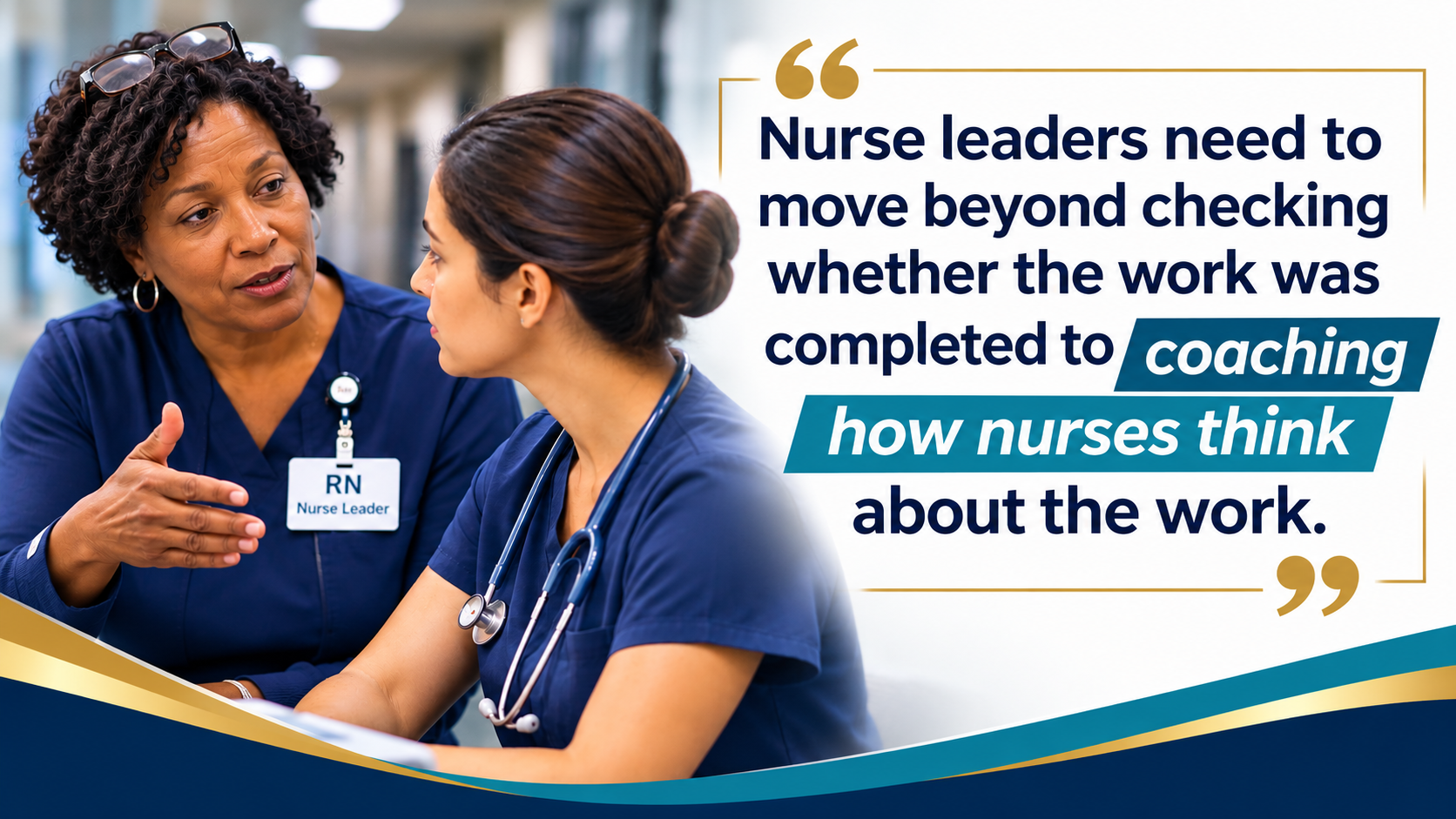
One of the greatest challenges facing nurse leaders today is helping a growing population of novice nurses develop the clinical judgment needed to care for increasingly complex patients. We invest considerable time teaching new nurses how to complete assessments, administer medications, document care, and follow clinical protocols. These are essential nursing responsibilities, but they are not the same as clinical judgment. Knowing what to do is not the same as knowing what to think about what you are seeing.
Consider a common situation on a medical-surgical unit. A nurse with eight months of experience is caring for a postoperative patient. During the morning assessment, the nurse documents a heart rate of 112, blood pressure of 98/60, and a slight decrease in urine output. The nurse completes the assessment, administers scheduled medications, and continues with the morning routine. Each individual task is completed as expected. What the nurse may not recognize is that these findings, when considered together, could indicate early clinical deterioration.
An experienced nurse might immediately begin asking different questions. Why is the heart rate increasing? Is the blood pressure trending downward? Could the patient be bleeding or developing an infection? What additional assessment is needed? Who should be notified, and how urgently? The difference is not necessarily knowledge or motivation. It is the ability to recognize patterns, interpret their significance, anticipate potential complications, and act before a patient’s condition worsens. This is the difference between task completion and clinical judgment. Unfortunately, the realities of busy acute care environments can unintentionally reinforce task-focused practice.
What We Need to Do Differently
New nurses quickly learn that they will be evaluated on whether medications are administered on time, assessments are documented, care plans are updated, and required tasks are completed. Electronic health records reinforce these expectations through checklists, reminders, and documentation requirements.
Historically, much of clinical judgment developed through informal interactions with experienced nurses. A seasoned nurse might notice a subtle change in a patient’s condition and ask a newer colleague, “What do you think is happening here?” A charge nurse might explain why a particular finding was concerning. A preceptor might help a novice connect several seemingly unrelated assessment findings. These interactions were often brief and unplanned, but they were powerful learning opportunities.
In today’s increasingly novice-dense nursing environments, we can no longer assume that this informal learning will occur consistently. Experienced nurses may be supporting multiple new graduates while managing their own complex patient assignments. Charge nurses may have limited time for clinical coaching. In some settings, the most experienced nurse on a shift may have only a few years of practice. As the experience composition of nursing teams changes, clinical judgment development must become more intentional rather than something we assume will happen naturally over time. This is where nurse leaders have an important opportunity.
Rethinking the Way You Round
Most nurse leaders conduct some form of daily rounding. They check on staffing, patient care concerns, equipment needs, quality indicators, and operational issues. These activities are important, but I believe leader rounding can serve another purpose: helping nurses strengthen their clinical judgment. Rather than asking only whether the work is getting done, leaders can use brief coaching conversations to explore how nurses are thinking about their patients. I call this approach Clinical Judgment or Cognitive Rounding. A two- or three-minute conversation with a nurse about a patient can create an opportunity to practice clinical reasoning.
The key is to ask questions that will move the nurse beyond describing tasks toward interpreting clinical information, anticipating risk, and identifying appropriate actions. Five good questions (based on the Christine Tanner Model) to ask to develop clinical judgment include the following:
1. NOTICE: What are you seeing that concerns you about this patient?
This question encourages nurses to move beyond collecting assessment findings to recognizing meaningful changes or abnormalities.
2. INTERPRET: What do you think those findings mean?
This question helps nurses connect clinical information, consider possible explanations, and recognize patterns.
3. ANTICIPATE: What could happen next if the patient’s condition changes?
Anticipation is a critical element of clinical judgment. Nurses need to think ahead rather than wait for a patient to deteriorate before responding.
4. RESPOND: What would you do, and when would you escalate?
This question connects clinical reasoning to action. It also helps leaders assess whether nurses understand when additional assistance or escalation is needed.
5. REFLECT: What have you learned that you can apply to your next patient?
Reflection helps nurses transfer learning from one clinical situation to another, an important step in developing expertise.
Clinical judgment development should not be limited to orientation, simulation, or annual competency assessments. If we want to move our novices from task-focused to deeper clinical thinking, development needs to become part of the daily work of nursing. Leaders do not need to ask all five questions during every interaction. Even one well-chosen question can encourage a nurse to think more deeply about a patient’s condition. Over time, these conversations can help create a unit culture where nurses are expected not only to report what they did but also to explain what they noticed, what they think it means, and what they anticipate might happen next.
© emergingrnleader.com 2026
To lead through these challenges and others effectively, nurse leaders need new tools and strategies. Let me help; I have supported hundreds of organizations over the past six years. Please contact me at roseosherman@outlook.com to book a workshop or keynote for your team. Not seeing what you want on this list? Feel free to reach out, and I am happy to design a custom program to meet your needs.
Staying Power: Building a Culture of Retention in the New World of Work
Brand New in 2026 with Rave Reviews – The Inverted Pyramid: Leading Teams of Novice Nurses The Inverted Pyramid WS Information Sheet
Our Most Popular Right Now –The New World of Work Workshop
A Leader Favorite – Building Bridges Not Walls: Leading Multigenerational Work Teams – Click Here for More Information Building Bridges Not Walls
A Must-Read Book in 2026 – Click Here to Buy



 LinkedIn
 Instagram
