By Rose O. Sherman, EdD, RN, NEA-BC
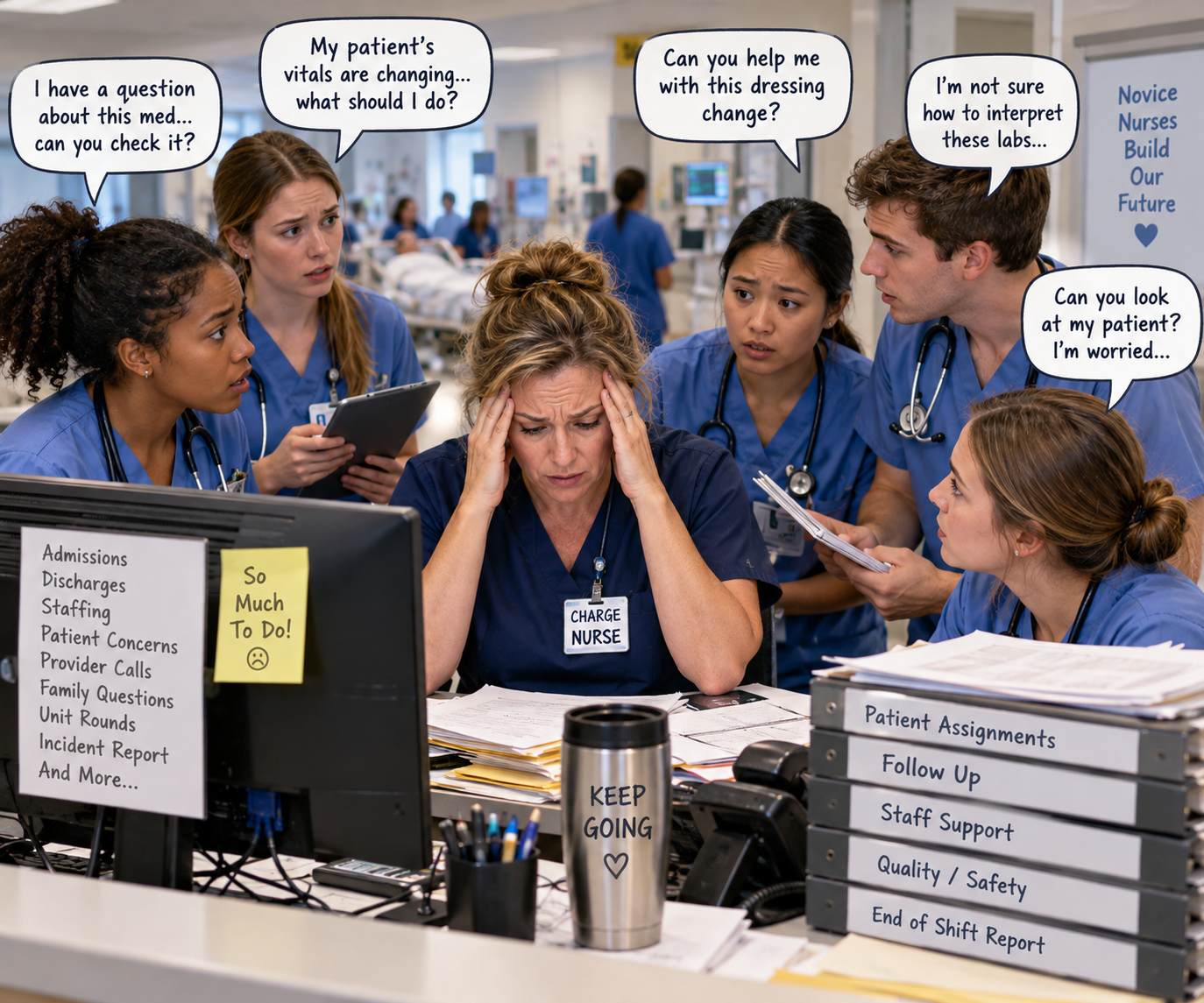
In most leader development workshops I do today, experienced nurse leaders now discuss how challenging it is to recruit nurses into charge nurse roles. Fewer experienced nurses want to take charge, and charge nurse burnout is now a major concern. A nurse manager recently shared this story:
So our hospital recently announced a charge nurse development course. No one, and I mean no one, on my unit volunteered to take it. I started lobbying my best candidates individually, but even that was challenging. Several told me that they were prioritizing their well-being and saw risks in taking the role. Today, they observed, everyone argues about their assignment; the demands are overwhelming, and you often have to take a patient assignment. It is a no-win role. Paying extra each hour helped at first, but it doesn’t anymore. I really can’t blame them.
What has changed?
If you walk onto almost any acute care unit today, the shift in the team’s demographics is striking. Ten years ago, a charge nurse oversaw a team where the median bedside tenure might have been five to eight years. Today, it is not uncommon for a charge nurse with barely two or three years of experience to lead a shift where 70% or more of the staff are in their first eighteen months of practice. In the Inverted Pyramid of Nursing Experience, most hands-on patient care rests on clinicians who are still developing pattern recognition, clinical prioritization, and situational awareness.
At the center of this delicate balance, especially on nights and weekends, are charge nurses. Often compared to air traffic controllers, these frontline leaders assign patient care, manage admissions, discharges, and transfers, facilitate unit communication with other departments, and handle patient and family complaints when a nurse manager is absent. But if we continue to treat the charge nurse role as merely administrative rather than deeply developmental and protective, the entire structure of the Inverted Pyramid risks collapse.
Charge nurses once relied on the informal, distributed vigilance of seasoned bedside peers. If a patient began to subtly decompensate, an experienced nurse down the hall usually caught it. But when the majority of your team is now novice nurses, your role changes. Novice nurses “don’t know what they don’t know.” The charge nurse must now act as the primary safety net, anticipating complications and scanning the entire floor for early warning signs rather than assuming staff will self-identify and escalate distress.
The nurse manager above made a good point about the challenges of assigning patient care in this environment. Matching patient acuity to nurse competency has become exponentially harder. When most of the unit is at the novice or advanced beginner stage, traditional patient-to-nurse ratios lose their meaning. The charge nurse must balance cognitive overload, skill mix, and emotional reserve across a team that has little buffer for unexpected emergencies.
Reimagining the role
Charge nurses have shifted from administrative coordinators to real-time clinical coaches. They are doing all of the following:
-
Helping newer nurses prioritize when everything feels urgent.
-
Validating assessments before calling rapid responses or attending physicians.
-
Debriefing difficult moments at the bedside to accelerate clinical judgment.
The tension and reason so many nurses now back off from taking charge is that you cannot provide just-in-time coaching if the charge nurse is also carrying a full or partial patient assignment. Charge nurses carry immense psychological weight. They are acutely aware of the fragility of the safety net under their watch. They worry about professional liability. Without deliberate leadership backing, formal charge preparation, and shifts without patient care assignments, charge nurses quickly burn out from the constant vigilance required to protect both patients and colleagues.
A Call to Action for Nurse Leaders:
Leaders can take three action steps to support their charge nurses.
- Redesign the charge nurse role so patient care assignments are not part of the role. A charge nurse with a patient load in an Inverted Pyramid unit cannot maintain the situational awareness and level of patient surveillance necessary.
- Invest in and expand charge nurse training so that nurses feel confident when they take the role. We cannot simply assign the nurse with the most longevity by default; they need explicit coaching in situational leadership, conflict management, and psychological safety. These roles have become more complex, and nurses need the skills to be effective. This development should not be a one-and-done activity but should be done quarterly to address new challenges as they surface.
- Establish Charge Support Structures and Provide Mentorship so they feel supported without feeling isolated. Expand the administrative supervisor’s role on nights and weekends to include real-time coaching for charge nurses. Nurse managers should meet monthly with every charge nurse to evaluate their activities and challenges.
In an environment shaped by the Inverted Pyramid, expecting a charge nurse to act as shift coordinator, clinical mentor, crisis responder, and patient caregiver all at once is a direct path to cognitive overload, burnout, and turnover. If we want resilient units, we must intentionally design the charge role for today’s workforce. That means protecting unassigned charge shifts, prioritizing just-in-time clinical coaching over administrative friction, and recognizing that safeguarding our charge nurses is the most effective way to safeguard our bedside staff and our patients.
© emergingrnleader.com 2026
To effectively lead through these challenges and others, nurse leaders need new tools and strategies. Let me help you as I have helped hundreds of organizations over the past five years. Please contact me at roseosherman@outlook.com to book a workshop or keynote for your team. Not seeing what you want on this list? Feel free to reach out, and I am happy to design a custom program to meet your needs.
Brand New For 2026 and Already Receiving Rave Reviews – Staying Power: Building a Culture of Retention in the New World of Work
Brand New for 2026 and Already Popular – The Inverted Pyramid: Leading Teams of Novice Nurses The Inverted Pyramid WS Information Sheet
Our Most Popular Right Now –The New World of Work Workshop
A Leader Favorite – Building Bridges Not Walls: Leading Multigenerational Work Teams – Click Here for More Information Building Bridges Not Walls
A Must-Read Book in 2026 – Click Here to Buy



 LinkedIn
 Instagram