By Rose O. Sherman, EdD, RN, NEA-BC, FAAN
During Inverted Pyramid workshops, I am often asked: How did we get to a place where experienced acute care nurses are in such short supply? This question reminds me of a dialogue in one of Ernest Hemingway’s novels, The Sun Also Rises. One of the book’s characters asked the other, “How did you go bankrupt?“ The character answers, “A little at a time and then suddenly.”
I first remember fielding questions from nurse leaders who were seeing this phenomenon about four years ago. The Nursing Advisory Board called it the Experience-Complexity Gap in 2023. All of a sudden and seemingly overnight, it has mushroomed into a full-blown crisis for some health systems. Historically, acute care nursing staff included a broad base of seasoned, tenured nurses who supported and mentored a much smaller cohort of novice nurses. Today, novice nurses (zero to two years of practice) now make up the largest demographic in many acute care units, while the cohort of experienced nurses with more than 5 years of nursing experience has dramatically shrunk.
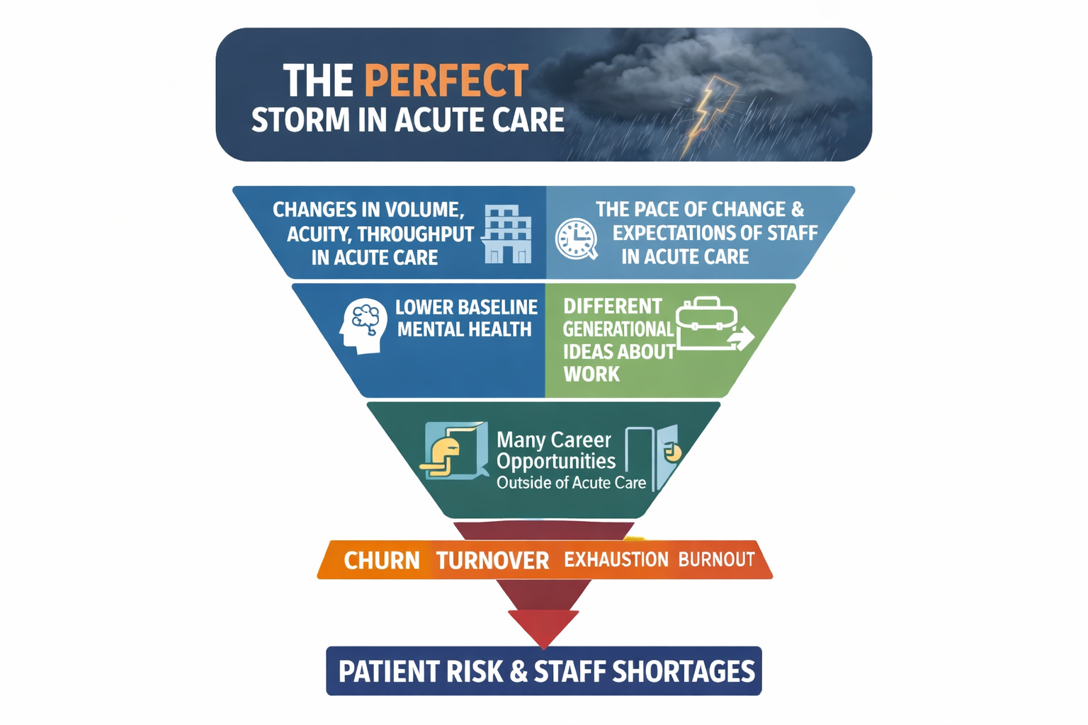
This shift is not a random hiring anomaly that will soon go away. It is rather a culmination of a perfect storm of structural, demographic, economic, and cultural forces colliding at once. There are 5 key forces driving this change:
A Silver Tsunami in the US Population Leading to Higher Patient Volumes and Acuity
By 2034, those over 65 will outnumber those over 18 in the US population. This demographic shift, seen both in the US and globally, is overwhelming healthcare delivery systems. The patients being admitted today are significantly older, more medically complex, and most are living with multiple chronic comorbidities. Lower-acuity patients are now managed in ambulatory settings. Hospital care has become more complex at a time when nursing staff have less experience.
The Accelerated Retirements of Baby Boomer Nurses
The retirement of Baby Boomer nurses was already looming, but many accelerated their retirement plans as an outcome of their experiences with Covid-19. When a 30-year nurse leaves the bedside, his or her employer not only loses an employee but also decades of clinical experience and institutional memory that cannot be replaced by a newly licensed nurse.
Declining Healthcare Reimbursement and Margin Compression
Hospitals today face tightening margins with Medicare and Medicaid cuts and rising operational costs. Financial pressure is forcing operational leaness and reducing non-productive hours. This means that preceptors and charge nurses are taking patient assignments while coaching novices. Novice nurses are being pushed into full assignments and higher-acuity patients earlier in their careers.
Shifting Generational Views on Work and Career
The newest generation of nurses (Generation Z) is approaching their careers with different expectations than previous generations. They are prioritizing work-life balance, mental well-being, and scheduling flexibility over institutional loyalty. Younger nurses today are less willing to endure what they assess as unsustainable working conditions in acute care as a “rite of passage.” This shift is leading to higher first- and second-year turnover and faster movement into advanced practice roles and positions outside hospital settings.
Changing Patient Expectations
Healthcare is also becoming more demanding as patient and family expectations shift. They expect immediate digital communication and hospitality-level customer service. Novice nurses must balance complex clinical tasks while also managing heightened consumer demands and escalating workplace incivility.
Where do We Go From Here?
The challenge of a novice-dense workforce is unlikely to change anytime soon. What is not helpful is casting blame, such as saying health systems are responsible for deteriorating working conditions or that the novices themselves lack resiliency. Nor is it helpful to suggest that higher pay in acute care, accompanied by mandated staffing ratios, will change the dynamic. The challenges are much more nuanced.
From my vantage point after interviewing hundreds of frontline nurse leaders over the past 12 months, it is clear that conditions in healthcare have radically shifted, as has the workforce. If the inverted pyramid of experience is our new reality rather than a temporary crisis, our operating models must evolve to support the shift. We cannot solve modern workforce dynamics with a 1990s delivery structure. Here are three areas where we must focus our energy:
- Redesign Care Delivery Models
To better support novices, we must move away from the traditional primary care model in which the new graduate carries a full, complex assignment. We have to leverage technology such as virtual nursing to serve as a bedside safety valve. Use experienced virtual nurses to conduct admissions and discharges, do dual sign-offs, and provide routine surveillance. This offloads administrative burden and places an experienced set of clinical eyes in the room when a patient begins to deteriorate.
- Shift from Task-Oriented Training to Clinical Reasoning and Sensemaking
Novice nurses struggle because they have not yet developed the intuitive pattern recognition that comes with years of bedside experience. Onboarding needs to shift from procedural checklists to scenario-based cognitive rounding, situational sensemaking, and early deterioration recognition. We need to do a better job of teaching novices how to synthesize clinical data and prioritize rapidly changing needs, helping them to build their decision-making muscle in a psychologically safe environment.
- Protect and Equip Frontline Nurse Leaders
Nurse managers, charge nurses, and unit-based educators are the structural bridge holding the inverted pyramid upright, but they are carrying an unprecedented cognitive load. If frontline leaders spend all their time managing schedules, attending meetings, and reducing operational friction, they cannot mentor or provide the clinical surveillance units need today. Health systems must invest in leadership development that focuses on coaching novices, fostering psychological safety, and building team resilience without burning out the leaders.
The Bottom Line
The experience-complexity gap is not a problem to be “waited out.” It is a permanent structural shift in the acute care nursing workforce that is unlikely to change. Organizations that thrive will stop longing for the triangle of the past and start engineering modern environments that build scaffolds for novices, making the inverted pyramid stable, safe, and sustainable for both patients and nurses.
© emergingrnleader.com 2026
To effectively lead through these challenges and others, nurse leaders need new tools and strategies. Let me help you as I have helped hundreds of organizations over the past five years. Please contact me at roseosherman@outlook.com to book a workshop or keynote for your team. Not seeing what you want on this list? Feel free to reach out, and I am happy to design a custom program to meet your needs.
Brand New For 2026 and Already Receiving Rave Reviews – Staying Power: Building a Culture of Retention in the New World of Work
Brand New for 2026 and Already Popular – The Inverted Pyramid: Leading Teams of Novice Nurses The Inverted Pyramid WS Information Sheet
Our Most Popular Right Now –The New World of Work Workshop
A Leader Favorite – Building Bridges Not Walls: Leading Multigenerational Work Teams – Click Here for More Information Building Bridges Not Walls
A Must-Read Book in 2026 – Click Here to Buy



 LinkedIn
 Instagram