By Rose O. Sherman, EdD, RN, NEA-BC, FAAN
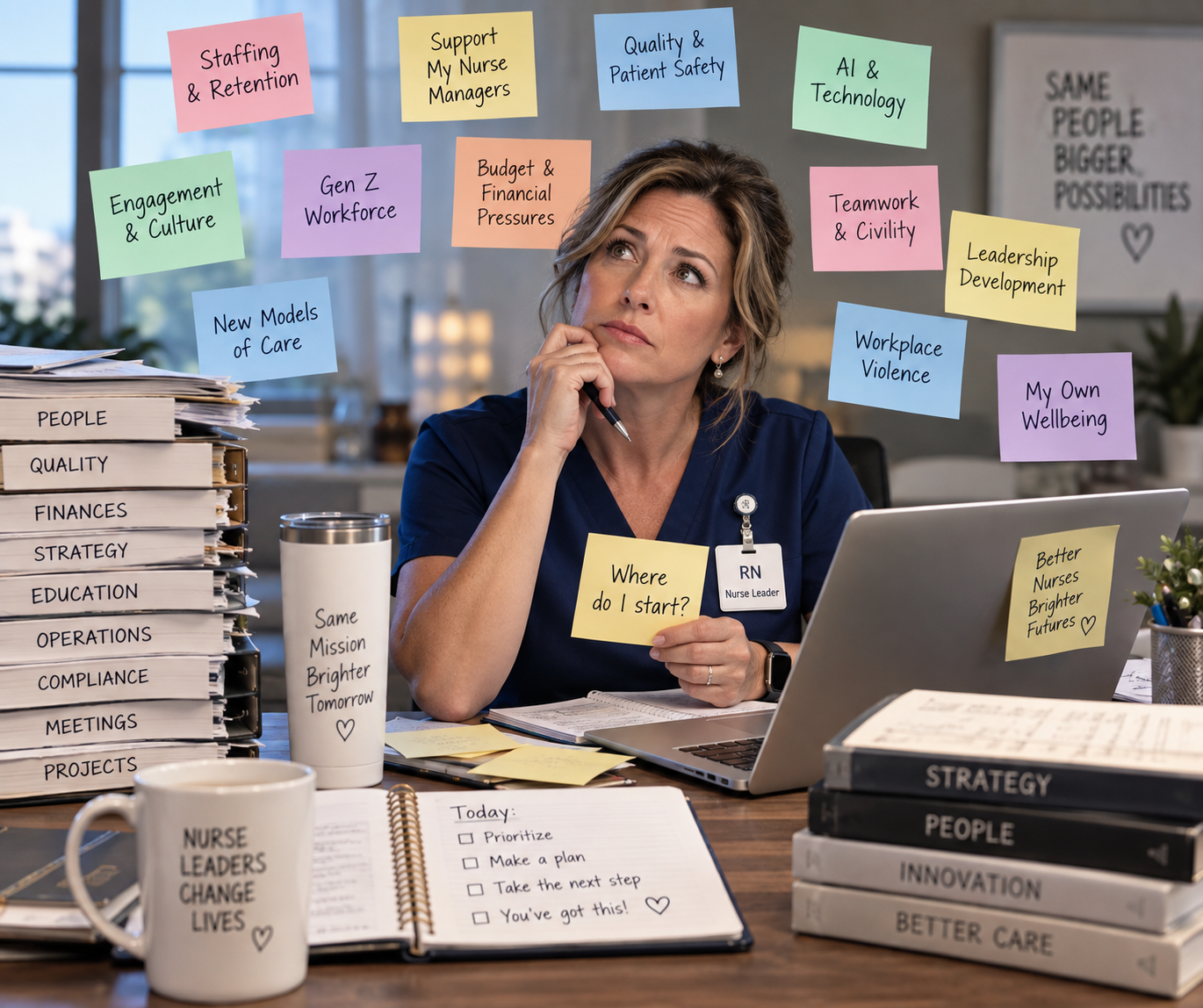
If you ask a group of nurse leaders what keeps them awake at night, staffing will usually top the list. But in 2026, the leadership agenda has become far more complicated than filling open nursing positions. Today’s nurse leaders are managing a workforce that looks very different from the one they led just five years ago. Teams are clinically younger. Generation Z is changing workplace expectations. Experienced nurses are retiring or leaving traditional acute care roles. Artificial intelligence is entering clinical practice at remarkable speed. Patient complexity continues to rise. Workplace violence and incivility remain troubling concerns. And nurse managers themselves are struggling under increasingly demanding spans of accountability.
At the same time, health systems are asking nursing leaders to improve quality, safety, patient experience, retention, and productivity—often with fewer resources. When I talk with nurse leaders today, I hear less discussion about getting “back to normal.” There is growing recognition that normal has changed. I think the more important question has become: What should nurse leaders be paying attention to now?
Here are ten priorities that I believe are shaping the nursing agenda for most leaders today:
1. Retaining Experienced Nursing Staff
Most but not all health systems can successfully recruit new graduates. But retention of nurses beyond that 2nd year in the hospital setting is a whole different challenge. Nurse leaders are fighting a revolving door. That is why retention, engagement, and creating reasons to stay are gaining ground.
2. Successfully Leading Teams of Novice Nurses
Many leaders are facing teams with less experience, which changes the amount of coaching, surveillance, precepting, and leader presence required. The Inverted Pyramid has now become widespread. The leadership question has become: “What has to change when novice nurses are no longer surrounded by experienced nurses?”
3. How Do We Meet the Needs of a Changing Workforce?
Gen Z is no longer the “future workforce.” They are increasingly the workforce nurse leaders are managing every day. Nurse leaders now struggle to meet expectations around flexibility, feedback, career progression, boundaries, technology, communication, and willingness to leave positions that don’t meet those expectations. The question now is: what is this generation telling us about how nursing work needs to change?
4. Redesigning Care Delivery Models
Leaders are asking how RNs, LPNs/LVNs, nursing assistants, virtual nurses, APPs, technology, and centralized resources should work together. AHA identifies redesigning staffing models and team-based care as a major 2026 workforce shift. The issue has shifted from how many nurses we need to how we can organize care with the talent we have.
5. Implementing AI without Losing the Human Side of Care
AI has quickly moved from an interesting innovation to a leadership issue. Nurse leaders are thinking about documentation, ambient listening, staffing and scheduling, clinical decision support, education, predictive analytics, workflow, and administrative burden. The question has become: what should we automate, and what shouldn’t we automate? Nurse leaders are also challenged with how to prepare nurses to use AI safely. And how do we make sure technology gives nurses more time for human connection, not less?
6. Rebuilding Teamwork, Workplace Civility and Psychological Safety
Turnover, inexperienced teams, individualism, incivility, and weakened relationships have changed unit cultures. Workplace violence is also a significant leadership concern; AHA’s 2026 environmental scan reports that 42% of nurse leaders say they have witnessed violence at work. Nurse leaders now ask how we can build an environment where nurses feel safe speaking up, asking questions, admitting mistakes, and challenging decisions.
7. Protecting the Nurse Manager Role
Nurse manager burnout and exhaustion continue to grow. Accountability and span of control are being actively debated as the leadership intensity in these roles increases. A manager overseeing 70 experienced nurses is not carrying the same leadership load as a manager overseeing 70 nurses when half the team is clinically novice. Span of control alone may be an inadequate metric.
8. Getting Back to the Basics on Quality and Clinical Safety
AONL President Ena Williams recently emphasized that rising patient complexity, workforce pressures, and rapid innovation make nurse leadership’s role in quality especially consequential. With an inexperienced workforce, leaders cannot assume that safety practices will simply be transmitted organically from experienced nurses to novices. They increasingly have to engineer the conditions for safe practice.
9. Building the Next Generation of Nurse Leaders
Succession planning is becoming an urgent issue for many health systems. Nurse leaders are finding it harder to get nurses to want management positions because staff see the workload their managers carry. The question isn’t simply “Who will be our next nurse manager?”It is“Have we designed a nurse manager job that talented nurses actually want?”
10. Doing All of the Above with Significant Financial Constraints
The tension is palpable as I talk with nurse leaders across the country. Nurse leaders are expected to improve retention, patient experience, quality, safety, and engagement while controlling labor costs and increasing productivity.
I think an 11th issue lies beneath all ten of the above, and that is leadership capacity. Nurse leaders know many of the things they should be doing, such as coaching, rounding, developing staff, building psychological safety, and improving retention—but the real question is whether they have the time, span of control, organizational support, and cognitive bandwidth to do them.
© emergingrnleader.com 2026
To effectively lead through these challenges and others, nurse leaders need new tools and strategies. Let me help you, as I have helped hundreds of organizations over the past five years. Please contact me at roseosherman@outlook.com to book a workshop or keynote for your team. Not seeing what you want on this list? Feel free to reach out, and I am happy to design a custom program to meet your needs.
Brand New For 2026 and Already Receiving Rave Reviews – Staying Power: Building a Culture of Retention in the New World of Work
Brand New for 2026 and Already Popular – The Inverted Pyramid: Leading Teams of Novice Nurses The Inverted Pyramid WS Information Sheet
Our Most Popular Right Now –The New World of Work Workshop
A Leader Favorite – Building Bridges Not Walls: Leading Multigenerational Work Teams – Click Here for More Information Building Bridges Not Walls
A Must-Read Book in 2026 – Click Here to Buy



 LinkedIn
 Instagram