By Rose O. Sherman, EdD, RN, NEA-BC, FAAN
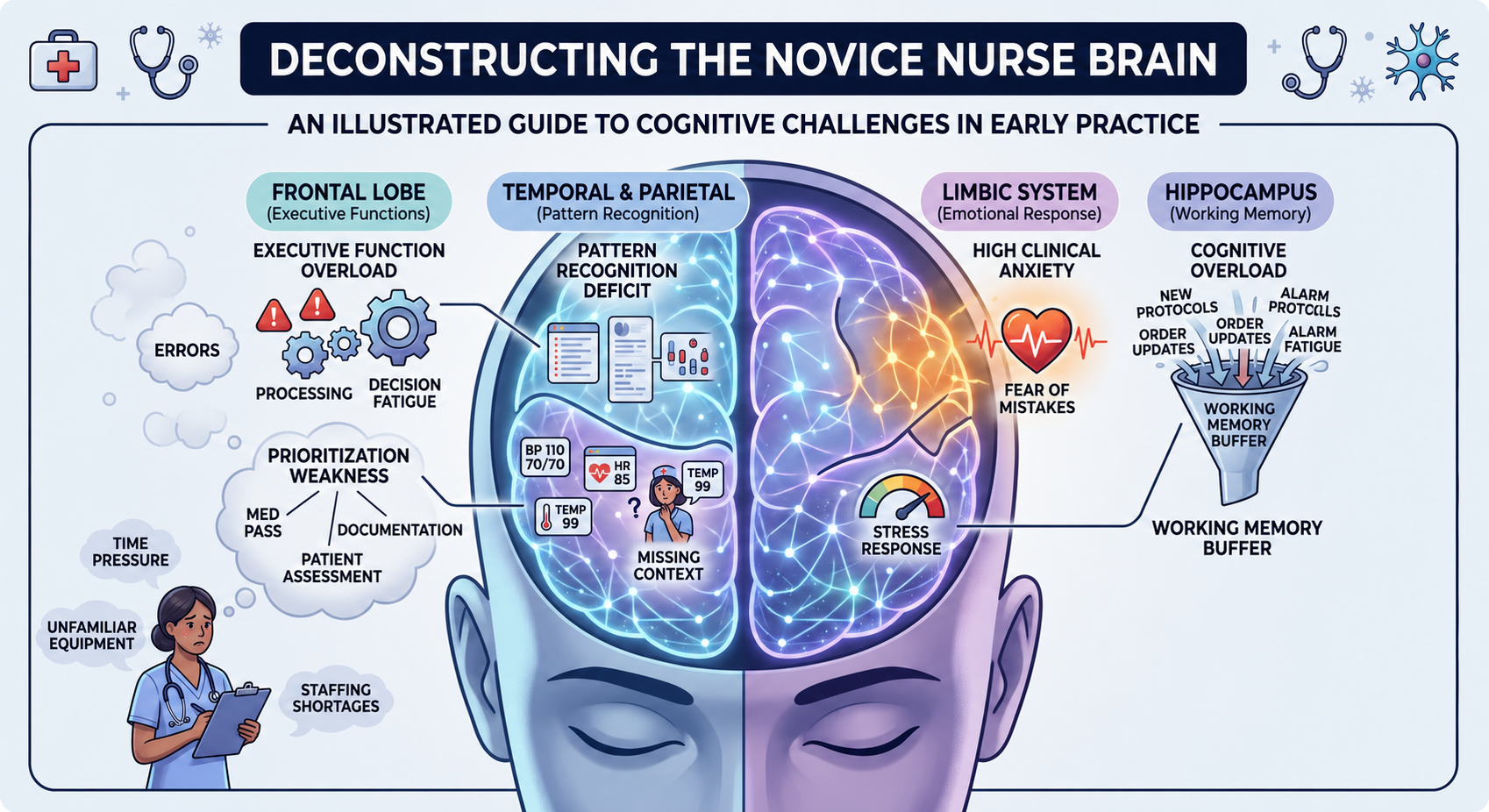
For nurse leaders and preceptors, watching newly licensed nurses struggle can feel baffling. You see a patient in bed 4 showing subtle signs of early sepsis, and your brain instantly triggers an action plan. Meanwhile, your novice nurse is hyper-focused on completing a routine medication pass on time, completely missing the trend in decompensating vital signs. What looks like a lack of focus or slow critical thinking isn’t a motivation problem—it’s a neurological and cognitive processing reality. With many units now dominated by novice staff, nurse leaders are grappling with how to best accelerate their learning to improve patient safety.
Understanding how the novice nurse brain processes information allows leaders to build targeted scaffolding that speeds up clinical competency development while reducing turnover. Dr. Patricia Benner’s Novice to Expert framework provides guidance on how to think about this. New nurses rely entirely on step-by-step rules because they lack contextual clinical experience.
Below are five cognitive hurdles new nurses face every shift and strategies leaders can use to mitigate them:
- Cognitive Overload – For most of us, our working memory can only hold 4 to 7 items at a time. An expert nurse bundles tasks (e.g., assessing lung sounds while checking IV lines and asking about pain). A novice nurse processes every single item as a standalone, high-energy mental task. This leads them to appear disorganized, document slowly, feel constantly “behind,” and miss obvious physical cues. To help with cognitive overload, nurse leaders and preceptors should help reduce unnecessary mental bandwidth by using standardized bedside shift report templates, pre-printed task checklists, and unit-specific “cheat sheets.” Reducing choices about what to do next helps cognitive overload.
- Pattern Recognition Deficits – Expert nurses rely on illness scripts—mental models built over years of seeing hundreds of patients. Novices have textbook knowledge, but they cannot yet connect isolated symptoms (a slight drop in blood pressure, mild confusion, low urine output) into a unified picture of clinical decline. To help build pattern recognition, leaders and preceptors need to shift their questions. Instead of asking “What are their vitals?”, ask “Which vital sign concerns you most right now, and why?” Practice explicit “thinking aloud” during complex patient cases. Ask “What is your biggest concern about this patient right now, and what evidence is driving that?”
- Decision Fatigue – An experienced nurse makes hundreds of clinical choices on autopilot. A novice nurse must consciously debate every micro-decision: Should I flush the line before or after? Do I call the doctor now or wait 10 minutes? Which patient do I see first? By hour 6 of a 12-hour shift, their executive functioning drops sharply. This is exhausting to the brain and leads to paralysis by analysis, frequent interruptions to ask basic questions, or simple mistakes late in the shift. To combat this, leaders need to establish explicit decision algorithms and red flag alerts. Provide clear “If/Then” guidelines for common unit situations (e.g., If SBP drops below 90, do X, then notify Y) to protect executive function for true emergencies.
- Prioritization Weakness – To a novice nurse brain without clinical context, an impending stat lab draw, a demanding family member, a routine dressing change, and a patient asking for water all carry equal weight. You then see novices focusing on easy, checklist-style tasks (like charting) while critical clinical needs get delayed. Nurse leaders and preceptors should implement the “2-Minute Mid-Shift Huddle.” and do a quick 120-second priority check at 11:00 and 15:00: “Tell me your top 2 priorities for the next two hours.” Ask questions such as “If two of your patients need you at the exact same moment right now, how will you decide who gets seen first?”
- Clinical Anxiety – High-stakes environments trigger the amygdala (the brain’s threat center). When adrenaline surges, the prefrontal cortex—where critical thinking occurs—functions less effectively. This is why we see novices demonstrate hyper-defensiveness when receiving feedback, or physical symptoms of stress during shift handoffs. Nurse leaders and preceptors must normalize the learning curve. Psychological safety is required for learning. Reframe mistakes made in good faith into learning opportunities through structured, non-punitive debriefs. Ask questions like “What was a moment today where you felt completely out of your depth—and what did you do to navigate it?” or “What is one clinical decision you made today that you feel really proud of?”
I sometimes become frustrated when I hear nurse leaders talk about the need to make novices more work ready before entering practice. The gaps discussed above take time to bridge and extensive clinical exposure. This does not happen overnight. The real change today is that in acute care, we have a novice dense workforce on so many units. Their brains are different than experienced staff and we need to acknowledge that.
© emergingrnleader.com 2026
To effectively lead through these challenges and others, nurse leaders need new tools and strategies. Let me help you as I have helped hundreds of organizations over the past five years. Please contact me at roseosherman@outlook.com to book a workshop or keynote for your team. Not seeing what you want on this list? Feel free to reach out, and I am happy to design a custom program to meet your needs.
Brand New For 2026 and Already Receiving Rave Reviews – Staying Power Building a Culture of Retention in the New World of Work
Brand New for 2026 and Already Popular – The Inverted Pyramid: Leading Teams of Novice Nurses The Inverted Pyramid WS Information Sheet
Our Most Popular Right Now –The New World of Work Workshop
A Leader Favorite – Building Bridges Not Walls: Leading Multigenerational Work Teams – Click Here for More Information Building Bridges Not Walls
A Must-Read Book in 2026 – Click Here to Buy



 LinkedIn
 Instagram