By Rose O. Sherman, EdD, RN, NEA-BC, FAAN
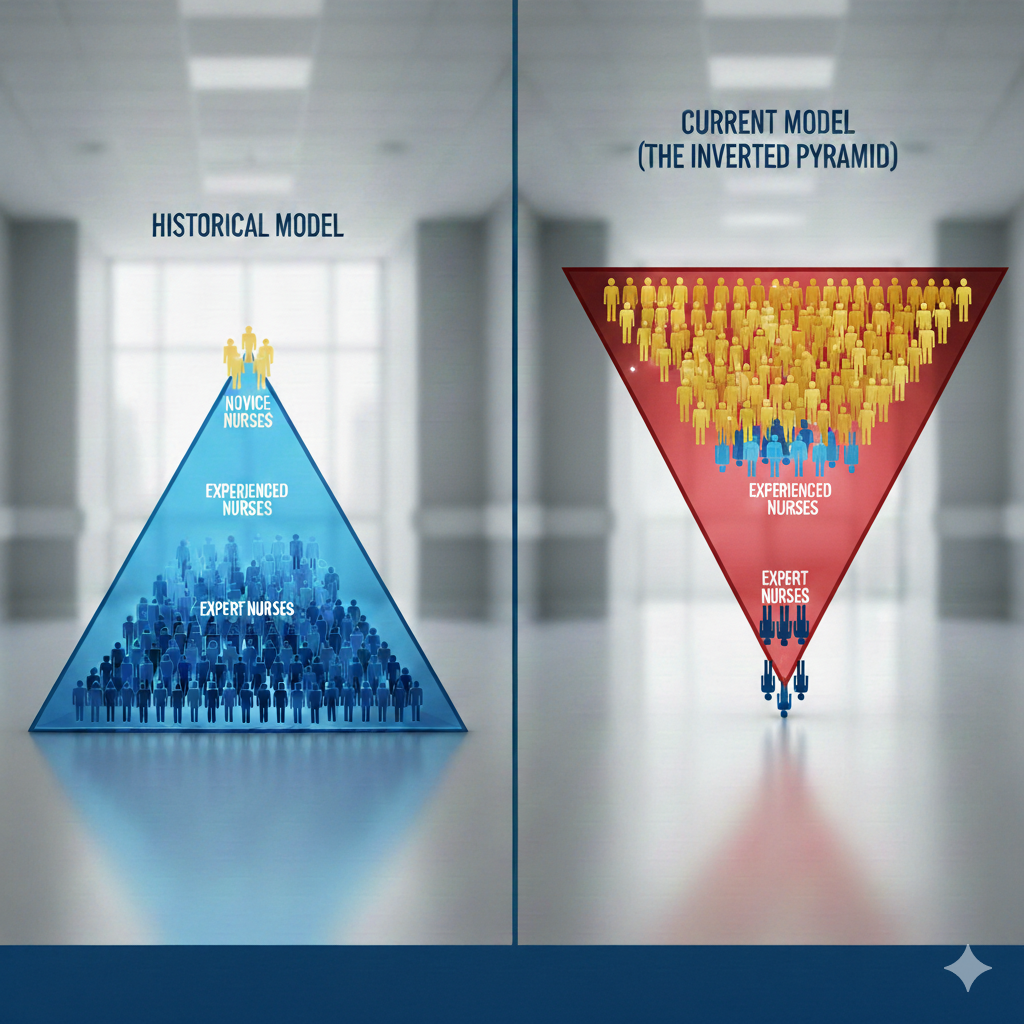
In our current healthcare landscape, we often hear nurse leaders lamenting the “readiness gap” of our new graduates. But as I’ve traveled across the country talking to systems, I’ve realized the problem isn’t just a lack of experience—it’s a dramatic shift in the composition of our nursing workforce. Historically, a solid base of veteran “expert” nurses supported a small group of novices. Today, the model has flipped into an inverted pyramid.
Most frontline staff in acute care environments are now novices, supported by a shrinking minority of experienced clinicians. Without a middle layer of experience, the burden of decision-making falls heavily on a few seasoned staff and leaders. This is leading to skyrocketing levels of burnout among nurse managers and preceptors. Clinical intuition is scarce, necessitating explicit protocols, AI-driven alerts, and virtual nursing to prevent errors. It is not surprising that, in a recent survey conducted by Vizient and Kaufmann Hall, more than 50% of nurse leaders are focusing their efforts in 2026 on improving patient safety and the onboarding new staff.
The inverted pyramid is likely to persist for a very long time. The highest RN turnover rate is now in the first three years of practice. New graduates enter practice with a tour-of-duty mindset, and most exit their units or departments without reaching the competency level on Benners’ Novice-to-Expert Skill Acquisition Scale. Nursing unions point to a lack of staffing ratios as being the issue, but seem ignore the reality that nurses themselves are making different decisions about their careers. Data from the National Council of State Boards of Nursing shows that only 53.3% of our nurses now work in hospitals, and that number is declining every year as other opportunities for nurses continue to expand.
The cycle keeps repeating itself, with medical-surgical units, Telemetry, Progressive Care, ICUs, EDs, and even ORs most affected. CNOs hear daily in their C-suites that they have never been better staffed with RNs, so why are we seeing so much turmoil and quality and safety issues? They understand that experience matters – a new graduate has far less capability than experienced staff, but that can be a hard sell to someone without clinical experience.
The challenge today is that most (but not all) health systems are not redesigning care delivery or adjusting staffing to respond to this new reality. Nurse managers are trying to lead teams of novice nurses with the same tools and strategies they have always used, but it is not working. The reason is that leading an inverted pyramid requires a very different mindset. Some key characteristics of this pyramid are outlined below:
Key Characteristics of the Inverted Pyramid:
- Experience Imbalance: The “median tenure” on a hospital unit has plummeted. It is now common for the most “senior” nurse on a night shift to have only 18 to 24 months of experience.
- The Vanishing Middle: The “Mid-Career” nurse (5–10 years of experience) has largely disappeared from the bedside, moving into positions outside acute care, into travel nursing, into advanced practice, or leaving the profession entirely.
- Cognitive Overload: Because fewer experts are available to share knowledge, the burden of decision-making falls heavily on the few remaining veterans and the nurse manager, leading to exhaustion and burnout.
- Safety Risk: Clinical “intuition”—which is developed over years—is scarce. This creates a reliance on protocols, technology, and external oversight to prevent errors that an experienced nurse would have caught.
Implications for Nurse Leaders
To be an effective leader in the inverted pyramid, you must lead differently. Some key leadership mindset changes that nurse managers should make include:
-
From Supervision to Psychological Safety: Novice nurses are terrified of making mistakes. Your goal is to create a safety net. They need to know that when they raise their hand to say “I don’t know,” they will be met with coaching, not judgment.
-
Prioritizing Resource Accessibility: In the inverted pyramid, the leader’s schedule should be driven by the frontline’s needs. This might mean “protected time,” where managers are physically on the unit during peak transition hours (like 07:00 or 19:00) to specifically support new staff.
-
Empowering the Preceptor Layer: Your preceptors are the middle layer of this pyramid. If they are burnt out or unsupported, the whole structure collapses. We must invest in “Preceptor Resilience” as much as we do in “Novice Competence.”
We cannot keep doing the same things and expect the situation to improve. Our new graduates are entering a more clinically complex environment than any generation before them, with a different mindset about work. The inverted pyramid is part of our new reality, and we will need to lead differently.
A Brand New Workshop for 2026: The Inverted Pyramid: Leading Teams of Novice Nurses The Inverted Pyramid WS Information Sheet
emergingrnleader.com 2026
To effectively lead through these challenges and others, nurse leaders need new tools and strategies. Let me help you as I have helped hundreds of organizations over the past five years. Book a workshop or keynote for your team by contacting me at roseosherman@outlook.com
Brand New For 2026 and Already Receiving Rave Reviews – Staying Power Building a Culture of Retention in the New World of Work
Our Most Popular Right Now – The New World of Work Workshop
A Leader Favorite – Building Bridges Not Walls: Leading Multigenerational Work Teams – Click Here for More Information Building Bridges Not Walls
A Must-Read Book in 2026 – Click Here to Buy



 LinkedIn
 Instagram
