By Rose O. Sherman, EdD, RN, NEA-BC, FAAN
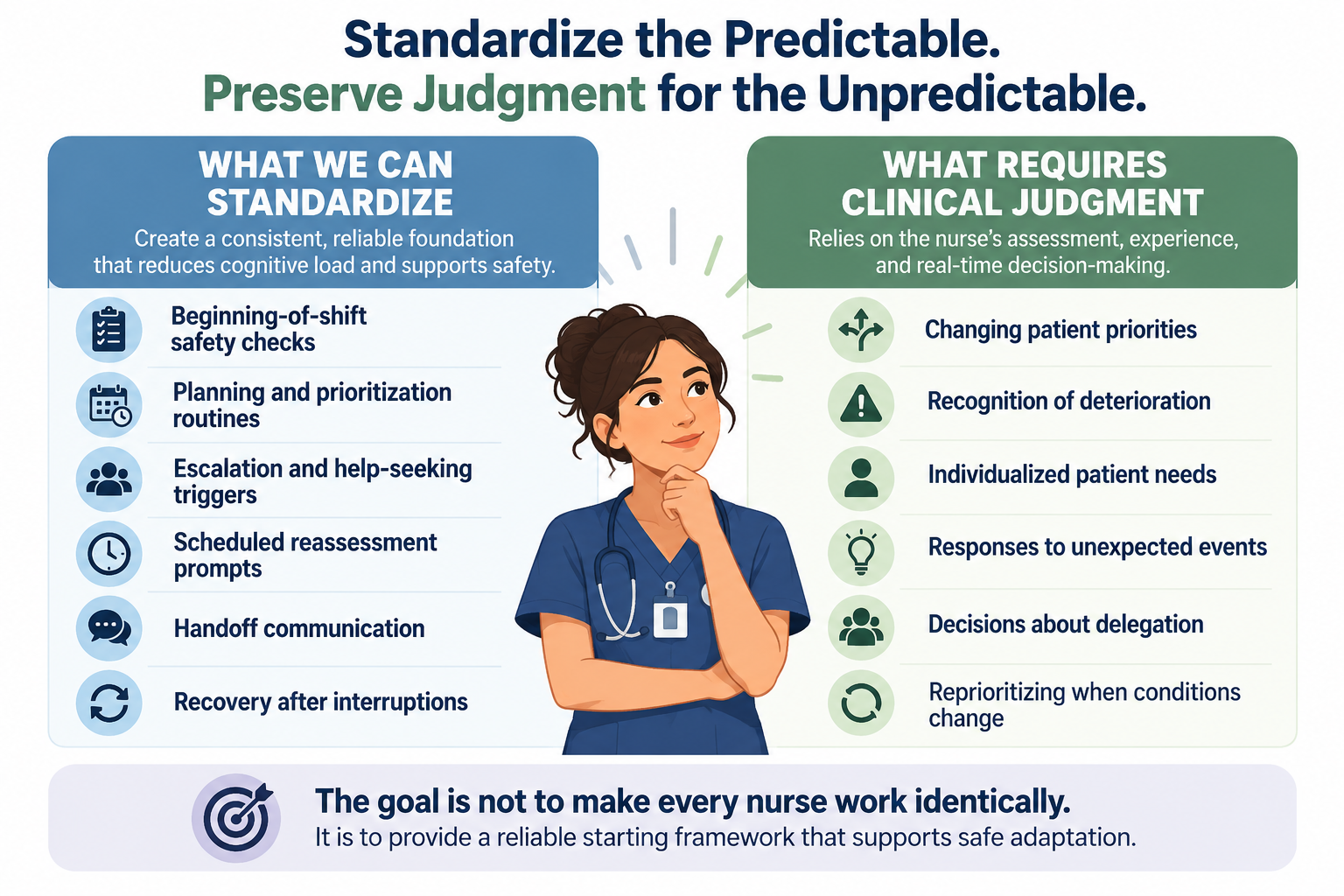
In recent workshops I’ve led on the Inverted Pyramid, many leaders have asked for my thoughts on standardized work for novice nurses. Consider the following story from a nurse manager:
I am not quite sure what to do, but more and more of my coaching conversations now focus on helping my novice staff stay on track during the shift. By 9:00 AM, many are already drowning and behind on their first medication pass. These nurses are smart, but everything still feels overwhelming. Our preceptors are working with them on time management, but they still struggle to pace themselves during the shift. What can I do about this?
This nurse manager is not alone in her frustration. When experienced staff and leaders watch novices struggle to complete routine tasks, they may assume they lack time management skills or motivation. In reality, they are cognitively overloaded. In the traditional nursing workforce, novice nurses learned shift organization by observing experienced colleagues. Much of this learning happened informally. Experienced nurses modeled how to anticipate problems, sequence care, recover from interruptions, and recognize when a plan needed to change. In today’s inverted-pyramid environment, that informal learning system is less reliable. We have fewer experienced nurses available to demonstrate the invisible work of organizing a shift. What was once learned through observation must now be taught more intentionally.
On novice-dense units, we need to provide more scaffolding and standardized work to guide them. Now you may be thinking, but we already have so many policies and procedures that should guide the work. Most clinical environments are flooded with clinical policies. If a novice nurse wants to look up how to flush a central line or administer a blood transfusion, our policy libraries offer pages of dense procedural steps.
What policies fail to provide is shift choreography. It wasn’t as necessary when most acute care workforces were made up of many experienced nurses. Experienced nurses don’t survive 12-hour shifts by consulting policy manuals; they survive on internalized mental models developed over years of pattern recognition. They know intuitively that if they don’t draw a 10:00 AM lab by 08:45, the entire morning falls apart. Novices don’t possess this level of intuition. That is where standardized work comes into play.
What is standardized work?
Standardized work is an agreed-upon, documented baseline of the safest, most efficient, and most reliable sequence of actions currently known to perform a specific process. Standardized work is cognitive scaffolding. It externalizes clinical memory, organizing predictable tasks into a visual rhythm so the nurse’s mental bandwidth remains free for changes in patient condition.
How do you design standardized work?
The definition and framework for standardized work draws from three primary bodies of literature: foundational lean operations, clinical patient safety/cognitive load theory, and healthcare management science. While relevant nursing literature exists on checklists, structured handoffs, care bundles, lean processes, cognitive aids, and nurse leader standard work, there is little guidance on standard work for novice nurses. The following are some ideas to get started:
Step 1 – Create a Standardized First 90-Minute Workflow
The first 90 minutes determine whether a novice controls the shift or the shift controls them. Standardize this launch window by including what should happen, while acknowledging that a nurse may need to administer a time-critical medication or respond to a deteriorating patient before completing a routine safety sweep. Likewise, charting critical assessments cannot always be deferred.
-
The Routine: Start with routine items that should occur, such as bedside shift report, then move to a safety sweep (lines, airway, pump settings), and finally to priority assessments.
-
The Pause: Recommend a five-minute planning pause after receiving report, during which the novice identifies the three highest priorities, time-sensitive tasks, and potential conflicts.
-
The Rule of Deferral: Explicitly tell novices what not to do during this window. Routine charting, non-urgent linen changes, and non-emergent family calls should be systematically deferred until after the initial clinical baseline is locked.
Step 2 – Establish Escalation Triggers
Novice nurses frequently delay asking for help because they fear looking incompetent or annoying a busy charge nurse. Vague advice like “Call me if you get overwhelmed” does not work. Replace subjective hesitation with objective operational triggers:
-
“If your 09:00 med pass is delayed past 09:45, notify the charge nurse.”
-
“If you cannot obtain IV access on the second attempt, stop and call the resource nurse.”
-
“If an admission arrives while you are completing an urgent transfusion, activate the unit buddy system.”
When the trigger is objective and measurable, seeking help is no longer seen as a personal failure—it is simply following standard protocol.
Step 3 – Shift to Process Rounding
When leaders or charge nurses conduct rounds, asking “Are you doing okay?” consistently yields a reflexive “I’m fine,” even when the nurse is overwhelmed.
Instead, ask process-oriented questions that reinforce standard work:
-
“Which task took longer than expected during your morning round?”
-
“What is one thing on your list right now that, if we take it off your plate, will keep your afternoon on schedule?”
Step 4 – Provide Guidance on How to Reset When Things Go Off Track
Novice nurses often start with a reasonable plan. The problem is what happens when an admission arrives, a patient deteriorates, or several unexpected requests interrupt their workflow. Experienced nurses have developed strategies to recover. Novices often have not. Provide guidance on what to do, such as:
-
Pause: Recognize that the current plan needs to change.
-
Reprioritize: Identify immediate safety needs, time-sensitive tasks, and what can safely wait.
-
Redistribute: Ask for help, delegate appropriate work, or activate the unit’s support system.
-
Reset: Establish a revised plan for the next 30–60 minutes.
Nurse leaders should not simply tell novices to follow standardized work. They need to design it with frontline nurses and preceptors, test it, and revise it based on what actually happens during a shift. If multiple novices are consistently behind by 9 AM, the problem may involve medication schedules, admission patterns, assignments, interruptions, or unavailable resources—not just the individual’s ability to organize care.
Standardized work is not about turning nurses into robots or reducing professional nursing to a checklist. It is about recognizing that we have fundamentally changed our workforce experience without always redesigning the systems that support clinical practice. Experienced nurses developed their organizational skills over years of practice, often with strong role models nearby. Today’s novices need us to make that invisible expertise visible. By standardizing predictable work, creating clear escalation triggers, and teaching nurses how to reset when a shift goes off track, we can reduce unnecessary cognitive burden while strengthening clinical judgment. In an inverted-pyramid environment, standardized work is not micromanagement. It is a safety net.
My Challenge to You
This week, ask three novice nurses: “What part of your shift is hardest to organize, and what guidance would make it easier?” Look for patterns in their answers. Then work with your preceptors and experienced nurses to create one simple, standardized workflow that addresses a common challenge. Pilot it, gather feedback, and refine it before expanding.
© emergingrnleader.com 2026
To lead through these challenges and others effectively, nurse leaders need new tools and strategies. Let me help; I have helped hundreds of organizations over the past six years. Please contact me at roseosherman@outlook.com to book a workshop or keynote for your team. Not seeing what you want on this list? Feel free to reach out, and I am happy to design a custom program to meet your needs.
Staying Power: Building a Culture of Retention in the New World of Work
Brand New in 2026 with Rave Reviews – The Inverted Pyramid: Leading Teams of Novice Nurses The Inverted Pyramid WS Information Sheet
Our Most Popular Right Now –The New World of Work Workshop
A Leader Favorite – Building Bridges Not Walls: Leading Multigenerational Work Teams – Click Here for More Information Building Bridges Not Walls
A Must-Read Book in 2026 – Click Here to Buy



 LinkedIn
 Instagram