• Home
  • About the Author
  • Books
  • Workshops and Keynotes
  • Contact Us

Emerging Nurse Leader

A leadership development blog

Nursing Turnover is Again on the Rise

April 30, 2026 by rose

By Rose O. Sherman, EdD, RN, NEA-BC, FAAN
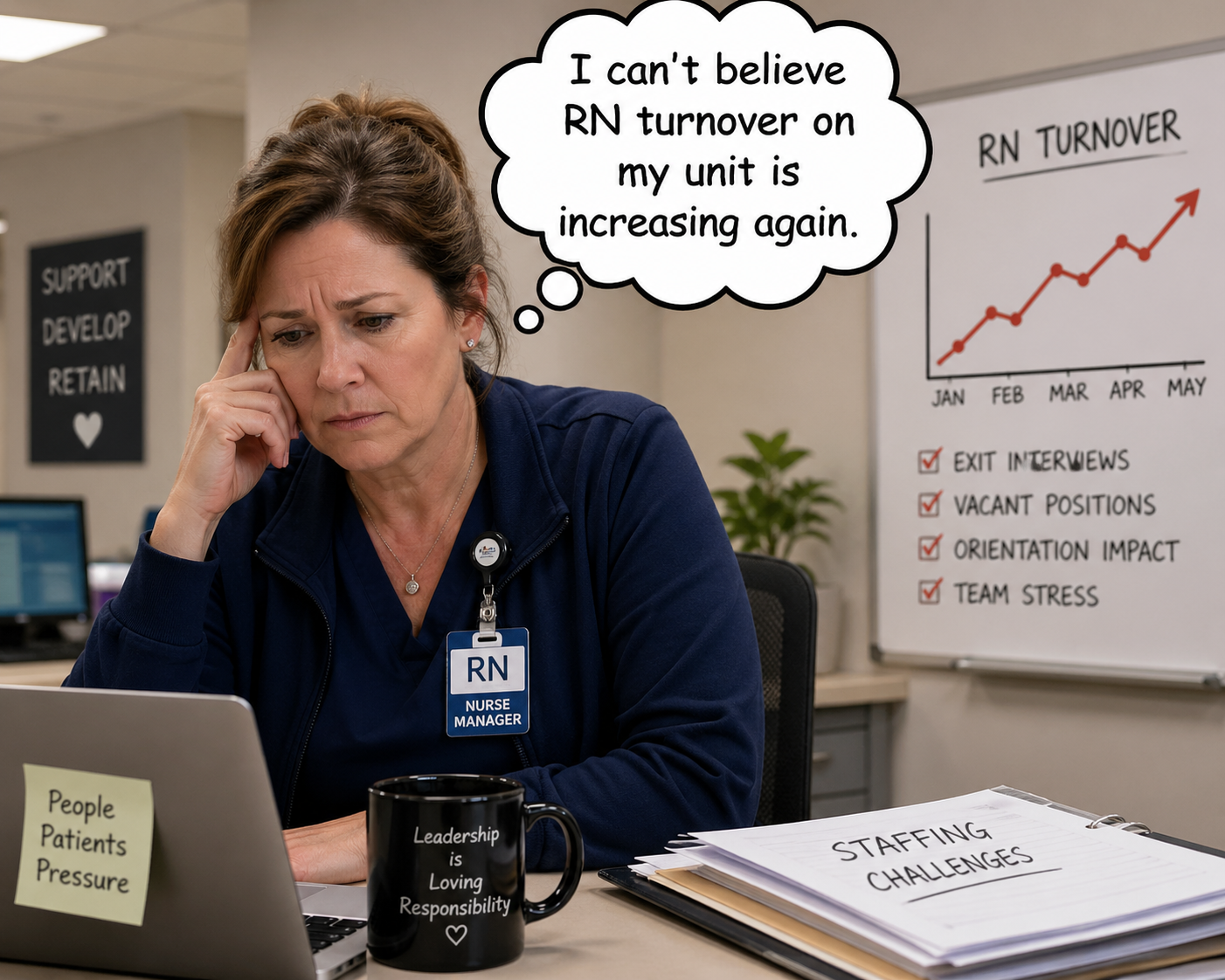
A CNO recently reached out to ask me what I was seeing in nursing recruitment and retention. She had just reviewed the nurse turnover for the previous quarter in her large hospital and was surprised to see that it was now trending upward. I assured her that she is not alone. The recently released 2026 National Health Care Retention and RN Staffing Report indicates that turnover is now once again on the increase.

After a drop to 16.4% last year, current RN turnover averages 17.6%. This 1.2% increase in RN turnover has already cost the average hospital an additional $360,000. This increase was in contrast to the average US hospital’s overall 2025 goal of reducing turnover by 2.6%. The report indicates that the healthcare landscape now faces a deteriorating national crisis in which demand for care significantly outstrips the supply of labor. While hospitals have successfully lowered vacancy rates to their lowest levels this decade at 8.6%, the RN labor shortage could increase to 250,000 by 2028.

Regional RN turnover was mixed in 2025. The South-East saw the high end of the average (18.7%) while the North-Central region saw the low end (16.2%). All regions except South-Central recorded increases, with the North-East posting the biggest jump (+3.3 points). Behavioral health nurses continue to lead all specialties in turnover at 22.5%, followed by emergency (20.7%), telemetry (19.5%), and step down (19%), all above the national RN average. Departments like Telemetry and ER are projected to replace their entire staff within less than 4.5 years. Interestingly, Magnet facilities did not, on average, beat the national benchmark of 17.6% annual turnover despite considerable efforts to improve work environments.

Close to 30% (29.5%) of all new hospital hires leave within their first year. For RNs specifically, 22.7% of new hires exit within 12 months. First- and second-year retention has improved among novice nurses, with most now leaving employers between years two and three. Residency programs are effective in first-year retention, though ROI declines over time. The report notes that the “Baby Boomer” retirement surge is no longer a future threat—it is a current driver of turnover with retirement now surfacing as the third most likely reason why RNs are leaving their organizations.

Staff retention is the single most important lever for both financial stability and patient safety in 2026, yet it is very complicated and not a one-size-fits-all solution. The work of nursing, healthcare workplaces, and the nursing workforce itself is dramatically different in this post-COVID-19 world. Many retention strategies that organizations have used historically don’t seem to work as well today. And it is not just nursing where we are seeing the impact – turnover among all healthcare disciplines is on the increase. So where do we go from here? Here are five suggestions to get started:
1. Control what you can control – example – a nurse leader approached me after our Staying Power workshop to report that her health system was offering buyouts to experienced staff to “save money.” Am I the only one who thinks this is insane?” I assured her that she needed to speak up because this practice could not only backfire but also cost money in the long term.
2. Focus on the areas where turnover is known to be higher – we have good data that ED, Behavioral Health, Progressive Care Units, Med-Surg, and Telemetry Units are most at risk. These are the areas where you need to focus your redesign and support efforts.
3. Design glide paths and emeritus nurse programs for your nurses close to retirement – we have the data that, unless they are given other options and reduced work, Baby Boomer nurses will need to retire because they can no longer physically do the work. The reality is that we risk a disaster if we don’t do everything we can to keep as many of them in the workforce for as long as possible.
4. Use the turnover crisis as an opportunity to restructure the work of nursing – the data shows us that up to 50% of the work that most RNs do daily does not need to be done by nurses. Never let a crisis go to waste. The key question today should be: what do nurses need to stop doing, because we don’t have enough of them now, nor will we ever have enough in the future? There are plenty of smart, unemployed college graduates displaced by AI out there who could be utilized in healthcare.
5. Form a Generation Z nurse retention task force – the data is clear that Gen Z nurses are turning over at a much higher rate than other Generational cohorts. They think differently about work, life, and career. Their workforce participation will continue to grow over time, and with it, potentially higher RN turnover. We need to listen to their ideas and develop different interventions when needed. Don’t assume that our current investments in healthy work environments will work for them.
emergingrnleader.com 2026

To effectively lead through these challenges and others, nurse leaders need new tools and strategies. Let me help you as I have helped hundreds of organizations over the past five years.  Book a workshop or keynote for your team by contacting me at roseosherman@outlook.com

Brand New For 2026 and Already Receiving Rave Reviews –  Staying Power Building a Culture of Retention in the New World of Work

Brand New for 2026 and Already Popular – The Inverted Pyramid: Leading Teams of Novice Nurses  The Inverted Pyramid WS Information Sheet

Our Most Popular Right Now –The New World of Work Workshop

A Leader Favorite – Building Bridges Not Walls: Leading Multigenerational Work Teams – Click Here for More Information   Building Bridges Not Walls

A Must-Read Book in 2026 – Click Here to Buy

Filed Under: The Future of Healthcare

Sign Up For Blogs!

Get the latest blog posts sent directly to your email. Don't miss a post!


Popular Posts

  • iStock_000015892112XSmall 5 Ways to Promote Professional Accountability in Nursing
  • A Blog for Nursing Leadership Skills & Career Strategies
  • Servant Leadership in Nursing
  • Becoming a Transformational Nurse Leader

Recent Posts

  • Nursing Turnover is Again on the Rise
  • Pulling the Future Forward
  • Inverted Pyramid Workshop – Open to All Leaders – June 17 2026
  • What Nurse Leaders Are Getting Wrong About Generation Z
  • Staying Power: Building a Culture of Retention Workshop – May 19th Open to All Leaders

Categories

  • Career Tips
  • Communication
  • Conflict Management
  • Leading Others
  • The Business of Healthcare
  • The Charge Nurse Role
  • The Future of Healthcare
  • The Leader Within

    Translate to:

    Powered by Google Translate.

Search

Books

The Nurse Leader Coach: Become The Boss No One Wants To Leave
The Nuts and Bolts of Nursing Leadership: Your Toolkit for Success

© Copyright 2012 Emerging RN Leader · All Rights Reserved

LinkedIn LinkedIn Instagram Instagram

grab this