By Rose O. Sherman, EdD, RN, NEA-BC, FAAN
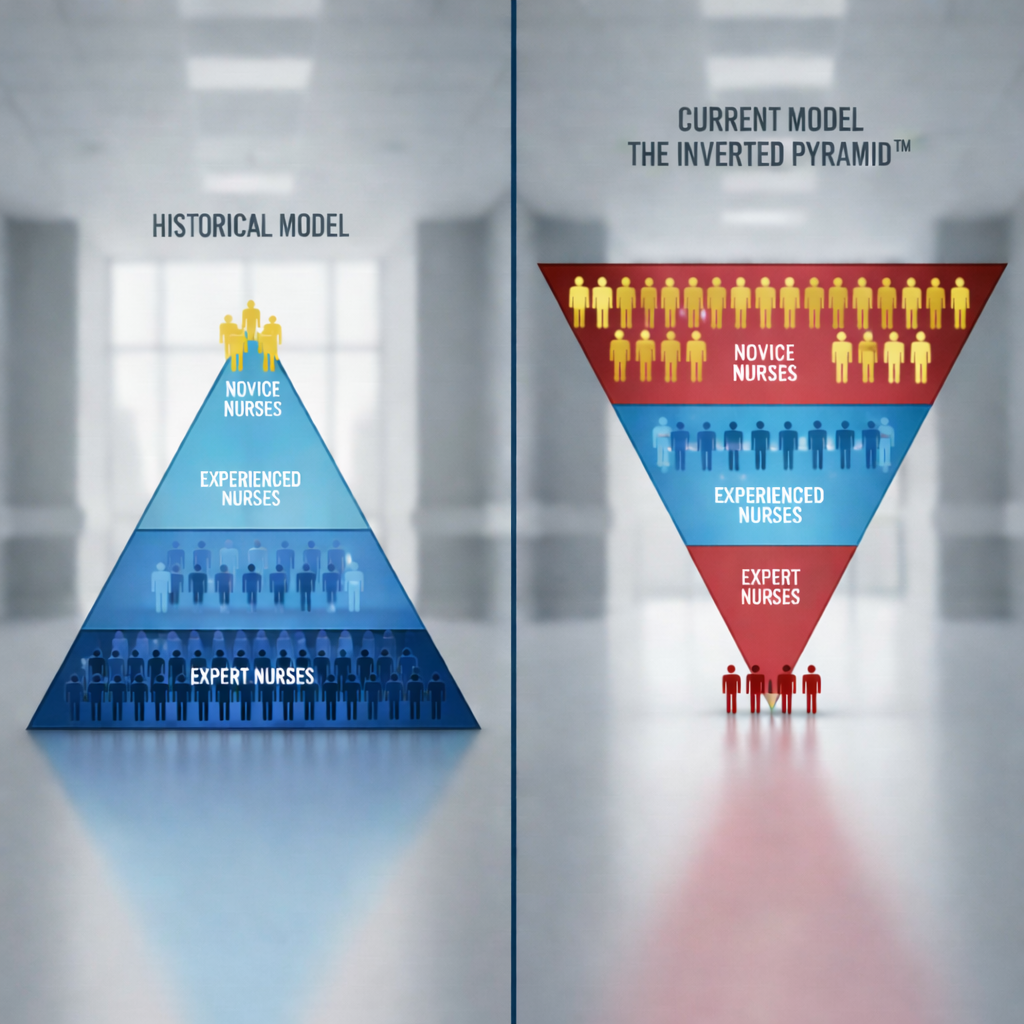
In Ernest Hemingway’s novel The Sun Also Rises, two of his characters discuss bankruptcy. One asks the other how he went broke, and he answered with a now widely used quote: It happened gradually and then suddenly.” That same phenomenon of gradually, then all at once, is how many nurse leaders feel as they look at their staff, who are now largely composed of novice nurses. One nurse leader recently discussed the changes in the critical care unit she has managed for ten years:
It seems that everything has radically changed since the COVID pandemic. In the pre-COVID environment, I had a nice mix of experienced and novice nurses, but no more. My experienced nurses sought other, less stressful positions or retired. I am now left with a team largely composed of novices who stay 1-2 years and then leave. The new staff I interview rarely have critical care experience. We are doing everything we can to build a healthy work environment, but frankly, I don’t see this dynamic changing anytime soon, regardless of what we do. Young nurses see their careers differently today and don’t plan to stay in any one job for more than a few years. What I have today is a much different team, and so I must lead differently. I just had a conversation with my CNO about how hard it is to have a high-reliability organization with a novice workforce.
While not every specialty area is equally affected, this precarious structural shift in our clinical environments is happening across the country, especially on our medical-surgical units, ED, ICU, and telemetry. These units used to have a broad base of experienced “expert” nurses supporting a smaller group of novices. Today, that pyramid has flipped. On many units, we now have a massive influx of new graduates, supported by a shrinking “middle” layer of experience—a phenomenon I call the Inverted Pyramid—and this is resonating with leaders.
This isn’t just a staffing challenge; it’s a patient safety crisis. It is not surprising that, in the 2026 NSI Executive Priorities, nurse leaders cited the quality and safety of patient care as their number 1 challenge. When the most “Senior” nurse on a night shift has less than 24 months of experience, the risk for “Failure to Rescue” skyrockets because the intuitive clinical “radar” of a veteran workforce simply isn’t there. To help you identify your leadership “danger zones,” I’ve developed an Inverted Pyramid Assessment Risk Assessment. I encourage you to be brutally honest as you walk through three critical areas on all your at-risk units/departments that include the following:
- The Experience Level of Your Nurses
- The Level of System Support and Infrastructure for Novice Nurses
- Your Leadership Focus
Once you complete your assessment, if you find your unit scores in the 26–35 point range, your focus should be on risk mitigation, with the primary goal of preventing clinical failure to rescue. Some sample actions that could be included in a mitigation plan include the following:
- Hardwiring your clinical radar on the unit. Because novice nurses often lack the “sixth sense” to detect subtle patient deterioration, you must supplement their manual recognition with technology tools and systemic safety nets. These are the units that should be the top candidates for virtual nursing integration.
- Protect your expert nurses. Recent AONL-Laudio data indicate that nurses who spend more than 20% of their time precepting are at high risk of burnout. Your nurses with 5+ years of experience are your most vulnerable and valuable resource. If they are precepting every shift, they will leave. Aim to keep the time percentage below 50%. This will require a shift in the current preceptor model, such as “Tiered Precepting.” Instead of one expert doing all the heavy lifting, use “mentorship pods” in which a nurse with 1-2 years of experience helps a brand-new novice with basic tasks while the expert focuses only on high-level clinical coaching.
- Formalize night shift support. The 3:00 AM “AI search” for clinical help, which many novices now use, is a massive red flag for patient safety. If the night shift is staffed primarily with novice nurses, the Night Shift Charge Nurse should not take a patient assignment. They need to be fully available for supervision and delegation, and to help the novices with complex clinical decisions.
- Refocus your leadership rounding. As the leader of a unit with an inverted pyramid, you need to shift your rounding from “logistics” to “clinical outcomes.” During your rounds, stop focusing on issues like whiteboards and cleanliness. Instead, ask the novice nurse: “What is the clinical trajectory of your most complex patient, and what is your plan if they decline?” This coaches them to think critically rather than just following a task list.
I believe the nurse leader in the scenario above was wise in recognizing that the Inverted Pyramid may be with us for a very long time. Ultimately, AI and other technologies will offer better structural support, but for now, nurse leaders need to move from the current question: How do we fix novice nurses? to How do we design systems to match today’s workforce reality?
Are your leaders leading in an Inverted Pyramid and need help? Consider booking our workshop on this topic. This workshop has a strong ROI and is appropriate for all levels of nurse leaders, including charge nurses and NPD professionals.
The Inverted Pyramid: Leading Teams of Novice Nurses The Inverted Pyramid WS Information Sheet
© emergingrnleader.com 2026
To effectively lead through these challenges and others, nurse leaders need new tools and strategies. Let me help you as I have helped hundreds of organizations over the past five years. Book a workshop or keynote for your team by contacting me at roseosherman@outlook.com
Brand New For 2026 and Already Receiving Rave Reviews – Staying Power Building a Culture of Retention in the New World of Work
Our Most Popular Right Now –The New World of Work Workshop
A Leader Favorite – Building Bridges Not Walls: Leading Multigenerational Work Teams – Click Here for More Information Building Bridges Not Walls
A Must-Read Book in 2026 – Click Here to Buy



 LinkedIn
 Instagram