By Rose O. Sherman, EdD, RN, NEA-BC, FAAN
When an experienced nurse leaves a hospital, we often measure the loss in familiar ways: turnover costs, vacancy rates, recruitment expenses, and the time required to orient a replacement. But what if the greatest loss is something we are not measuring? Experienced nurses do an enormous amount of invisible work that keeps patients safe, supports novice nurses, and helps nursing units function effectively. Much of this work is never documented, formally assigned, or recognized in staffing calculations. Yet it may be among their most important contributions.
The Clinical Safety Net We Take for Granted
Think about the experienced nurse who walks past a patient’s room, notices something subtle, and stops to investigate. The patient does not look quite right. There may be no alarming vital signs or obvious deterioration, but something about the situation raises concern. Or consider the experienced charge nurse who recognizes that a novice colleague is becoming overwhelmed before that nurse asks for help. These are examples of clinical judgment developed over years of practice. Experienced nurses recognize patterns, anticipate complications, and often intervene before problems become emergencies. Their contributions aren’t always visible because the adverse events they prevent never happen.
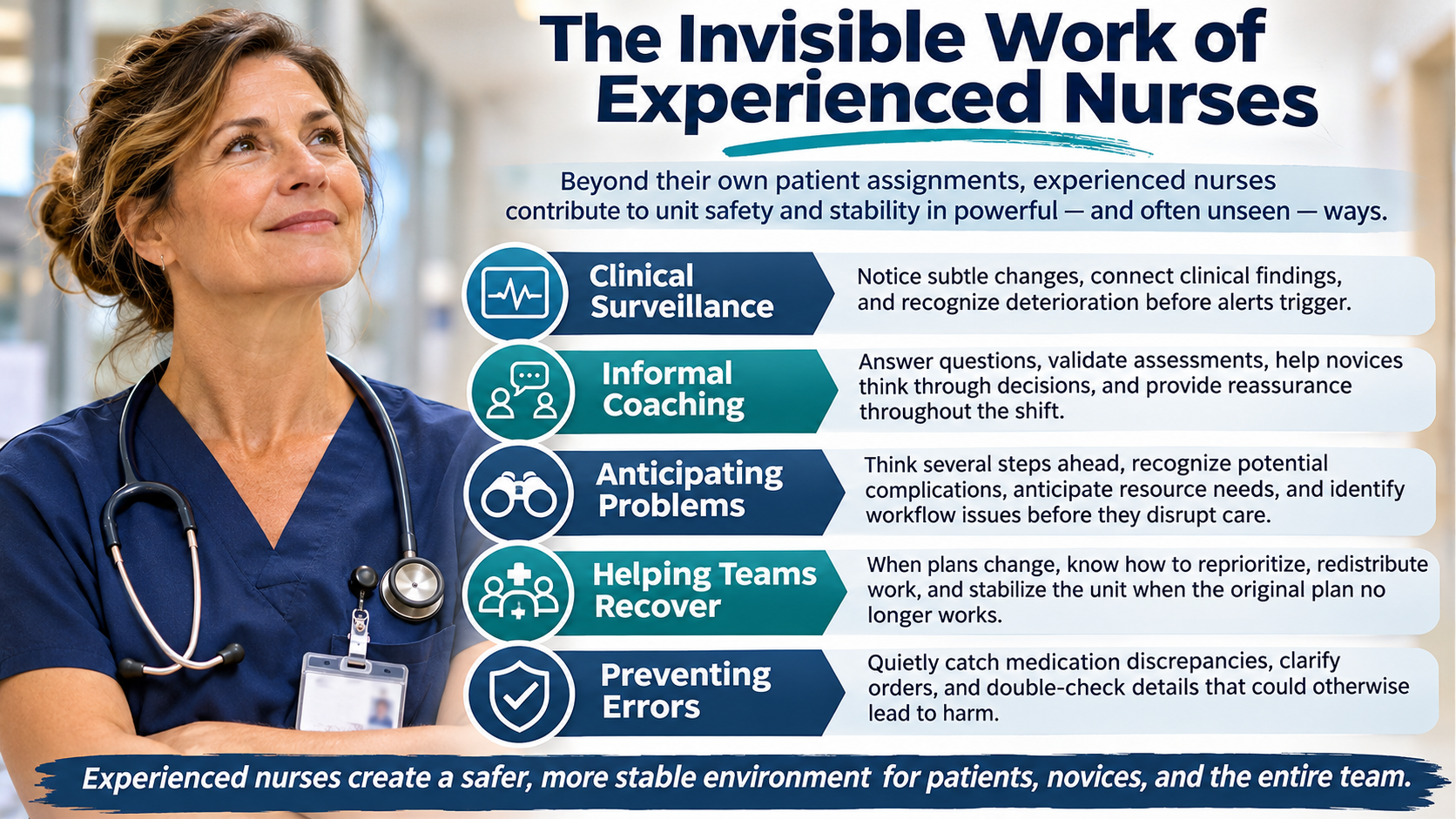
Five Types of Invisible Work Experienced Nurses Contribute to Units
Experienced nurses contribute to unit safety in ways that go far beyond their individual patient assignments.
1. Clinical Surveillance
They notice subtle changes, connect seemingly unrelated clinical findings, and recognize deterioration before standard monitoring systems trigger an alert.
2. Informal Coaching
They answer questions, validate assessments, help novice nurses think through clinical decisions, and reassure them in unfamiliar situations. Much of this coaching happens spontaneously throughout a shift.
3. Anticipating Problems
Experienced nurses think several steps ahead. They recognize potential complications, anticipate resource needs, and identify workflow problems before they disrupt patient care.
4. Helping Teams Recover
When admissions arrive unexpectedly, patients deteriorate, or staffing changes occur, experienced nurses know how to reprioritize and redistribute work. They help stabilize the unit when the original plan no longer works.
5. Preventing Errors
They quietly catch medication discrepancies, question unusual orders, recognize missing information, and intervene when something does not seem right.
These contributions rarely appear in productivity reports, but they are essential to safe care. The Inverted Pyramid of Nursing Experience is changing that dynamic as units have fewer and fewer experienced nurses today. The informal safety net is disappearing. As nursing teams become more novice-dense, experienced nurses often take on more invisible work. They may carry a full patient assignment while also answering questions, supporting new graduates, helping with complex clinical decisions, and managing unexpected events. This additional cognitive and emotional work is rarely reflected in staffing assignments or workload calculations. An experienced nurse may appear to have the same number of patients as everyone else while carrying significantly greater responsibility for the team’s safety and functioning.
The few experienced nurses left feel overwhelmed and underappreciated. During a recent session, nurse managers uniformly agreed that we are ignoring these experienced nurses; they receive far less professional development than they did in the past and don’t get the sign-on bonuses new graduates receive. Managers are also burned out and exhausted because they are picking up more of this invisible work.
Yet many organizations continue to operate as though their nursing workforce’s experience composition has not changed. We use the same staffing approaches, assign similar workloads, and expect the same informal support systems to function. Ironically, the nurses we most need to retain may be the ones carrying the greatest invisible workload.
How Do We Make the Invisible Visible
To make the invisible visible, nurse leaders need to ask different questions:
- How much informal coaching are experienced nurses providing during a typical shift?
- Who serves as the clinical safety net when novice nurses encounter unfamiliar situations?
- Are experienced nurses receiving workload adjustments for their mentoring and surveillance responsibilities?
- What happens on shifts when few experienced nurses are available?
- Which critical safety processes depend on knowledge that exists only in the heads of experienced staff?
These questions should become part of staffing discussions, workforce planning, and unit-based risk assessments. We also need to recognize that retaining experienced nurses requires more than asking them to stay. It means redesigning their roles so that their expertise is valued, their contributions are visible, and their workload is sustainable. When experienced nurses leave, hospitals lose much more than years of service. They lose clinical intuition, organizational memory, informal mentoring capacity, and countless small interventions that prevent larger problems. Much of this work has remained invisible because it was always there. In today’s novice-dense nursing environment, we can no longer afford to take it for granted.
Book Now – Brand New Full-Day Workshop for Your 2027 Leadership Needs – Rethinking Leadership and Redesigning Work
© emergingrnleader.com 2026
To lead through these challenges and others effectively, nurse leaders need new tools and strategies. Let me help, Ihave supported hundreds of organizations over the past six years. Please contact me at roseosherman@outlook.com to book a workshop or keynote for your team. Not seeing what you want on this list? Feel free to reach out, and I am happy to design a custom program to meet your needs.
Staying Power: Building a Culture of Retention in the New World of Work
Brand New in 2026 with Rave Reviews – The Inverted Pyramid: Leading Teams of Novice Nurses The Inverted Pyramid WS Information Sheet
Our Most Popular Right Now –The New World of Work Workshop
A Leader Favorite – Building Bridges Not Walls: Leading Multigenerational Work Teams – Click Here for More Information Building Bridges Not Walls
A Must-Read Book in 2026 – Click Here to Buy



 LinkedIn
 Instagram
