By Rose O. Sherman, EdD, RN, NEA-BC, FAAN
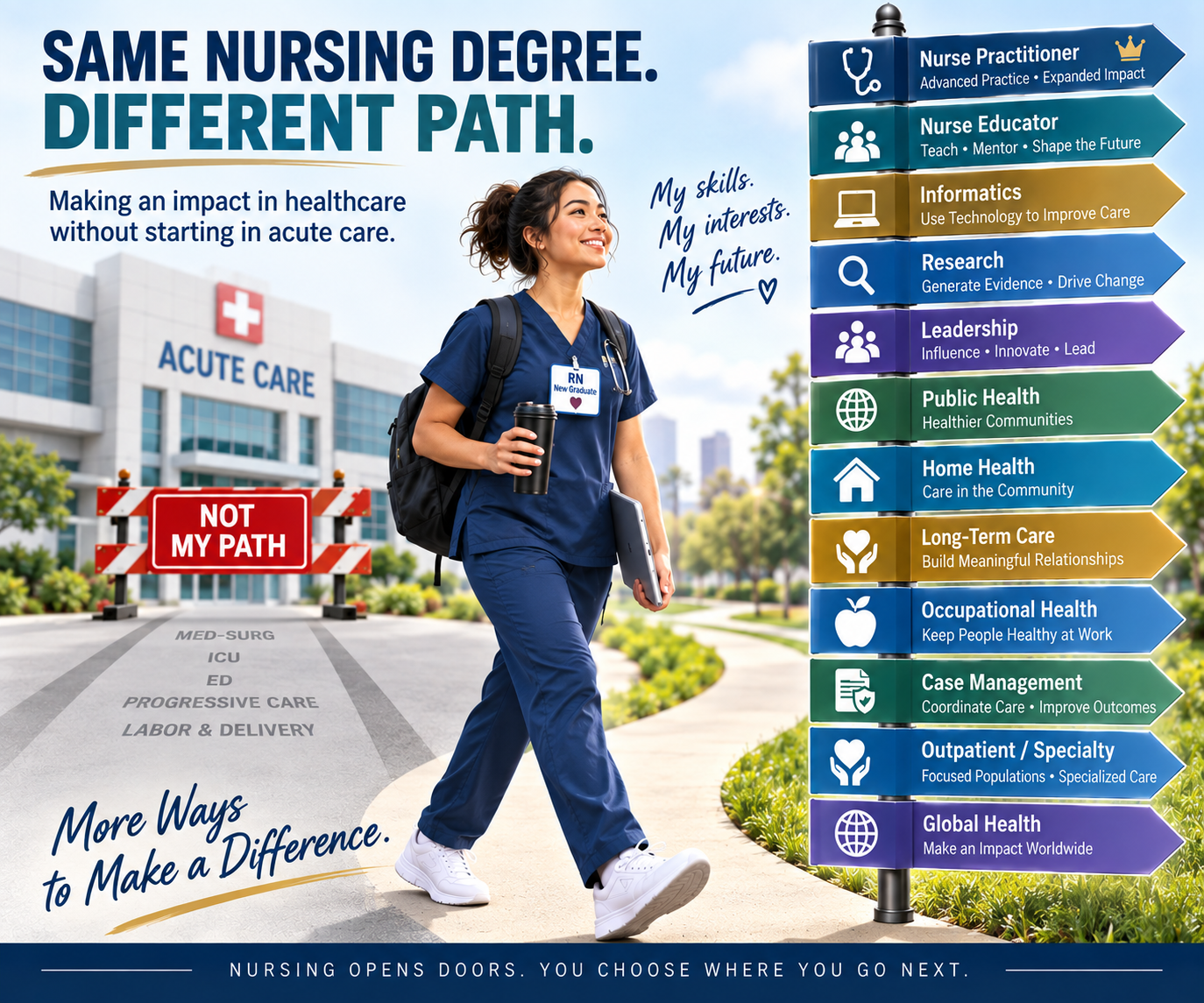
For generations, nursing had an unwritten rule: start your career in a hospital. New graduates were frequently advised to spend at least a year or two in medical-surgical nursing to “get experience” before considering other career options. Acute care was seen as nursing’s proving ground, where nurses developed assessment skills, clinical judgment, confidence, and credibility. But that traditional career pathway may be changing, according to many nursing faculty I talk with today.
Recent NCSBN data also suggests that the traditional hospital-first career pathway is far from universal. In its 2024 study of newly licensed registered nurses, 77.4% reported working in hospitals—meaning nearly 23% were working outside the hospital setting early in their careers. While these data do not show that these nurses intentionally bypassed acute care, they raise an important workforce question: Is acute care becoming just one of many entry points into professional nursing rather than nursing’s default starting point?
Today’s nursing graduates enter the profession with visibility into career opportunities that previous generations rarely considered at the beginning of their careers. They see nurses working in outpatient settings, public health, home care, behavioral health, informatics, occupational health, long-term care, telehealth, case management, education, and countless specialty roles. Many are also entering nursing with plans for graduate education and advanced practice.
For some new nurses, acute care is a stepping stone. For others, it may increasingly become a step they choose to bypass altogether. We tend to focus on retention and ask: How do we keep nurses from leaving acute care? But an equally important workforce question may be: How many nurses choose not to enter acute care in the first place? And if fewer nurses make that choice, what will it mean for the future experience profile of the acute care nursing workforce?
The Drivers for the Change
There are four key drivers for the change we are seeing:
- The old career ladder has become a career lattice. Nursing graduates can see far more possible pathways, and social media makes those possibilities visible almost immediately.
- The value proposition of acute care has changed. The question isn’t whether acute care provides extraordinary clinical development—it does. The question is whether graduates believe the benefits outweigh nights, weekends, holidays, workload, scheduling constraints, workplace stress, and physical demands.
- Many ambulatory care, home care, and school nurse positions now accept new graduates, sometimes even offering residency programs.
- Graduate education changes the calculation. 73% of nurses today have BSNs. Most NP graduate programs today don’t require any acute care experience. Many schools now offer a BSN-DNP, and their students stay in the program full-time until they finish the terminal degree. With the Labor Department projecting NP roles as the fastest-growing career opportunity in the US, this trend could accelerate.
The Implications
In the future, as more opportunities open outside of acute care, hospitals may need to compete for new graduates, not merely recruit them. That’s an important distinction. Filling residency cohorts isn’t necessarily evidence that acute care remains the preferred destination. We already see this with over 50% of new graduates leaving their initial roles between the second and third year of practice.
Nurse leaders may eventually have to articulate a much stronger answer to: “Why should I begin my nursing career here?” Failing to do so could have profound implications for acute care environments already struggling with sustained high patient volumes and acuity. The future challenge for acute care may not simply be keeping the nurses we have. It may be convincing the next generation of nurses that acute care is a place worth coming to and staying long enough to become the experienced nurses we desperately need.
© emergingrnleader.com 2026
To effectively lead through these challenges and others, nurse leaders need new tools and strategies. Let me help you as I have helped hundreds of organizations over the past five years. Please contact me at roseosherman@outlook.com to book a workshop or keynote for your team. Not seeing what you want on this list? Feel free to reach out, and I am happy to design a custom program to meet your needs.
Brand New For 2026 and Already Receiving Rave Reviews – Staying Power: Building a Culture of Retention in the New World of Work
Brand New for 2026 and Already Popular – The Inverted Pyramid: Leading Teams of Novice Nurses The Inverted Pyramid WS Information Sheet
Our Most Popular Right Now –The New World of Work Workshop
A Leader Favorite – Building Bridges Not Walls: Leading Multigenerational Work Teams – Click Here for More Information Building Bridges Not Walls
A Must-Read Book in 2026 – Click Here to Buy



 LinkedIn
 Instagram