By Rose O. Sherman, EdD, RN, NEA-BC, FAAN
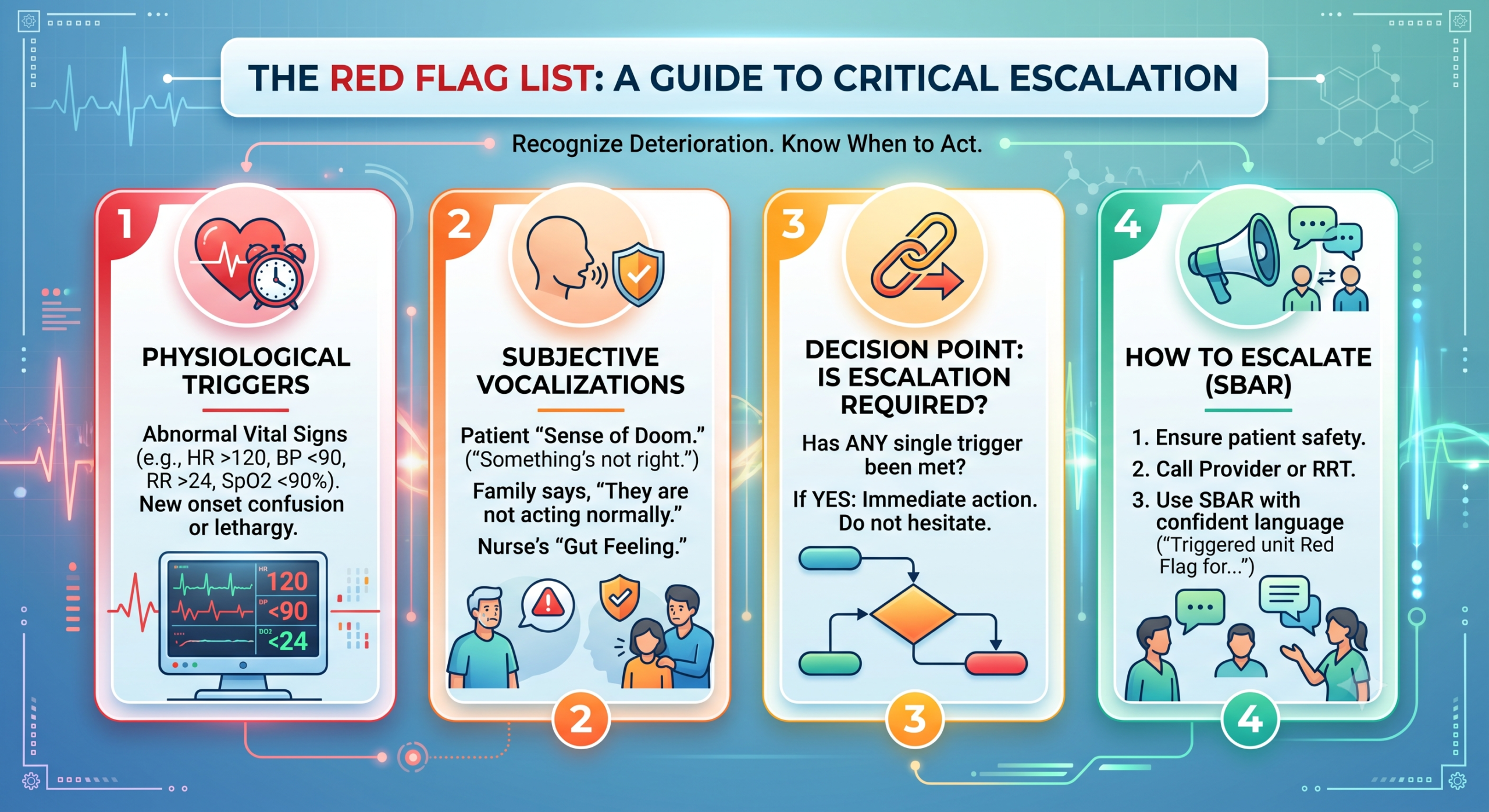
One of the challenges of having a novice-dense workforce in acute care is teaching them to recognize clinical deterioration and, more crucially, to overcome the “intimidated silence” that often occurs in these environments. As I do the Inverted Pyramid Workshops across the country, so many nurse managers have talked with me about this issue. Without experienced staff to coach novices in clinical surveillance, small changes in a patient’s condition that indicate more serious underlying issues are not being identified. Transfers to higher levels of care increase, as does length of stay.
Because novice nurses frequently struggle to differentiate between a patient who is “expectedly sick” and one who is actively decompensating, a Red Flag List provides objective, permission-giving criteria to escalate care. Red Flag lists provide decision scaffolding for novice staff. A Red Flag List is a clear, single-page document that explicitly outlines the clinical triggers, patient status changes, or operational events that must be escalated to the Nurse in Charge, the Patient’s Physician, or the Rapid Response Team.
By removing the ambiguity around when to call for help, you eliminate the novice’s fear of “bothering” the charge nurse or the physician while creating an ironclad safety net for clinical risk management. An orthopedic nurse manager recently explained how she developed this Red Flag List to improve care on her unit.
I began to notice that my novices were not anticipating some of the critical complications that we see in orthopedics, such as compartment syndrome, vascular compromise, or thromboembolic events. They were falling into the trap of thinking – of course their leg hurts terribly, they just had total knee arthroplasty. After meeting with stakeholders, I determined that novice nurses on my unit faced a specific challenge: distinguishing expected post-operative pain from limb- or life-threatening emergencies. Their ability to connect these dots on their own just was not there. We needed more of a safety net so we designed a Red Flag List.
The orthopedic-specific Red Flag List they designed is designed draws a hard line in the sand, helping them differentiate expected surgical recovery from critical complications like compartment syndrome, neurovascular compromise, and thromboembolic events. It is a yellow/red flag list that requires nurses to notify the Charge Nurse, Rapid Response Team, and/or the Physician immediately if a patient exhibits any of the following:
| Assessment Category | Yellow Flag – Notify Charge Nurse | Red Flag – Notify Provider – Call RRT |
| Vascular Status – Operated Extremity | Capillary refill: 3–4 seconds. Extremity feels slightly cooler than the unoperated side. Patient reports mild, intermittent “pins and needles” | Capillary refill: greater than 4 seconds. Extremity is cold, pale, cyanotic, or mottled. New, progressive, or continuous numbness/paresthesia. Inability to move digits (e.g., new foot drop or loss of finger extension). Absence of peripheral pulse (even by Doppler) |
| Pain Trajectory | Pain is 8–10/10 but decreases slightly with ordered opioids. Patient requires maximum allowed PRN breakthrough doses | Severe, deep, throbbing pain that is completely unresponsive to maximum opioid doses. Pain that increases rapidly and is disproportionate to the surgical procedure. Pain elicited by passive stretching of the muscles (e.g., gently moving the toes/fingers) |
| Surgical Site & Drains | The incision dressing is saturated with serosanguineous fluid and requires reinforcement. Hemovac or Jackson-Pratt (JP) drain output: 100–150 mL over 2 hours | Active, bright red (frank) blood rapidly saturating the dressing Hemovac/JP drain output: greater than 200 mL in a single hour. A rapidly expanding, tense, hard hematoma or visible bulging around the surgical site |
| Thromboembolic & Pulmonary (DVT, PE, & Fat Embolism)
|
Unilateral calf tenderness or localized swelling in the non-operated leg. Heart Rate: 100–115 bpm | Sudden onset of SOB, tachypnea (RR > 24), or chest pain. SpO2 less than 92% on room air (or a sudden 4% drop from baseline), Petechial rash across the chest, neck, or axilla (classic sign of Fat Embolism Syndrome), Heart rate greater than 120 bpm |
This manager was wise enough to anticipate that defining when to call is only half the battle; the menu must also define how to communicate the risk efficiently. She required the use of SBAR directly on the handout so the novice knows exactly what information to have ready when they escalate. Novices, she observed, often worry about waking up a surgeon at 02:00. You have to give them this exact script to structure their call:
S (Situation): “Dr. Brooks, this is Susan on the Orthopedic Unit. I am calling to escalate care for Mr. Miller in Room 304, status post total knee arthroplasty today. He has actively triggered our unit Red Flag List for suspected Compartment Syndrome.”
B (Background): “He returned from the PACU at 16:00. His neurovascular checks were baseline normal until the last 30 minutes.”
A (Assessment): “He is experiencing severe, localized calf pain rated at a 10/10 that did not respond to the IV Dilaudid given 45 minutes ago. His calf is visibly tense and hard to the touch. Most importantly, he screams with pain upon passive dorsiflexion of his toes. His pedal pulse is still palpable, but weak.”
R (Recommendation): “Because he meets the explicit Red Flag criteria for compartment syndrome, I need an immediate bedside evaluation for a compartment pressure check and potential emergency fasciotomy. I have already verified he is NPO. Can you be here within 15 minutes, or should I contact the on-call hospitalist?
She realized that part of the challenge in using Red Flag lists is that you also need to educate the surgeons. When a novice calls a physician using the Red Flag Menu, his/her response dictates whether they will utilize it next time or hide their concern out of fear. This manager asked physicians to avoid saying, “Why are you calling me?” If the escalation is unnecessary, I told them to contact me and I will coach the nurse through the decision they made. These lists are not foolproof she noted – her unit went through many iterations but they are a good start to improving patient safety and novice nurse confidence.
© emergingrnleader.com 2026
To effectively lead through these challenges and others, nurse leaders need new tools and strategies. Let me help you as I have helped hundreds of organizations over the past five years. Please contact me at roseosherman@outlook.com to book a workshop or keynote for your team. Not seeing what you want on this list? Feel free to reach out, and I am happy to design a custom program to meet your needs.
Brand New For 2026 and Already Receiving Rave Reviews – Staying Power Building a Culture of Retention in the New World of Work
Brand New for 2026 and Already Popular – The Inverted Pyramid: Leading Teams of Novice Nurses The Inverted Pyramid WS Information Sheet
Our Most Popular Right Now –The New World of Work Workshop
A Leader Favorite – Building Bridges Not Walls: Leading Multigenerational Work Teams – Click Here for More Information Building Bridges Not Walls
A Must-Read Book in 2026 – Click Here to Buy



 LinkedIn
 Instagram