By Rose O. Sherman, EdD, RN, NEA-BC, FAAN
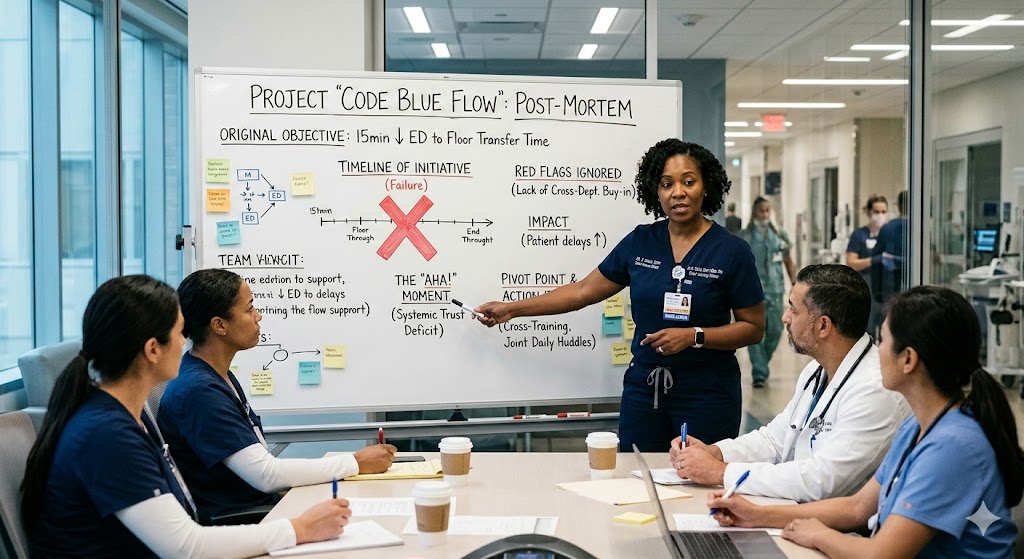
Failing is hard. Whether you didn’t get the job you really wanted, your new business doesn’t have enough clients, or a project you strongly advocated for in your health system isn’t working, it is natural to feel disappointment. The truth is that while success stories can offer a roadmap, failure stories offer real education.
I was reminded of this when I spoke with a colleague who is feeling like a failure. She took a position that she had hoped would launch her to the next level in her career, without doing enough due diligence. While she is not failing in terms of her performance, she now realizes it was the wrong move and plans to quit the role. I urged her to spend some time doing a post-mortem on her experience.
A post-mortem isn’t just a venting session—it’s an honest dissection of a job, project, or idea that didn’t meet expectations. Author Dori Clark reminds us that failure provides important data. It is feedback that can and should teach you something you can use in your life and work. As you do your post-mortem, consider the following:
- Analyze Why It Happened
Not all failures are created equal. There’s a difference between a “sloppy mistake” (avoidable) and a “noble failure” (an educated risk that didn’t pan out). When writing your post-mortem, identify which one yours was. Did you not do enough due diligence, as was true in my colleague’s case? Did you misread the market? Was the timing off? Or did you simply overextend your resources? Failure is often less about a lack of talent and more about the inability to recognize patterns. Identifying the root cause transforms a personal embarrassment into a universal lesson. Use this three-step process:
-
The Objective: What was the original goal? (My colleague wanted a role that would put her on the path to a senior leadership role in a health system)
-
The Gap: What actually happened? (When she started her new job, she began to understand that the opportunities in her new place of employment were, in fact, very limited, and she had less decision-making authority than in her prior role)
-
The Pivot: Based on this data, what will you never do again? What will you double down on next time? (My colleague decided she would never make another move without a significant amount of due diligence, including consultation with at least 5-10 colleagues outside the organization who knew enough about the new organization to offer a perspective)
2. Consider Radical Transparency about Your Failure
When we experience failure, our instincts are often to hide our missteps. But the truth is that we can gain respect, and sharing our stories humanizes us. When we can be transparent about what has happened, we regain control of the story. We reassume agency. Vulnerability can be a bridge. It also helps us to demonstrate mastery by explaining why a specific strategy failed. We also provide warning signs to others who may be traveling the same path we were on.
3. Moving from Ouch to Aha
The goal of a failure post-mortem isn’t to garner sympathy; it’s to generate insight. We can use it ourselves to inform our next move. Bill Gates once observed that “Success is a lousy teacher. It seduces smart people into thinking they can’t lose.” When you document your failures, you stop being a victim of your circumstances and start being a scientist of your own life. You’re not “failing”; you’re gathering data for your next win.
After a post-mortem, my colleague decided to begin exploring other career opportunities and move forward as quickly as she could after securing a new position. She learned that a “Post-Mortem” isn’t just about what went wrong; it’s about protecting your energy so you can move forward into a different future.
© emergingrnleader.com 2026
To effectively lead through these challenges and others, nurse leaders need new tools and strategies. Let me help you as I have helped hundreds of organizations over the past five years. Book a workshop or keynote for your team by contacting me at roseosherman@outlook.com
Brand New For 2026 and Already Receiving Rave Reviews – Staying Power Building a Culture of Retention in the New World of Work
Brand New for 2026 and Already Popular – The Inverted Pyramid: Leading Teams of Novice Nurses The Inverted Pyramid WS Information Sheet
Our Most Popular Right Now –The New World of Work Workshop
A Leader Favorite – Building Bridges Not Walls: Leading Multigenerational Work Teams – Click Here for More Information Building Bridges Not Walls
A Must-Read Book in 2026 – Click Here to Buy



 LinkedIn
 Instagram