By Rose O. Sherman, EdD, RN, NEA-BC, FAAN
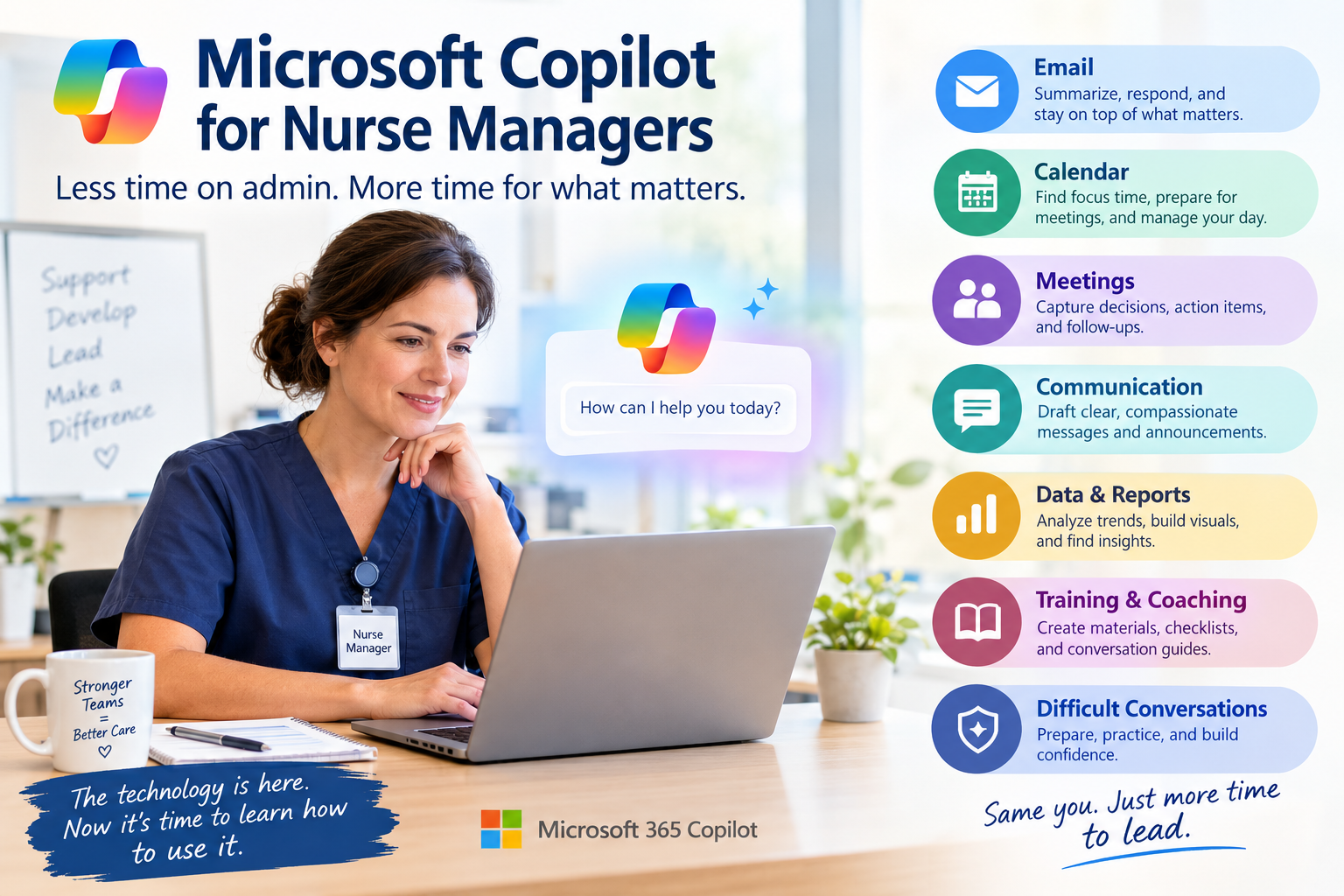
Healthcare organizations are investing heavily in artificial intelligence, and Microsoft 365 Copilot is becoming one of the tools available to nurse leaders. Yet I am noticing a troubling gap. Organizations are buying the technology, but many frontline managers receive little practical training on how to incorporate it into their daily work.
A nurse manager may have access to Copilot in Outlook, Teams, Word, and Excel but still spend hours every week responding to emails, preparing meeting agendas, reviewing schedules, and developing reports. The technology is available, but few leaders are using it to improve their workflow. This is a missed opportunity, especially when nurse managers are overwhelmed by administrative responsibilities and struggle to find enough time for their staff.
Giving Back Time to Nurse Managers
Consider how much of a typical nurse manager’s day is spent on activities that don’t require their unique leadership expertise. They read lengthy email chains, search for information, prepare agendas, document meetings, organize calendars, draft routine communications, and develop reports. These activities are necessary, but AI can make many of them more efficient. Microsoft 365 Copilot is especially promising because it works within applications many nurse managers already use. Here are seven practical applications that I believe every nurse manager should learn:
1. Managing Email
Nurse managers receive numerous emails daily. Important communications become buried among routine announcements, meeting invitations, and long reply-all conversations. Copilot in Outlook can help managers summarize email threads, identify key points, draft responses, and improve message clarity and tone. Teach managers how to use the following prompts to help with their work:
- “Summarize the important emails I received in the past 24 hours. Identify which require my response or action.”
- “Summarize this email thread and identify the decisions made, unresolved questions, and next steps.”
- “Draft a professional, supportive response to this employee’s concern. Keep it concise and avoid sounding defensive.”
- “Rewrite this email so that my expectations are clear, respectful, and actionable.”
Imagine a nurse manager returning from three days off. Instead of spending the first hour sorting through messages, the manager could use Copilot to identify priority communications and begin responding more efficiently.
2. Managing the Leader’s Calendar
Many nurse managers have calendars filled with meetings, leaving little time for rounding, coaching, or simply being visible on their units. Copilot can help managers review calendar commitments, prepare for meetings, and, in supported versions, schedule meetings or protect focus time. Teach nurse managers how to use these prompts to more effectively manage their calendars:
- Review my calendar for next week. Identify days with back-to-back meetings and opportunities for uninterrupted leadership work.
- “Help me identify two 60-minute blocks this week for staff rounding and coaching.”
- “Prepare me for tomorrow’s staffing meeting by summarizing relevant emails, previous decisions, and outstanding action items.”
- “Review my upcoming meetings and help me identify which may need an agenda, a shorter duration, or a different format.”
One of the most important questions a nurse manager can ask is: Does my calendar reflect my leadership priorities? AI can help identify how time is being allocated, but the manager must decide what deserves that time.
3. Making Meetings More Productive
Nurse managers spend significant time in meetings and often leave with additional follow-up work. When organizational policy allows, Copilot in Microsoft Teams can summarize meeting discussions, identify decisions, and capture action items. Teach the nurse manager how to use these prompts in Teams:
- “Summarize the three most important decisions made during this meeting.”
- “Identify action items, responsible individuals, and deadlines discussed.”
- “What questions were raised that we did not resolve?”
- “Draft a brief follow-up message summarizing our agreements and next steps.”
Consider a nurse manager who conducts a monthly staff meeting. Instead of spending another 30 minutes preparing notes afterward, the manager could review a Copilot-generated summary, correct any errors, and distribute an action-oriented follow-up. This creates an opportunity to improve accountability while reducing documentation time.
4. Writing Communications to Staff
Nurse managers regularly communicate about practice changes, staffing processes, educational requirements, recognition, and performance expectations. Writing these messages takes time, particularly when the topic is sensitive or likely to create resistance. Copilot can help create an initial draft and adjust the tone. Teach the managers how to use these prompts in Word or Outlook:
- “Draft a positive, professional message thanking staff for their flexibility during a difficult staffing week.”
- “Help me explain a new bedside shift report expectation. Emphasize patient safety, explain why the change is important, and acknowledge that staff may have concerns.”
- “Rewrite this announcement using plain language and a supportive tone.”
- “Create three talking points I can use during a staff huddle to explain an upcoming workflow change.”
AI does not replace authentic leadership communication. It can, however, help managers communicate more clearly and spend less time staring at a blank screen.
5. Preparing Reports and Understanding Data
Nurse managers are expected to monitor quality, staffing, productivity, turnover, overtime, and patient experience. Many receive reports but have limited time to analyze trends and translate them into action. Copilot in Excel can help explore data, identify patterns, generate formulas, and create visualizations. Teach managers how to use these prompts in Excel:
- “Analyze this overtime report and identify patterns by week and shift.”
- “Create a chart showing our monthly turnover trend.”
- “Identify unusual changes in these staffing metrics and suggest questions I should investigate.”
- “Summarize the major findings in this report for a nursing leadership meeting.”
A nurse manager should never assume that a calculated trend or suggested explanation is correct without checking the underlying data.
6. Developing Educational and Coaching Materials
Nurse managers are frequently asked to educate staff, reinforce expectations, and coach performance. Copilot in Word and PowerPoint can help develop first drafts of materials, discussion guides, checklists, and presentations. Teach managers to use these prompts in Word and PowerPoint:
- “Create a one-page checklist for a charge nurse preparing for the first 30 minutes of a shift.”
- “Develop five coaching questions I can ask a novice nurse who is struggling with prioritization.”
- “Draft a 10-minute staff huddle discussion about closed-loop communication.”
- “Create an outline for a brief presentation on preventing interruptions during medication administration.”
Any clinical content should be reviewed against current evidence, approved policies, and organizational standards before use.
7. Preparing for a Difficult Leadership Conversation
This may be one of AI’s most underappreciated uses. Nurse managers regularly navigate conflict, resistance, accountability concerns, and emotionally challenging conversations. AI can help them rehearse what they want to say, consider alternative perspectives, and develop better questions. Teach them how to use these prompts in Word:
- “Help me prepare for a conversation with an employee who frequently arrives late. Suggest an opening statement that is respectful but direct.”
- “Role-play an employee who is resistant to a new scheduling process. Help me practice responding without becoming defensive.”
- “Suggest five coaching questions to help an experienced nurse who is frustrated about repeatedly supporting novice colleagues.”
- “Review this draft conversation opener. Does it communicate accountability while preserving psychological safety?”
Managers should use hypothetical or de-identified scenarios unless their organization’s approved AI policies explicitly permit the information involved. Copilot should never make employee performance judgments or replace the manager’s responsibility to listen, investigate, and make fair decisions.
Why Access is Not Enough
I believe organizations make a mistake when they assume that purchasing AI licenses will automatically improve productivity. Many nurse managers are not technology experts. They may be unsure what Copilot can do, how to write an effective prompt, or whether they are permitted to use it with particular information. Some may be concerned about making mistakes or exposing confidential information. These are legitimate concerns.
Organizations need to provide practical, role-specific education rather than expecting managers to discover these capabilities on their own. Have managers use Copilot during a workshop with realistic nursing leadership scenarios. The suggestions above are a good place to start. This might be the most valuable leadership development you can give your nurse managers right now.
Book Now – Brand New Full-Day Workshop for Your 2027 Leadership Needs – Rethinking Leadership and Redesigning Work
© emergingrnleader.com 2026
To lead through these challenges and others effectively, nurse leaders need new tools and strategies. Let me help; I have supported hundreds of organizations over the past six years. Please contact me at roseosherman@outlook.com to book a workshop or keynote for your team. Not seeing what you want on this list? Feel free to reach out, and I am happy to design a custom program to meet your needs.
Staying Power: Building a Culture of Retention in the New World of Work
Brand New in 2026 with Rave Reviews – The Inverted Pyramid: Leading Teams of Novice Nurses The Inverted Pyramid WS Information Sheet
Our Most Popular Right Now –The New World of Work Workshop
A Leader Favorite – Building Bridges Not Walls: Leading Multigenerational Work Teams – Click Here for More Information Building Bridges Not Walls
A Must-Read Book in 2026 – Click Here to Buy



 LinkedIn
 Instagram
