By Rose O. Sherman, EdD, RN, NEA-BC, FAAN
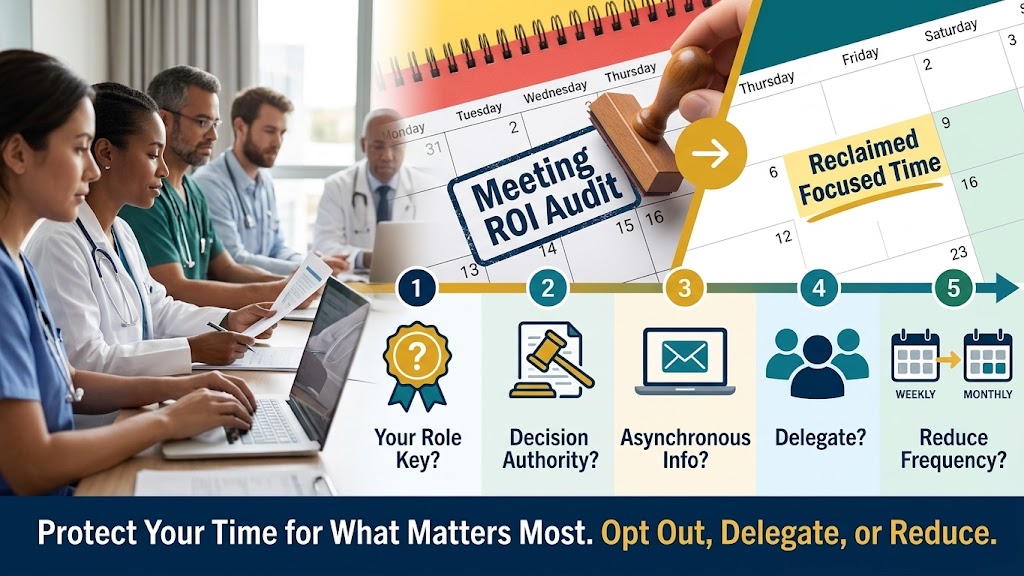
Ask frontline leaders what commodity they have the least of, and the answer is almost always the same: time. Yet, when you look at a typical nurse manager’s or clinical director’s calendar, back-to-back recurring meetings swallow up hours each week. We sit in administrative briefings, task force updates, and interdisciplinary huddles, wondering why we feel constantly pulled away from our teams and clinical operations. In a 2025 AONL-Joslin Nursing Leadership Insight Study, 82% of nurse leaders ranked meeting attendance among their top three activities for the prior week.
Every meeting has a real cost. When you say yes to a meeting, you are usually saying no to another essential activity. The currency isn’t just your hourly compensation; it is the opportunity cost—the coaching conversations delayed, the rounding missed, and the deep, strategic thinking that gets pushed past the end of the shift. If a meeting doesn’t yield a meaningful return on that investment, attending it is poor stewardship of your leadership energy.
Before you click Accept on a meeting and plan it into your day, run it through this five-question Meeting ROI Audit:
1. Does your role truly require you to be there?
-
The Deeper Question: Will my presence add unique value based on my specific role and responsibilities?
-
The Reality: Leaders often attend out of habit, institutional courtesy, or fear of missing out. If your specific perspective, oversight, or direct operational input isn’t required, you are functioning as an audience member rather than a participant. If someone else from your department is already attending with the same institutional lens, one of you is redundant.
2. Is a decision being made that impacts my unit/department and I need to have input?
-
The Deeper Question: Do I need to be in the room (or on screen) to make, approve, have input into, or directly influence a formal decision?
-
The Reality: High-ROI meetings solve problems, allocate resources, or establish policy. If the session exists merely to report on work that has already been done—with no pending choices that demand your executive authority—your live presence isn’t necessary.
3. Could I receive this information another way?
-
The Deeper Question: Could I receive this update through a brief summary, an email bulletin, an operational dashboard, or a shared document?
-
The Reality: A presentation where leaders read slides aloud to a captive audience is the lowest-yield use of leadership time. High-performing organizations distinguish between collaboration (which requires dialogue) and information dissemination (which does not). If the meeting is purely informational, ask the organizer if an asynchronous update can be provided instead.
4. Could someone else represent our unit or department?
-
The Deeper Question: Could another manager, nurse leader, clinical nurse specialist, or even an administrative staff member attend instead?
-
The Reality: Delegating committee or meeting seats serves two powerful purposes: it protects your operational bandwidth and supports deliberate leadership succession planning. Providing a high-potential staff member the platform to represent the unit builds their systems-level thinking and organizational visibility.
5. Could I attend this meeting less frequently?
-
The Deeper Question: Is monthly or weekly participation critical, or would check-ins (or attending only as needed) suffice?
-
The Reality: Calendar cadences often stay static long after their initial urgency fades. A committee formed during a crisis might have required weekly touchpoints, but ongoing maintenance rarely does. Negotiating your cadence down to once a month—or joining only when an item directly impacts your department—instantly claws back hours of focused time.
Reclaiming your calendar doesn’t require confrontation. It simply takes intentional communication with the meeting lead such as: “In reviewing my operational priorities and time on the unit, I am auditing my recurring commitments. Moving forward, my Assistant Manager will represent our unit at this meeting to support their leadership development. If a specific agenda item requires my direct administrative sign-off, please flag it, and I will gladly join that session.”
Protecting your time isn’t about doing less; it’s about ruthlessly prioritizing the work and the people that matter most. If we want our leaders visible, grounded, and proactive, we must empower them to stop spending high-value hours in zero-yield rooms.
Book Now – Brand New Full-Day Workshop for Your 2027 Leadership Needs – Rethinking Leadership and Redesigning Work
© emergingrnleader.com 2026
To lead through these challenges and others effectively, nurse leaders need new tools and strategies. Let me help; I have supported hundreds of organizations over the past six years. Please contact me at roseosherman@outlook.com to book a workshop or keynote for your team. Not seeing what you want on this list? Feel free to reach out, and I am happy to design a custom program to meet your needs.
Staying Power: Building a Culture of Retention in the New World of Work
Brand New in 2026 with Rave Reviews – The Inverted Pyramid: Leading Teams of Novice Nurses The Inverted Pyramid WS Information Sheet
Our Most Popular Right Now –The New World of Work Workshop
A Leader Favorite – Building Bridges Not Walls: Leading Multigenerational Work Teams – Click Here for More Information Building Bridges Not Walls
A Must-Read Book in 2026 – Click Here to Buy



 LinkedIn
 Instagram
